

 Μake us preferred on Google
 SINGAPORE—In a scene from Amazon’s biblical series “House of David,” human actors portray fallen angels and mortal women. The surrounding landscape—a moody tableau of steel-gray skies and jagged mountains—is the work of AI.
Of the 850 visual-effect shots in the show’s first season, 73 were built using generative artificial intelligence, including a tool developed by one of China’s most popular social-media sites. That saved money on expensive on-location shoots, according to Wonder Project, the studio behind the series.
From Hollywood productions to short social-media videos, video makers are increasingly using AI to create content that once required sprawling crews.
“As production costs fall, it becomes more affordable for creators to experiment and test new ideas,” said Zeng Yushen of Kuaishou , the Chinese company whose AI model was used in “House of David.”
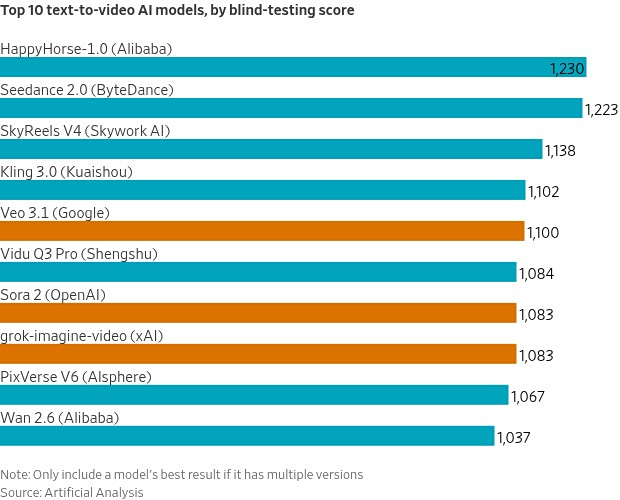
China plays a big role in this business, though it wouldn’t be obvious to most Americans watching television or scrolling through videos on their phones. Chinese labs claimed seven of the top 10 spots for video-generation models on rating platform Artificial Analysis, competing with those from Google and Elon Musk’s xAI.
This month, a video-generation model called HappyHorse went viral after beating American rivals in blind quality tests. Chinese e-commerce giant Alibaba later disclosed the model was its own.
And Seedance 2.0, the latest AI video generator from TikTok parent ByteDance, won attention earlier this year for its ability to turn script prompts into realistic short-movie scenes. ByteDance’s Douyin, the Chinese sibling of TikTok, competes with Kuaishou’s video-sharing app, which has hundreds of millions of users in China.
Such platforms “naturally have large volumes of labeled short-video data that can be used for training,” said Tilly Zhang , a technology analyst at research house Gavekal. “This creates a data barrier that most companies cannot easily replicate.”
Technical challenges
OpenAI recently decided to close its Sora video-generation service and abandon a partnership with Disney . Other U.S. players, including Google, continue to invest actively in the area.
Sora’s closure points to AI video’s technical and legal challenges. Generating a video can consume hundreds of times as much computing power as giving a text answer in a chatbot app. OpenAI sought to avoid compute-heavy side projects so it could focus on higher-margin products.
Copyright issues also dog the business. ByteDance has delayed releasing its Seedance update in the U.S. following a backlash in Hollywood. In China, some star actors recently denounced the unauthorized use of their likenesses in AI-generated videos.
China’s iQiyi , which runs a Netflix-like service, faced criticism in recent days when its chief executive said, “Filming with human actors could soon become a relic of the past.”
The CEO, Gong Yu , spoke as the company introduced an AI plan that would include a database of celebrities who permit their likenesses to be used in AI-generated videos. Some prominent actors were quick to declare that they had nothing to do with the plan.
Still, AI video is becoming part of everyday online life—particularly in China, but also in the U.S. as the two superpowers influence each other. Earlier this year, a series of absurdist AI parodies of martial-arts films attracted billions of views on Chinese social media and sparked a wave of like-minded videos created by fans. The initial videos were made using ByteDance’s AI tools by a Chinese food company to promote its marinated duck.
Some Chinese video-model startups are investing in “world models” that aim to simulate the physical world. A humanoid robot with a good world model can act more humanlike, some researchers say.
Both world models and AI video generation have to master the mathematics and physics of how real-world objects typically move. Companies such as Alsphere and ShengShu—which are backed by Alibaba—are working on both technologies.
Video factories
The fast-growing short-form drama industry has emerged as an early adopter of AI video generation. Series about romance or family feuds—consisting of episodes that run a few minutes—are designed to keep watchers tethered to their smartphones. Given the rapid pace and plot twists, people watching these small-screen productions tend to be less sensitive to visual imperfections.
The genre has exploded in China, where mini-dramas are being integrated into online-shopping sites and food-delivery apps to capture consumer attention. More recently, the format has also gained traction in the U.S., with platforms such as ReelShort and DramaBox, both created by Chinese founders, pulling in tens of millions of dollars from American viewers.
In a studio in the eastern Chinese city of Hangzhou, Shao Zhikun leads a team of 60 AI-drama producers whose workflow, he says, feels less like filmmaking and more like playing the lottery.
To produce a single usable scene, Shao’s team has to repeatedly prompt the AI model, burning through time and computing resources. The occasional winners are good enough to build on, he says. The team learned it could save money by first generating static images, which are cheaper to produce, as a guide for the model.
Using tools from ByteDance, Shao’s studio churns out 100 short-form dramas a month for platforms such as ByteDance’s Chinese streaming app Hongguo and ReelShort. Production costs range from a few hundred dollars to over $10,000—a fraction of traditional budgets, Shao said.
“The logic here is different,” the 29-year-old manager said. “We are not trying to create masterpieces. As long as one or two become hits, the costs are covered.”
Like videogames, mini-dramas try to hook viewers with free episodes or teasers before asking them to pay or watch ads to unlock the remaining content. They may also run ads.
Demand from the entertainment industry is gaining momentum outside China, said Zeng of Kuaishou, the Chinese video company. Wonder Project, the producer of the “House of David” series, said that for Season 2, more than four times as many shots were built using generative AI tools compared with Season 1.
Zeng heads global operations for Kling, Kuaishou’s video-generation tool. She said 70% of its revenue came from outside China, with the U.S. a major market. Kuaishou said it planned capital expenditures of some $3.8 billion this year, mainly to cover the rising computing demand for Kling.
“I would expect that in the next year or two, AI video will reach a point where people truly can’t tell the difference,” said Zeng. “The technology will be a staple in the film and entertainment industries.”