WASHINGTON—President Trump’s relationship with the Supreme Court has never been more toxic. Now, it risks getting worse.
After the court’s rejection of Trump’s tariffs provoked a new level of hostility from the president, the justices are set to consider a pillar of his immigration crackdown: limiting U.S. citizenship. Trump seems to be bracing for defeat.
The case, which will be argued Wednesday, tests Trump’s attempt to end birthright citizenship for the children of unlawful immigrants and temporary visitors. He has gotten trounced in the lower courts, and several conservative Supreme Court justices have already hinted, through little-noticed cues, that they may be skeptical, too.
A ruling against the president would further undercut Trump’s stated desire for a court that rubber-stamps his agenda. In the six weeks since the tariff decision , he has repeatedly disparaged the patriotism and loyalty of the justices who ruled against him.
“They sicken me, because they’re bad for our country,” Trump said last week.
He also predicted on social media that the court “will find a way to come to the wrong conclusion” on birthright citizenship—an outcome, he said, that other nations would celebrate.
Amid Trump’s attacks, his solicitor general, D. John Sauer, will stand before the justices and endorse a once-fringe theory about citizenship that even some hard-line conservative scholars rejected. He will ask the court to upend the longstanding notion that virtually anyone born on American soil is a citizen.
In 2024, Trump campaigned on doing exactly that. As with his global tariffs, he sees the issue as a political cudgel.
“I think President Trump believes that he wins politically no matter what the Supreme Court does,” said César Cuauhtémoc García Hernández, a law professor at Ohio State University. “If he loses at the Supreme Court, he can point to the justices as the bad guys.”
‘All persons born’
The case revolves around the citizenship clause of the 14th Amendment.
Ratified in 1868, it states: “All persons born or naturalized in the United States, and subject to the jurisdiction thereof, are citizens of the United States.”
Those words have long been understood to grant automatic birthright citizenship with only a few narrow exceptions. Children of foreign diplomats or invading armies have never been entitled to citizenship. Native Americans were initially excluded as well, but Congress later extended birthright citizenship to them under federal law.
The Supreme Court affirmed the broad understanding of the citizenship clause in a landmark 1898 decision that upheld the American citizenship of a man born to Chinese parents living in California.
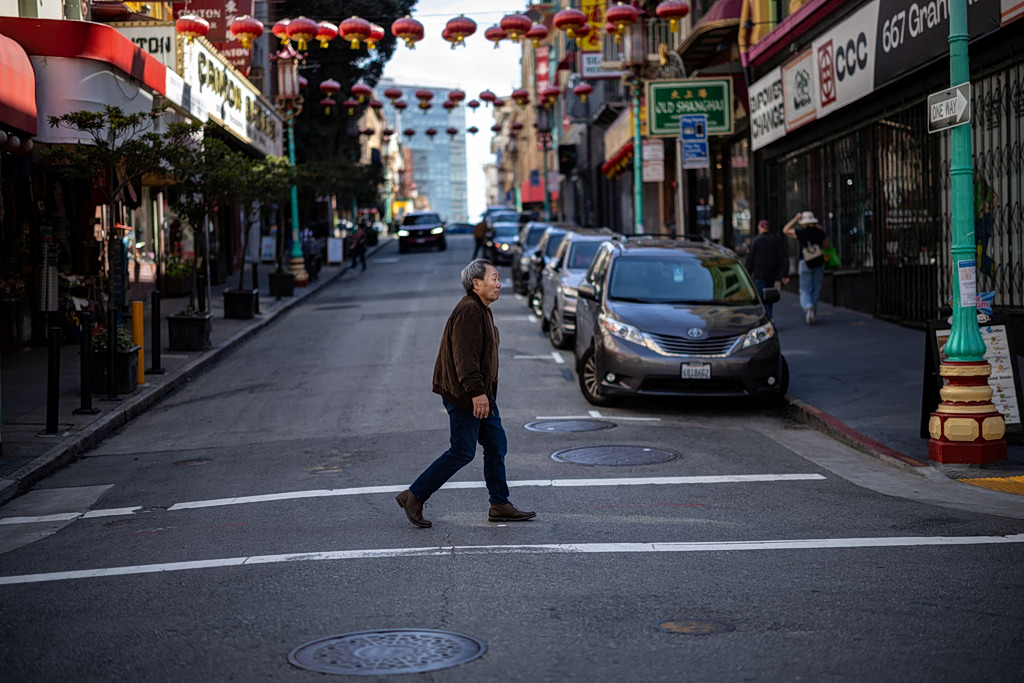
Norman Wong, the great-grandson of Wong Kim Ark, walks along Chinatown, in San Francisco, California, U.S., March 25, 2026. In 1898, Wong Kim Ark challenged the U.S. government after being denied re-entry to the country following a trip to his parents’ homeland. Though he was born in the United States, authorities claimed he was not a citizen. The Supreme Court ruled in his favor, firmly establishing that the 14th Amendment guarantees birthright citizenship. REUTERS/Carlos Barria
Trump is now trying to overhaul the traditional framework. On the first day of his second term, he declared via executive order that the government wouldn’t recognize American citizenship for children born here if their parents aren’t American citizens or lawful permanent residents. The policy would apply to children born after the order takes effect.
It has never taken effect. At least six lower courts ruled against it, with judges of varying ideologies calling it patently illegal.
“I can’t remember another case where the question presented is as clear as this one is,” said Judge John Coughenour, a Seattle-based appointee of Ronald Reagan , as he blocked the order last year. “This is a blatantly unconstitutional order.”
A debate over history
The Trump administration and its allies acknowledge they are challenging the prevailing interpretation. But they say , in modern times, the broad reading has encouraged immigrants to come to the U.S. “ solely to acquire citizenship for their children .” And they argue the 14th Amendment’s reference to “jurisdiction” restricts its scope.
“The conventional view is wrong,” NYU law professor Richard Epstein wrote in an amicus brief .
A broad swath of other legal scholars and historians, including some on the right, say the administration is distorting the 14th Amendment’s text, defying Supreme Court precedent and mischaracterizing what the amendment’s drafters intended.
Yale law professor Akhil Amar wrote in an amicus brief that the administration’s historical evidence amounts to “an artful pastiche of misleading, misinterpreted, and/or atypical shards.” Other scholars accused the administration of cherry-picking and “ revisionist history .”
Clues from the court’s conservatives
On today’s court, the three liberal justices are all but certain to vote against Trump’s executive order. Several of the six conservatives may have subtly tipped their hands against it, too.
Last year, in an earlier iteration of the case, the court heard arguments on the power of district judges to issue broad injunctions. The court didn’t address the legality of the executive order, but Justice Brett Kavanaugh, a Trump appointee, telegraphed some real-world concerns.
“How’s it going to work?” Kavanaugh asked. “What do hospitals do with a newborn? What do states do with a newborn?”
In December, a few weeks after the court agreed to review the order’s substance, Chief Justice John Roberts may have dropped a hint of his own. In his annual year-end message , he approvingly quoted from an 1876 speech by Susan B. Anthony in which the women’s-rights pioneer endorsed a sweeping vision of the Constitution’s citizenship guarantee.
Most tellingly, Justice Clarence Thomas has already adopted a broad interpretation of the citizenship clause, albeit in a different context. In a 2022 case about federal benefits for Puerto Rico residents , Thomas argued that the clause promises equal protection for all citizens.
Though birthright citizenship wasn’t an issue in the case, Thomas would have understood the implications of his argument on future litigation over the birthright issue, said Dilan Esper, a lawyer who has written on birthright citizenship.
“It makes sense that Clarence Thomas, the descendant of slaves, thinks the citizenship clause is extremely important,” Esper said. “He thinks it’s really important that the authors of the 14th Amendment came in and granted citizenship on this principle that there’s no second class of people born in this country.”
Write to James Romoser at james.romoser@wsj.com