On the eve of the second anniversary of the Oct. 7 attack and the ongoing war in Gaza, the conflict has divided Hollywood into hostile camps.
For two years, controversies have engulfed film festivals, popular TV shows produced in Israel have gone dark on American streaming platforms and escalating accusations of antisemitism and complicity in genocide have pitted artist against artist.
Last month came the latest salvo: a boycott by thousands of Hollywood figures against all TV and movies connected to Israel—a country where largely left-wing creators have been waging their own battle against the Israeli government.
Like so many disputes involving the Middle East, it’s messy, ugly and unresolved.
“To boycott creators from any country in the world is outrageous,” Liat Benasuly, the producer of Netflix’s hit series, “Fauda,” said in an interview. “We are not our government—we suffer from them.”
“The boycott completely plays into their hands,” she said. “They want nothing more than to silence us.”
Initiated by an organization called the Film Workers of Palestine, the boycott now has more than 5,000 signatories, including Emma Stone, Olivia Colman, Joaquin Phoenix, Ava DuVernay and Mark Ruffalo. The pledge obligates actors, directors and producers not to screen films, appear in or work with what it considers complicit institutions, including festivals, cinemas, broadcasters and production companies.
As the boycott was taking off, a separate controversy was brewing in Israel, where “The Sea,” an Arabic-language film about a boy from Ramallah, became Israel’s official contender for next year’s Oscars—only to be denounced by Israel’s minister of culture, who threatened to establish a new state-controlled film award. Meanwhile, a bill currently in the Israeli Knesset put forth by Benjamin Netanyahu’s communications minister aims to shut down public television and radically expand government control over the country’s independent media and cultural institutions.

All of this has exacerbated the significant divisions over Israel and antisemitism that have roiled Hollywood since Oct. 7. For over a decade, Americans have been avid consumers of Israeli screen content, particularly its TV series, including American adaptations such as HBO’s “Euphoria” and “In Treatment,” Showtime’s “Homeland” and “Your Honor”—shows many viewers in the U.S. probably aren’t even aware are Israeli co-productions. Two of the most successful of these—Netflix’s “Fauda” and Apple TV+’s “Tehran”—deal explicitly with the Middle Eastern conflict. Both shows have been delayed by the war and its fallout.

Xnet1234 / Kan 11 / Apple TV+
In Israel, Hollywood’s actions have demoralized and bewildered writers, filmmakers and producers, many of whom oppose Netanyahu’s government. How, they ask, can American artists object to President Trump’s efforts to muzzle shows like Jimmy Kimmel but not support them?
The New Blacklist
As with other protests against the war, the boycott letter included Jewish signatories, exposing rifts among Jews in Israel and abroad.
“There is tremendous social pressure right now to align on one side or another in what is a highly oversimplified discussion,” said actress and former “Jeopardy!” host Mayim Bialik, who stars in Jim Jarmusch’s new movie, “Father Mother Sister Brother.” At the Venice Film Festival last month, where the film won top prize, protesters objected to its distributor MUBI receiving funding from Sequoia Capital, a venture-capital firm with financial ties to Israel.
“It feels very strange to be a liberal Jewish artist right now when you’re being painted as someone antithetical to wanting to end the war,” Bialik said in an interview. “No other minority is being asked to choose between allegiances. This boycott absolutely smacks of something else, and it’s called antisemitism.”
Earlier this month, more than 1,200 people in the movie and TV industry, among them Liev Schreiber, Sherry Lansing and Jennifer Jason Leigh, signed an open letter denouncing the boycott.
“It amounts to artists blacklisting fellow artists based on their nationality, ethnicity or identity—and we wouldn’t do it to artists in any other country,” said actress Rebecca De Mornay, who signed the letter. “We need to support artists, not dehumanize them.”
Paramount is the only major Hollywood studio to have officially come out against the boycott. “The idea that you’re going to censor art, I don’t believe to be in line with American values and freedom of speech,” said Paramount CEO David Ellison, who closed on Paramount in August, in an interview.
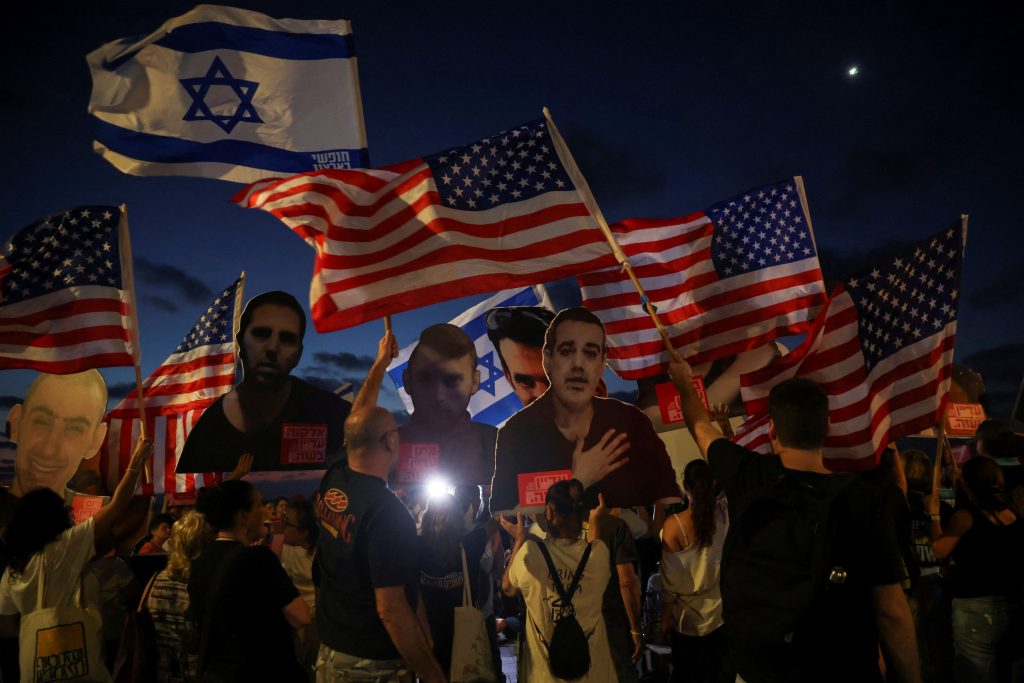
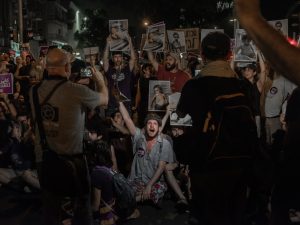
People hold flags and cutouts of hostages, as hostage families and a women protest group call for the implementation of a U.S. plan to end the war in Gaza and release all hostages, on the day U.S. President Donald Trump and Israeli Prime Minister Benjamin Netanyahu meet at the White House, near the U.S. Consulate in Tel Aviv, Israel, September 29, 2025. REUTERS/Shir Torem
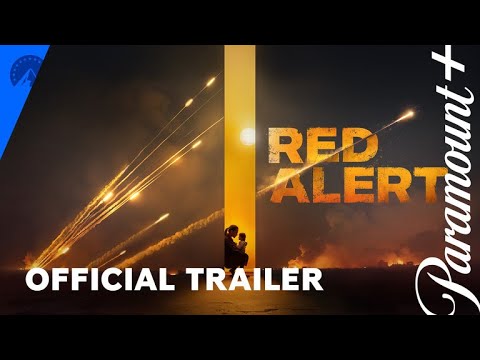
On Tuesday it will air “Red Alert,” a limited drama series about the fate of multiple characters, including an Israeli family with young children, an Arab family and Israeli police officers after the Oct. 7 Hamas attack.
Ellison ordered it after meeting its producer, Lawrence Bender, at a memorial service for lawyer and power broker Skip Brittenham, who died just over two months ago, Bender said at a Sept. 3 event. Bender told him about the show and Ellison immediately asked to see it.
Bender said he knows there will be repercussions for “Red Alert.”
“I just made a real decision that I don’t care. I’m going to lose friends,” Bender said at the screening. He doesn’t have much regard for those who signed the boycott.
“The 4,000 idiots,” Bender dubbed them (that number has since grown) in the interview, adding that many of the people the petition is seeking to punish oppose the current Israeli government.
HBO Max will also air a scripted seven-part series about the Hamas attacks called “One Day in October.” Each episode interweaves multiple narratives about the human impact of the attacks and its aftermath. Warner Bros. Discovery CEO David Zaslav, who was involved in the decision to acquire the series, declined an interview request but said in a statement the company’s role is “to shed light on the full spectrum of the human experience,” adding that the show will give voice to those who experienced the attacks “so they can be seen, heard and remembered.”
Growing Isolation
Other streaming and entertainment companies have mostly avoided content about the conflict. Apple, like many networks, treads very carefully around topics that could be divisive. At Apple TV+, the third season of “Tehran,” which was completed in late 2023 and aired in Israel in December 2024, still has no U.S. release date. Apple also recently postponed the on-the-news thriller series called “The Savant,” starring Jessica Chastain as an undercover investigator who infiltrates online hate groups, following the killing of Charlie Kirk. Chastain issued a statement saying, “We are not aligned on the decision to pause the release.”
A person familiar with Apple’s thinking said “Tehran” will return although no date has been announced yet. Another Israeli series sold to Apple in 2023, “ Red Skies ,” a drama set during the Second Intifada, also has no set release date—and another person familiar with the situation said its future is less certain.
The fifth season of “Fauda,” a series that has been praised for its nuanced portrayal of an Israeli military unit operating undercover as Palestinians in the West Bank and Gaza, has also been delayed, though for different reasons. After Oct. 7, its creators scrapped their original script to take into account the attacks. The series is now in postproduction and while Netflix has not yet announced a release date in the U.S., it is expected to come out in Israel in January.
Such well-established shows stand in contrast to what writers, directors, agents and producers in the U.S. and Israel describe as an increasingly dire situation for Israeli content. Even before the boycott, producers in both Hollywood and Israel sensed little appetite to produce or promote their shows, citing a combination of anti-Israel sentiment, antisemitism, risk aversion and fear of negative financial and personal repercussions.
Ben Silverman, chairman of Propagate and a producer whose credits include “Stick” and “The Office,” refers to what amounts to a “soft boycott” of shows and films from Israel amid a concerted social media campaign of disinformation.
“It’s created a version of virtual cancel culture, so a lot of people are scared to enter the fray,” he said in an interview. “I believe so much of it is pure old-fashioned antisemitism grounded in bad information and untruths.”
Former Paramount chair Shari Redstone recently signed on as chair of the Israel-based studio Sipur, which produced “Bad Boy,” in part because she wanted to stand up for the Israeli creative community.
“People are afraid to use their voices,” Redstone said in an interview. “That’s why I’ve become so vocal.”
“It’s disconcerting and troubling that the content coming out of Israel is being treated differently from any other country,” Redstone said.
In Israel and in the U.S., agents and producers report a decrease in both funding and distribution deals. In many cases, investors and partners have pulled out. “Since Oct. 7th, it’s been very difficult for Israeli TV and film creatives and producers to find investment or collaborations or funds,” said Tzvika Gottlieb, CEO of the Israeli Film and TV Producers Association. “People say, ‘This is not the right time. We have to wait.’”
The organization behind the boycott, Filmworkers for Palestine, say that they are targeting institutions and not Israeli individuals.
Most productions in Israel, as in other small countries, rely at least in part on government funding, even though they operate entirely independently from the government. Numerous creatives in Israel compared the effort to boycotting artists funded by National Endowment for the Arts grants or National Public Radio as a sign of opposition to Trump. Or to refusing Iranian films because of Ayatollah Khamenei’s rhetoric or Iranian funding of terrorists.
“I think singling out Israel is suspicious,” Rick Rosen, an agent and co-founder of WME, said in an interview.
A Silent Boycott
The Toronto International Film Festival drew controversy in September when it invited and then withdrew the documentary “The Road Between Us,” about a retired Israel general’s efforts to save his family following the Oct. 7 attack. The reason? The filmmakers hadn’t secured rights to Hamas’s body camera footage.
The film, a Canadian production, was eventually screened before a sold-out audience and won the People’s Choice award for best documentary—but only after a petition was signed by more than 1,000 entertainment figures, including Debra Messing and Amy Schumer, accusing TIFF of “silencing Jewish voices.” TIFF did not respond to requests for comment.
“The Orwellian pretexts TIFF gave for disinviting the film were very discouraging,” said producer Howard Gordon, whose credits include “Homeland,” “24” and other TV series, and who was one of those who responded to TIFF’s initial withdrawal of the film. “I think capitulation to fear is really the problem.”
Multiple Israeli filmmakers described what amounts to a “silent boycott” in which they are getting fewer invitations to film festivals abroad. “Externally, we’ve been sidelined and boycotted since the war started,” said Roni Aboulafia, a filmmaker and chair of the Israel Documentary Forum. “But it’s getting worse. This past year has been really difficult for Israeli films—even Israeli films critical of the government—to get into film festivals.”
“One festival programmer told me they weren’t going to take my film but that it ‘wasn’t just because of Israel,’” said Yael Melamede, an Israeli American documentary filmmaker whose most recent film, “ADA – My Mother the Architect,” is an Israeli-American co-production. “Most people are silent about the reasons, but she was very clear and in a way, I was grateful because you start to think you’re imagining things.” In another instance, she said, a prominent programmer dropped her documentary two days beforehand due to pressure from sponsors.
These rejections hit hard among people in the entertainment industry, many of whom have been actively protesting Netanyahu’s government since it came into power in January 2023, well before the Oct. 7 attack. In interviews, producers and filmmakers described attending protests every Saturday night to end the war.
“The government has it in for us anyway, so the boycott is just another way to do away with our voices,” said Danna Stern, a producer of “Fauda” and one of the producers of the documentary, “Supernova: The Music Festival Massacre.”
“The Sea,” which received financing from the Israeli Film Fund, risks becoming one of the boycott’s first targets. On Sept. 16, the film, written and directed by Shai Carmeli-Pollak, an Israeli, and produced by Baher Agbariya, a Palestinian Israeli, won best picture at Israel’s Ophir Awards. A quietly devastating family drama, it tells the story of a boy from Ramallah who wants to visit the sea in Tel Aviv. It may as well be on the other side of the earth.
Asked whether the boycott applies to all films made collaboratively by Palestinians and Israelis, even if funded by Israeli organizations, Film Workers of Palestine responded in an email, that film institutions must “end complicity in Israel’s genocide and apartheid, and endorse the full rights of the Palestinian people under international law, in line with Palestinian civil society guidelines.”
Carmeli-Pollak began writing in 2014, inspired by Vittorio De Sica’s “The Bicycle Thief,” another film about the challenge to morality in a world of economic and social despair. After many delays, he filmed in the West Bank before the Oct. 7 attacks with a largely Palestinian cast.
The day after the Ophir awards, Israel’s culture minister Miki Zohar denounced the film as “defamatory” and “embarrassing” and said he would establish a new Israeli state Oscar that would “reflect the nation’s values and spirit.”
“In a way it’s good that now, people will understand that I do not represent this government at all,” Carmeli-Pollak said in an interview. “It gives me hope that people outside Israel will open their hearts to it and see that this is a film about seeing the humanity of each other, how similar we are. All people want to go to the sea.”
Write to Pamela Paul at pamela.paul@wsj.com and Joe Flint at Joe.Flint@wsj.com