For generations of women, the logic has seemed airtight: Focus on a career in your 20s, and worry about starting a family once you are established in a job.
This mindset has catapulted women into higher-earning positions, and into traditionally male-dominated fields. The share of women in their prime working years who are in the workforce is around a record high. And women are having babies later, if they have them at all. The answer to fertility constraints, they’re told, is egg freezing.
Isabel Brown , 28, didn’t want to wait. She married last year and had a baby this year. She’s now building her career as a conservative activist, hosting a podcast for conservative media company the Daily Wire and speaking on college campuses as a representative for Turning Point, the youth organization Charlie Kirk co-founded.
Kirk’s widow, Erika Kirk , now leads the organization and is amplifying a message especially resonant for young conservative women: Family is central. Children come first.
“Young people are realizing that our lives are going to be so much more meaningful if we have a family to share our success with from the start,” Brown said. She and other conservative women talk about timing family and work as “seasons” of life.
The term is from the biblical passage Ecclesiastes 3:1: “For everything there is a season, and a time for every matter under heaven.”
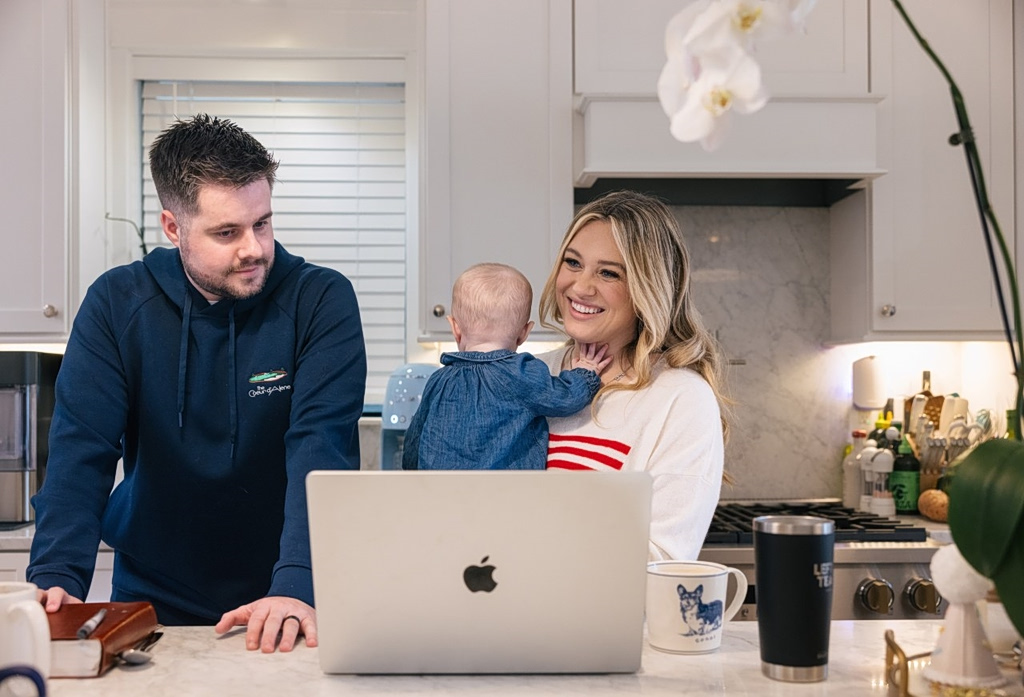
Brown and her husband, Brock Belcher. | Photography by Alyssa Schukar for WSJ
Many of the women who view their lives in this way say they think of themselves as existing in between the extremes of tradwives (who treat caring for their homes and families as a more permanent, full-time job) and girlbosses (who center their lives around work).
As recently as 15 years ago, self-described conservative and liberal women between the ages of 18 and 35 were having children at around the same rate, according to an analysis from a large national study called the General Social Survey by Samuel Perry, a sociology professor at the University of Oklahoma. But in recent years, the gap has widened, his analysis shows. As of 2024, roughly 75% of liberal women in this age range were childless, compared with around 40% of conservatives. In 2010, the difference was only 5 percentage points.
“Liberals are leaning hard into being DINKs [Dual Income No Kids], being childless or having fewer kids, and it being very much a choice, whereas for conservatives having kids is still very much a part of what it means to be a whole person,” Perry said.
Having kids doesn’t preclude workforce participation, and plenty of liberals are still putting a priority on parenthood. But as birth and marriage rates fall, some conservatives are doubling down on the importance of starting a family.
“If you decide to not work or not lean in in the first 10 years of being a mom and you do that in your 20s, there’s still plenty of time to start working in your 30s and have a meaningful career,” said Carrie Lukas , the president of Independent Women, a right-leaning public policy organization focused on women’s economic issues.
At a conference for conservative college women in Scottsdale, Ariz., last month, speaker after speaker (including Brown) encouraged the 100 gathered women ages 18 to 22 to pursue careers and education—but not at the expense of marriage and children.
Reagan Conrad, who hosts “The Comments Section” podcast for the Daily Wire, discouraged egg freezing. “If we as women are putting our eggs on ice for a decade to make sure that our career is thriving,” she said, “we have a prioritization problem.”
K.T. McFarland talked about leaving her job in public affairs at the Pentagon at 34 to raise five kids and deciding to return to the workforce after 9/11, when she was 50. The former Fox News analyst served as President Trump’s deputy national security adviser in his first term.
Kimberly Begg , president of the nonprofit Clare Boothe Luce Center for Conservative Women, which was hosting the event, told the audience that Gen Z is the “loneliest generation” because members of that demographic group are a part of smaller and more fractured families. Begg also said that they have been told lies such as “faith and family hold you back.”
The 49-year-old says she regrets putting her travel-heavy job as general counsel of a nonprofit over the needs of her five young kids earlier in her career. “One of my daughters learned how to use the phone and she called me constantly because she wanted me to come home,” Begg said in an interview after the conference. “My children were not thriving.”
She decided to quit that role after seeing how the big-eyed Beanie Babies she brought home as souvenirs for her daughter after each work trip had taken over her room.
After five years at home, during which time she wrote two nonfiction books and advised nonprofits, Begg joined the Luce Center in 2024. A few months after she became president, she shifted the in-person office hours—which they call “collaboration hours”—to end at 2 p.m. to accommodate mothers picking their kids up from school and other family priorities.
“Children and marriages and families need more than just loving thoughts,” said Begg. “They need presence. And these hours allow me to be present with my children while I’m engaging in meaningful work.”
She encourages the students she mentors to look for the flexible work arrangements that have become more common postpandemic. (Though they can come with drawbacks for career advancement and pay .)
“You can have everything you want,” Begg says. “But you can’t have it all at once.”
Grace De Mars , a 21-year-old senior at California Baptist University who attended the conference, recently got engaged to her high school boyfriend. She has been trying to reconcile her aspirations to become a history teacher with her desire to start a family in her mid-20s. Her mother, who had her at 39, warned her about how much harder that late pregnancy was than her previous three.
“I have to come to terms with what’s more important for our children and for our family,” said De Mars. “Especially as a teacher, it’s not like I can just clock out and go home and not take my work with me.”
As a young mother and policy analyst working remotely for conservative think tank the Heritage Foundation, 28-year-old Emma Waters is both living and researching the seasons approach. She left a fast-paced, coalition-building role when she and her husband decided to have children so that she could be home with them—now ages 2½ and 11 months—during the day. Since then, she says she’s turned down other in-person career opportunities she would have otherwise enjoyed.
“I love my work, but my top priority is to raise my children, and that cannot be outsourced to someone else for eight hours a day, five days a week,” said Waters. “The ‘you can have it all’ mindset is so misleading and sets women up for disappointment.”
She knows that not every woman can work remotely, and that living on a single salary isn’t an option for many families. She also doesn’t prescribe her family’s approach as a singular ideal, acknowledging that seasons look different for everyone.
In her work as a policy analyst, she is advocating for “more financial support for married, working families in particular alongside the social support systems we have in place for single-parent families already.”
Mostly, however, she thinks it is the culture that needs to change to make it easier for people to fit their work around their families, rather than the other way around.
“The answer is more community support to find flexible work for young mothers,” Waters said.
In posts to her roughly 2 million mostly young Instagram and TikTok followers, Turning Point representative Brown asks: Why wait for marriage and parenthood? “It’s not true that walking down the aisle or welcoming a child into the world will somehow limit your personal freedom,” she said.
Brown records her show for the Daily Wire from her house in Washington, D.C., and often brings her daughter to the speaking engagements she travels to all over the country.
Her husband, Brock Belcher , who works in communications for the Trump administration, shares child-care responsibilities for their daughter Isla “with the exception of breast-feeding,” Brown joked.
Their experience as a young family, Brown said, differs from the message she thinks a lot of young people see about how they should structure their lives.
“We are looking around at the antifamily state of affairs in our country,” Brown said, “and realizing that, for the most part, people aren’t happy or fulfilled.”
Write to Rachel Wolfe at rachel.wolfe@wsj.com and Paul Overberg at paul.overberg@wsj.com