For Democrats, Tuesday brought more than three big election victories. It laid out a path to revival for a party that has been dispirited and disempowered under the dominance of President Trump.
Two women with centrist profiles and national security backgrounds, Abigail Spanberger in Virginia and Mikie Sherrill in New Jersey, not only won their elections for governor but did so with unexpectedly large margins—by 13 percentage points or more, nearly final results showed. Both had focused on an affordability agenda , promising to lower the cost of everyday life, while linking their opponents to Trump and the MAGA movement.
The two victories, along with the election of democratic socialist Zohran Mamdani as mayor of New York, showed voters elevating a new generation of leaders, potentially infusing the party with new energy, though challenges remain. The debate between centrists and progressives over the direction of the party is unsettled, and Mamdani may offer Trump a new political cudgel.
But the results showed that Republicans have their own problems finding their footing with Trump in the White House, at least in politically competitive states. Neither GOP candidate for governor could outrun Trump’s low approval ratings in New Jersey or Virginia. Some Republicans said the results showed that Democrats have the greater momentum ahead of next year’s pivotal midterm elections.
Jack Ciattarelli , who was endorsed by Trump and embraced much of the MAGA movement during his campaign in New Jersey, was drawing 43% support in nearly final results—almost exactly in line with Trump’s job approval rating in the state. A large survey of Tuesday’s electorate, called the Voter Poll by SSRS, found that 42% of New Jersey voters approve of Trump’s job performance.
In Virginia, Republican Winsome Earle-Sears, the target of Democratic ads linking her to Trump, was drawing 42% of the vote, just above Trump’s 39% job approval rating as recorded by the Voter Poll. In both states, twice as many voters, or more, said their vote was meant as a signal of opposition to Trump rather than support.
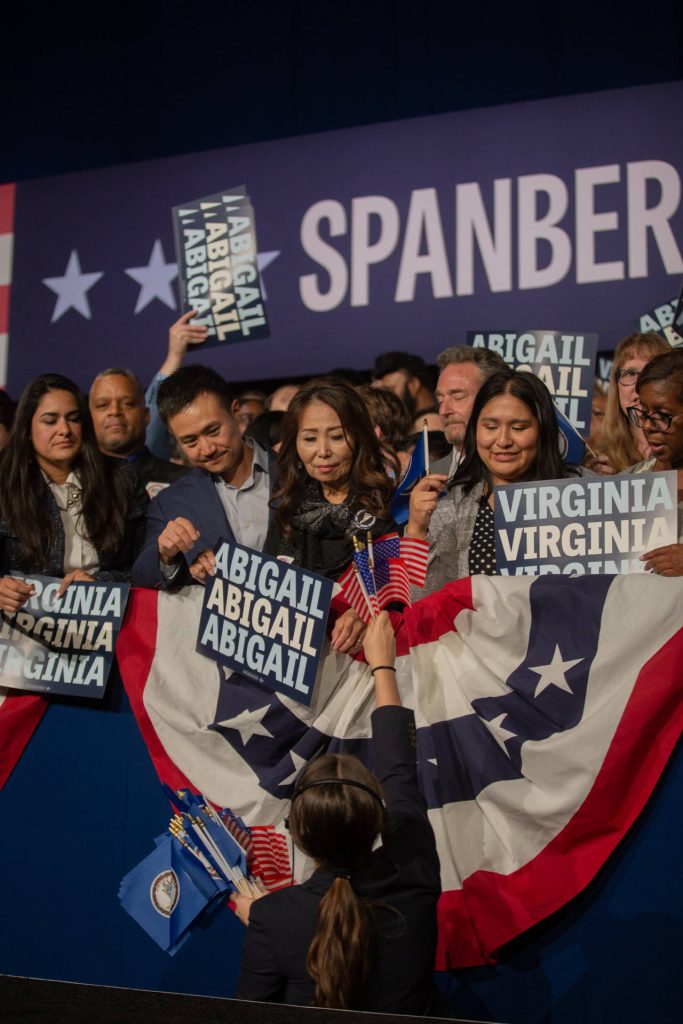
Spanberger supporters in Richmond, Va. Hadley Chittum for WSJ
“There is no sugarcoating these results. They’re really bad for the party,” said Michael DuHaime, a former political director of the Republican National Committee and for former Sen. John McCain’s presidential campaign, among others. “Republicans would be smart to heed the warning signs of this election.” Heading into next year’s House and Senate elections, he said, “these races are an early warning system.”
Fewer votes typically show up in off-year elections than in presidential races, but Democratic vote totals came closer to matching presidential-year tallies than Republicans produced—an indication that Democratic voters had the greater enthusiasm.
Spanberger’s vote total amounted to 84% of the votes her party won in Virginia last year, when Vice President Kamala Harris was the nominee, while Earle-Sears was drawing only 69% of Trump’s 2024 vote.
In New Jersey, Sherrill drew 81% of her party’s 2024 vote, compared with the 70% that Ciattarelli won of Trump’s tally that year.
The lesson, DuHaime said, is that Republicans in competitive districts need to build an identity independent of Trump, and they can’t count on winning by driving their most loyal supporters to the polls, especially when up against a centrist opponent who is hard to label as an extremist. “You don’t have Trump’s strengths, and you’re just going to inherit his downside.”
Republicans say it is far too early to assess how voters will act one year from now. They say that voters will soon feel the benefit of tax cuts passed under Trump’s tax and domestic policy bill, which he dubbed the “One Big Beautiful Bill,” and that Mamdani’s election has made Democrats vulnerable to being labeled as tax-and-spend liberals.
“I think that the midterm elections are a completely different dynamic,” said Chris LaCivita, Trump’s longtime political adviser.
Another caution against overreading Tuesday’s results: Spanberger faced a weak opponent who failed to rally Republicans, while Mamdani ran in a three-candidate race that may have split the opposition to him.

New Yorkers react to Mamdani’s victory speech. Jose A. Alvarado Jr. for WSJ
“Candidates matter, and here Republicans failed horribly,” LaCivita said, referring to Earle-Sears, his party’s nominee in Virginia.
Some of the voting trends that propelled Trump into the White House last year showed signs of reversing.
Trump won in 2024 in large part because sizable shares of Latino, Black and other minority voters shifted toward the GOP. So did young voters. At the same time, Democrats stalled in 2024 in the upper-income suburbs that have increasingly embraced their party.
On Tuesday, those voters shifted toward the Democrats. Democratic support among Latino voters grew by 9 points in New Jersey and by 5 points in Virginia, the Voter Poll found.
The reversal was apparent in heavily Latino parts of New Jersey, such as Passaic County, not far from New York City, where 43% of residents are Latino. Sherrill was leading the county by 15 percentage points. Last year, Trump won Passaic by about 3 points. In both Virginia and New Jersey, Black voters also showed a similar but smaller shift toward the Democrats.
If repeated in next year’s midterms, the trend threatens an important Republican Party achievement from 2024. Long reliant on white, working-class voters, the party last year made significant progress in broadening into a multiracial, multiethnic working-class party.
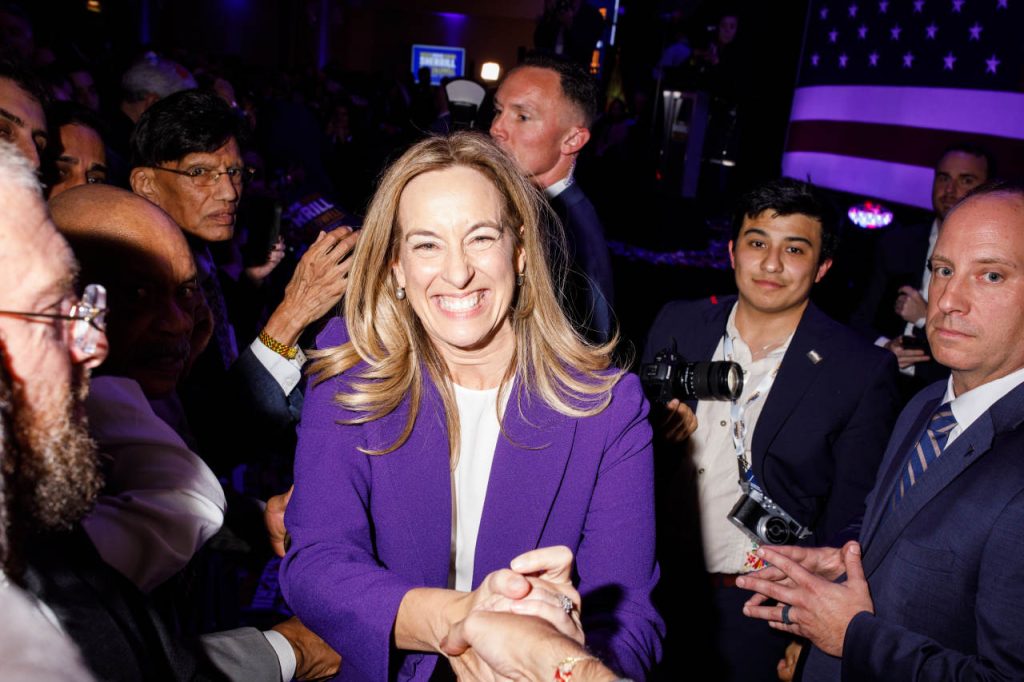
Sherrill greets supporters in East Brunswick, N.J. Brian W. Fraser for WSJ
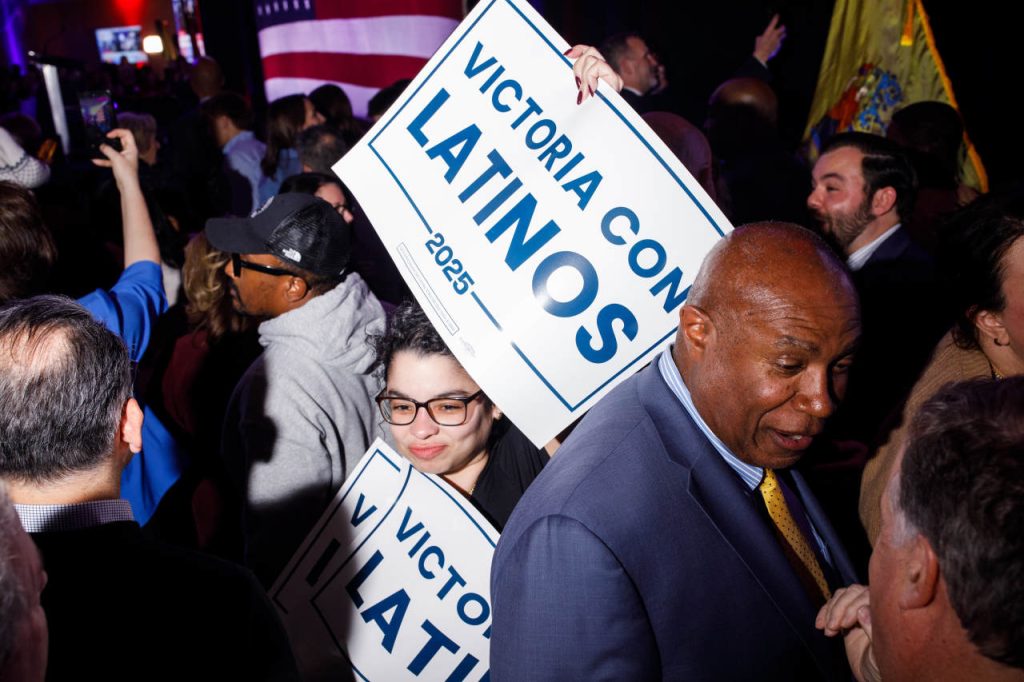
Democratic support among Latino voters increased in New Jersey. Brian W. Fraser for WSJ
The swing away from the GOP among young voters—those under age 30—was even more dramatic. After Trump lost that group by only about 5 or so points in each state, the GOP candidates for governor were losing them on Tuesday by nearly 40 points, the Voter Poll found.
Meanwhile, the populous and wealthy suburbs of Virginia and New Jersey, outside Washington, D.C., and New York, resumed their embrace of Democratic candidates after support had receded in 2024.
In Virginia’s Loudoun County, often cited as the wealthiest in the nation by median household income, Spanberger was drawing 64% of the vote, an 8-point improvement from the party’s 2024 showing. High-income Fairfax County, right outside the nation’s capital, showed a similar swing.
Democratic victories in other states added to the party’s sense of momentum. California voters passed Proposition 50, which temporarily puts in place a new map of congressional districts that gives Democrats a chance to pick up five House seats by ousting Republicans. Democratic Gov. Gavin Newsom cast the plan as an opportunity for voters to fight back against Trump, who has pressed GOP-led states to draw new House maps to elect more Republican members.
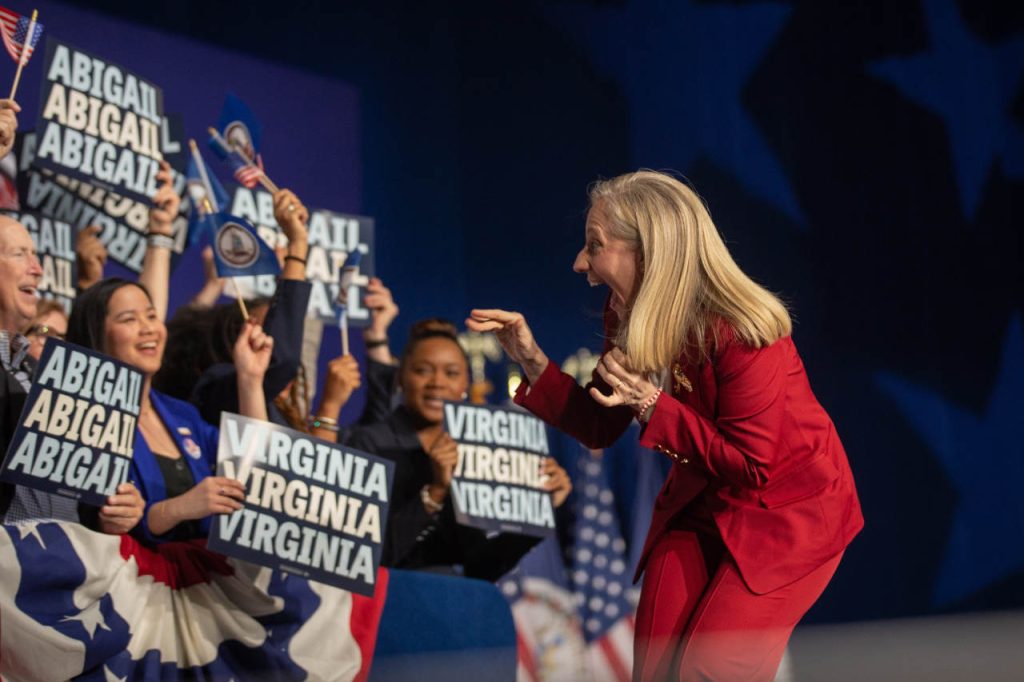
Spanberger takes the stage after winning Tuesday’s race. Hadley Chittum for WSJ
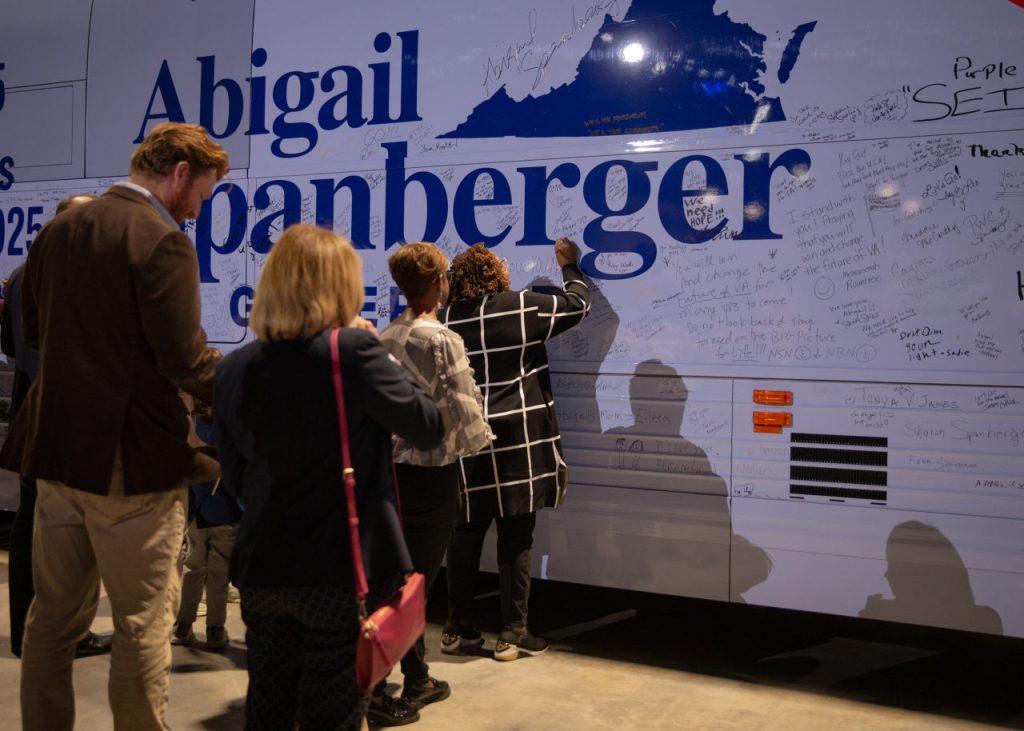
Supporters sign Spanberger’s tour bus in Richmond. Hadley Chittum for WSJ
In Pennsylvania, Democrats held on to their 5-2 Supreme Court majority after an unusually expensive and contentious election over retaining three of the justices. Voters rejected Trump’s call to oust the three judges. And in Georgia, two Democrats beat GOP incumbents to take seats on the state’s Public Service Commission, which regulates utilities and sets the rates they can charge.
The Voter Poll by SSRS interviewed more than 12,000 people in Virginia, New Jersey, California and New York City who participated in elections there, reaching them through phone, text, mail, online panels and in-person interviews. The margin of error was plus or minus 2.1 percentage points in California, 2.0 points in Virginia and New Jersey and 2.2 points in New York City.
Write to Aaron Zitner at aaron.zitner@wsj.com and Anthony DeBarros at anthony.debarros@wsj.com