The European Union is to ease its landmark carbon-pricing program as the bloc’s leaders look to soften the impact of the war in the Middle East on Europe’s beleaguered industrial sector.
The European Commission, the bloc’s executive body, said Wednesday that it is proposing to remove a mechanism in its emissions-trading system, or ETS, that cancels surplus carbon allowances, a change that it said “will better equip [it] to respond to future market developments, including potential tightness in supply in the coming decades.”
“Stopping the invalidation of allowances will strengthen the system’s capacity to act as a buffer and ensure stability in the years ahead,” it said.
Under the ETS, companies whose operations emit climate-changing carbon dioxide must pay for a permit, or allowance, for each metric ton they emit. The system, in place since 2005, includes a market-stability reserve aimed at ensuring prices for those allowances remain broadly stable.
Companies are given a quota of free allowances in order to keep European industry competitive. Allowances are sold at auction and can also be traded among polluters.
The plan to ease the ETS comes after Commission President Ursula von der Leyen said last month that it needed to be modernized and made more flexible in the wake of escalation of conflict against Iran by the U.S. and Israel, a war that has sent oil and gas prices soaring.
“We will take into account the concerns of industry,” Von der Leyen said at the time.
As well as changes to the stability reserve, manufacturers would also be given roomier benchmarks for free allowances, she said.
The proposal will be sent for approval to the EU legislature and the European Council, which groups heads of its member states. A wider review of the ETS is due to be adopted in July and will include the change to the reserve.
Carbon markets are reacting positively to the planned change, said Guadalupe Ruiz, principal carbon markets analyst at OPIS, a Dow Jones company.
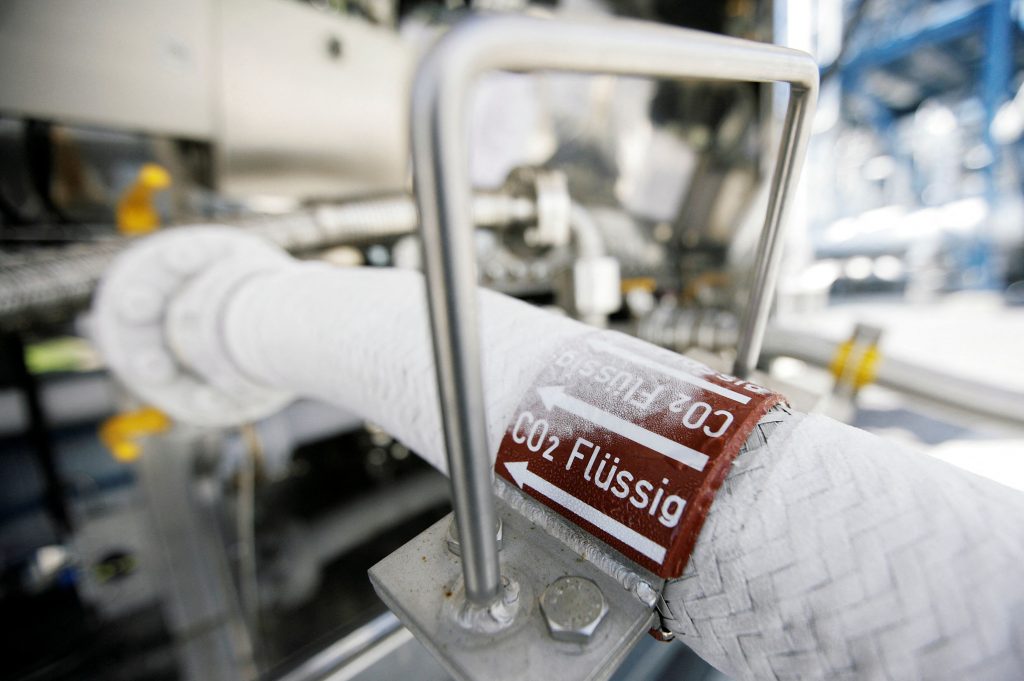
FILE PHOTO: A flexible tube for CO2 is connected to a truck before the first official run of the mini plant “Schwarze Pumpe” in Spremberg, September 9, 2008. Vattenfall’s CO2-free power plant is a pilot project for carbon capture and storage (CCS) – the first power plant in the world that will take the toxic emissions from coal and bury them deep in the ground. REUTERS/Hannibal Hanschke/File Photo
“The worst-case scenario of a sharply lowered [reserve] threshold—and the resulting flood of allowances that could have depressed prices—has been avoided,” Ruiz said. “Under the new rules, cancellations will no longer occur, but the intake threshold remains, preserving the core supply-demand dynamics.”
The proposed change comes as European industry, already struggling to gain momentum in its production levels, readies itself for a fresh blow from higher energy prices. That energy crunch driven by the Iran war is the most serious threat to European industry since the continent shut off supplies of Russian gas early in 2022, when President Vladimir Putin launched an all-out invasion of neighboring Ukraine.
The continent should brace for a potential lengthy disruption to international energy trade, EU energy chief Dan Jorgesen warned this week.
“We should be under no illusion that the consequences of this crisis for energy markets will be short-lived,” he said. “because they won’t.”
Still, the proposal could throw a “chaotic and rushed“ spanner in the works of the ETS, undermining confidence in the system, Brussels-based watchdog Carbon Market Watch warned.
“Shortsighted policymakers will only make this fossil price crisis–and the next ones– worse, instead of tackling the real problem: the EU’s dependence on fossil fuels,” CMW said.
The energy crunch looming over Europe is a crisis “not of our making,” a bloc spokesperson said Wednesday.
“It’s one in which the EU needs to act in the interest of European consumers and industry,” he said.
The 27-member group is better prepared than some peers because of its greater focus on renewable energies and diversified energy supply, the spokesperson said.
The EU calculates that by 2023, its carbon-pricing system had helped slash by nearly half emissions from electricity generation and manufacturing, the two main sources of the gases that cause global heating.
Still, some European leaders have called for a rethink of the ETS given the energy crunch squeezing Europe, and Italian Premier Giorgia Meloni last month called for the system to be scrapped immediately for the production of electricity from thermoelectric power.