When Ramez Souri , a Greek Orthodox Christian living in Gaza City, got the order to evacuate ahead of Israel’s invasion of his city, he didn’t heed the call to go south. Instead, he headed to his church.
He and hundreds of fellow Christians are among more than half a million Palestinians holding out in and around Gaza City, in the path of troops from three Israeli divisions who began bearing down on them this past week.
Souri is fearful of the fighting, but he couldn’t think of any other place to take his elderly parents. His 87-year-old father can’t move without help and likely couldn’t manage the long trip through Gaza’s war-torn streets. Souri is also worried about finding food and water in the southern tent encampments , where unfamiliar neighbors could turn out to be targeted members of Hamas.
It wasn’t that he thought the church would be safe. Souri lost his three children when an airstrike hit St. Porphyrius Greek Orthodox Church on Oct. 19, 2023, while he was sheltering there with his family in the early days of the war. It just seemed the least bad alternative.
“We will remain in the church,” he said. “But the church is not the safe place people imagine. I say this because I saw my children killed before my eyes. There is no protection. There is no safety. And we know there is no safety.”
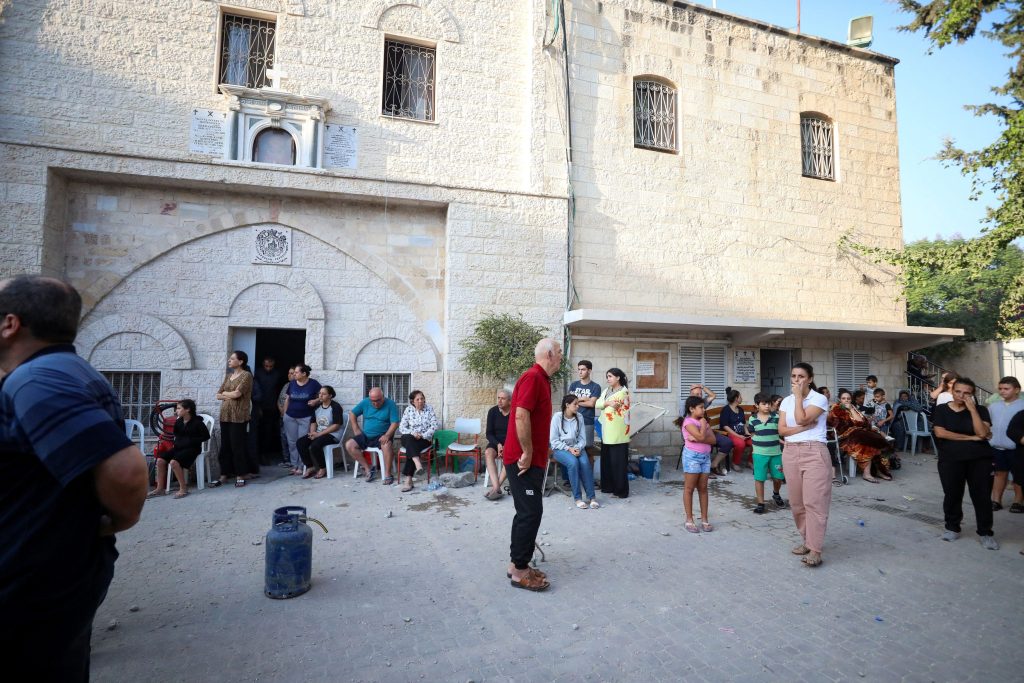
Palestinians gather at the Greek Orthodox Saint Porphyrius Church which was damaged by an Israeli strike, where Palestinians who fled their homes take shelter, in Gaza City, October 20, 2023. REUTERS/Mohammed Al-Masri
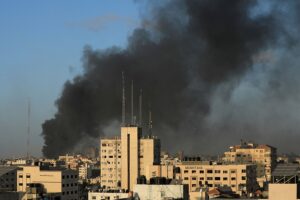
Israel moved into the ground phase of its operation to take over Gaza City early Tuesday morning, intensifying an attack that Israeli Prime Minister Benjamin Netanyahu said is aimed at forcing an end to the war on his terms. Residents reported a frightening barrage of military, with the wail of ambulances piercing the silence between explosions.
Hamas, which set off the conflict with its deadly attack on Israel nearly two years ago, has said it is willing to stop fighting and release Israeli hostages in exchange for talks to end the war, but it hasn’t agreed to step down and disarm as Israel insists.
Uprooting Gaza City’s civilians and sending them to encampments to the south is a major concern for aid organizations and other countries worried about the worsening toll on civilians. It is also a major challenge for Israel’s military.
Gaza City has one of the largest concentrations of Palestinian civilians remaining in the enclave. The United Nations and Israel estimated that there were around one million Palestinians in the area before the campaign, around half of Gaza’s overall population.
Israel has been pressing civilians to evacuate to the south. The military has said it has managed to get around 450,000 to go, leaving about half of the area’s population in place, though large crowds have been seen fleeing.
The Israeli military prepped the ground offensive with waves of airstrikes that brought down targets, including high-rise buildings it said were hiding Hamas monitoring equipment and fighting infrastructure.
Blasts in recent days have hit near St. Porphyrius, believed to be one of the oldest churches in the world, and the Catholic Holy Family Church, which was in weekly contact with Pope Francis before his death in April.
Edward Anton , a 42-year-old father of three who has been sheltering at the Catholic church since the war broke out, said Tuesday that more families had come rushing in as airstrikes and shelling intensified.
“I am staying inside the church, and all around us the sound of explosions,” Anton said. “We are surrounded on all sides. Everybody is scared and worried.”
Gaza was home to around 1,000 Christians when the war began. The Catholic Holy Family and Greek Orthodox St. Porphyrius compounds are now sheltering hundreds of them. The churches have also distributed food and water to families in the surrounding community.
Last month, the priests of both churches discussed what they would do if an evacuation order came. The churches decided their clergy and nuns would stay.
Farid Jubran , spokesperson and special adviser to the Latin Patriarchate of Jerusalem, said many of the people sheltering in the churches are disabled, sick, hungry or otherwise unlikely to endure the trip south.
“Of course, the choice is left to the people and to the clergy themselves,” Jubran said. “They said, as long as there are people in this place, we will not leave them.”
Parishioners met after the clergy had made their decision and resolved to stay as well, Jubran said. Pope Leo XIV called the church this past week for an update and to express his support and concern.
George Antone , 44, who is Edward Anton’s cousin and the head of Holy Family’s emergency committee, said the church is sheltering nearly 50 children, the elderly and people with disabilities. He said life in the church is a simple one—people attend Mass and then sit outside chatting while children draw and color pictures.
That calm has been punctured several times by the war. Antone said he was just entering the church on July 17 when an Israeli military strike produced a huge explosion inside. Three people were killed and 10 were wounded, including the parish priest. Netanyahu said at the time that he deeply regretted the strike, saying it was caused by stray ammunition.
Parishioners didn’t leave then and remain at the church.
“The thought of Gaza City being invaded and fully occupied frightens us all,” Antone said. “It would frighten anyone alive on earth. But in the end, what can we do? Where can we go?”
Diana Massad , a 25-year-old who is sheltering in one of the classrooms at Holy Family Church with her family, said her relatives are asking themselves the same questions.
They hear reports of dire conditions in the south. Renting an apartment would be astronomically expensive, which means living in a tent. She worries about how she would go to the bathroom or bathe in those conditions.
“There is no place,” Massad said. “The first and last option for us is to remain in the church.”