DUBAI—More than 1,000 people in town for a Google corporate sales extravaganza were stuck in this Persian Gulf emirate when the conflict with Iran broke out last weekend, people familiar with the matter said.
Google’s cloud unit had just wrapped up its big annual “Accelerate” show in Dubai last Friday when—hours later—the missiles and drones started flying.
Sudden airspace closures left Google employees who had decided to stay on for the weekend stranded, people familiar with the matter said. Staffers from around the globe, many of whom came with their families, scrambled to secure seats on a trickle of flights home, the people said.
Many were stuck in hotels, waiting for instructions from local authorities, creating a challenge for the company as it sought to get employees home and out of harm’s way, the people said.
“Grounded by a regional escalation that has paralyzed one of the busiest travel hubs on Earth, it’s hard not to feel scared,” Yasmeen Ahmad, a Google Cloud executive, wrote Tuesday on LinkedIn, where she said she used Google’s AI tools to stay informed.
Since Saturday, Google has arranged for many of its staffers stuck in Dubai to leave, and the number still stranded there has fallen significantly, said one of the people and another person familiar with the matter.
“While I am deeply relieved to be home and safe, it honestly doesn’t feel like a real return yet,” Paris-based Google engineer Samy Fadel posted Tuesday on LinkedIn after getting back to France. “Many of my colleagues and fellow travelers are still trying to get back to their families as airspace disruptions and evacuations continue across the region.”
“Our focus is on the safety and well-being of our employees in the region,” the company said.
Google’s glut of stranded staff is a notable example of a broad phenomenon. Large companies have long flocked to Gulf states as a conference hub, drawn by their extensive flight connections, opulent meeting spaces and, in the case of Dubai, its nightlife and entertainment.
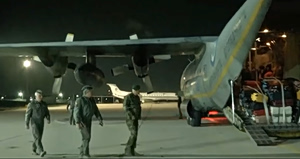
That has led to outsize corporate evacuations. Private-charter company Elevate Aviation was hired by a corporate client this week to evacuate some 1,000 staff and their families from the region, and ended up using an airport in Oman for the first tranche of departures, Elevate’s chief executive told the Journal.
Overall nearly 20,000 Americans had returned to the U.S. from the Middle East since the conflict began, State Department spokesman Dylan Johnson said Thursday. Those figures didn’t include American citizens who have fled to other countries or are still in transit to the U.S., the State Department said.
France’s foreign minister said Thursday that the country evacuated 750 people from the Middle East, with 5,000 still waiting to leave.
The region has heavily courted tech titans, with AI data center capacity projected by PwC to triple by 2030, to 3.3 gigawatts from 1 gigawatt. High-profile initiatives include Stargate U.A.E., unveiled during a visit by President Trump last year.
Dubai in particular has grown rapidly as the region’s business and finance hub, thanks to its easy visa and capital policies, and a carefully crafted reputation as a well-managed oasis removed from the broader region’s conflicts.
The war has pierced that comfortable bubble . Iran had fired around 1,400 missiles and drones at the U.A.E. as of Thursday, according to the government, which said most had been intercepted.
Among the facilities damaged in the country over the past week were two Amazon Web Services data centers, which the Amazon cloud computing arm said took direct hits .
The Iranian attacks are aimed at expanding the war and its economic impact to put pressure on the U.S. and Israel to bring it to an end. They hit during the height of the U.A.E. tourist season.
The country’s main airports were shut by airspace restrictions and drone attacks but have since allowed a number of flights, opening an exit for some trapped travelers. Others have made it out by traveling overland to neighboring Oman. Still others sheltered in mountain resorts or lined up rides on private planes to get out.
Multiple people contacted by The Wall Street Journal in the days just before the war said they had received no communications from their companies about the risks of the looming conflict or contingency plans in the event it kicked off. The U.A.E. government didn’t send out any advisories either and didn’t sound alerts when the shooting started.
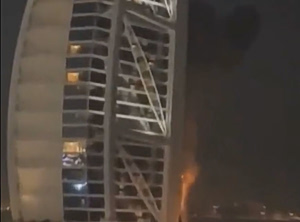
Dubai beachgoers initially watched the first missile intercepts explode overhead with curiosity, then went about their weekends—until the bombardments picked up and a few drones slammed into the city, sending them running for cover.
By midweek, Dubai was getting back to work, with the city’s trademark heavy traffic back in full swing, complicated by GPS jamming aimed at thwarting drone attacks. But the war continued, with alerts about incoming attacks sounding Thursday and Friday.
Write to Sam Schechner at Sam.Schechner@wsj.com and Katherine Blunt at katherine.blunt@wsj.com