Elon Musk took a gulp of water on stage at the World Economic Forum in Switzerland last month and started talking up one of his latest passions: data centers orbiting Earth .
“The lowest-cost place to put AI will be space,” Musk said. “That will be true within two years, maybe three.”
Behind the scenes, the groundwork was already under way for a megamerger of SpaceX and xAI—his artificial-intelligence startup—intended to make the sci-fi vision a reality.
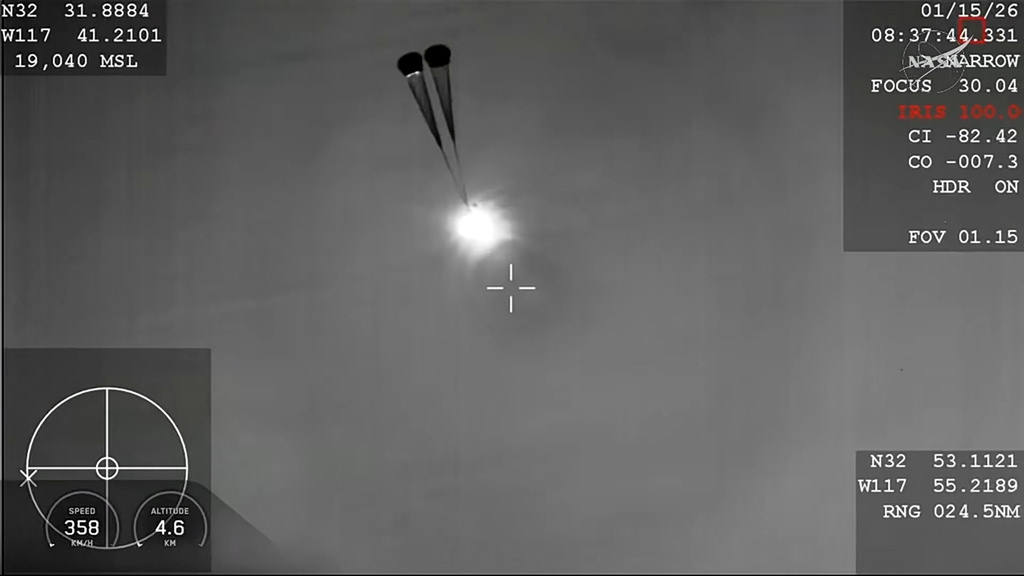
This screengrab from video provided by NASA shows the NASA’s SpaceX Crew-11 members re entering the earth in a middle-of-the-night splashdown near San Diego, Calif., Thursday, Jan. 15, 2026. (NASA via AP)
Within days, bankers from Morgan Stanley provided an estimated valuation of both companies that could be used to structure a merger, according to people familiar with the matter and investor disclosures viewed by The Wall Street Journal. SpaceX’s board decided as of Jan. 30 the company was worth $1 trillion, and xAI’s board decided it was worth $250 billion, the documents show.
SpaceX and xAI signed a merger agreement creating a $1.25 trillion company on Jan. 31. The deal closed two days later, making it the biggest corporate tie-up by value in American history.
The merger follows a busy year in dealmaking for Musk, from the combination of his social-media company X and xAI to Tesla’s $2 billion investment in the AI firm. It also promises a windfall for investors in xAI.
The billionaire entrepreneur has envisioned making xAI’s Grok the most popular artificial intelligence in the world, and building out its capabilities requires a lot of money. And for the startup, being hitched to SpaceX ahead of an initial public offering of stock gives it more financial muscle to compete with the likes of OpenAI and Anthropic.
However, longtime investors in the satellite builder and rocket operator have had to make room for Musk’s AI shareholders, and they face the prospect of supporting an artificial-intelligence company through what some believe to be a bubble reminiscent of the dot-com boom and bust.
Merging SpaceX and xAI represents a level of risk-taking and ambition that is novel even for Musk. The $1.25 trillion value assigned to the new SpaceX is a bet on Musk’s plan for the convergence of AI and space. It is also a wager on unproven technology deployed at a vast scale.
In a memo sent to employees Monday, Musk said starting launches of AI satellites is the company’s immediate focus. SpaceX, xAI and Musk didn’t respond to requests for comment.
New vision
Work on the deal gathered steam around the time Musk won a key victory in November, when Tesla investors endorsed his moonshot $1 trillion pay package , the largest ever for a public-company boss.
Not long after that, members of his inner circle set their sights on an even more audacious target: merging SpaceX and xAI. Combining them had emerged as a priority, people familiar with the deal said, given xAI’s capital needs and SpaceX’s coming IPO.
Some investors in xAI became convinced Musk’s companies should be more intertwined, given the ties the AI firm already had established with them.
Soon enough, SpaceX executives were selling the company’s new focus on AI satellites in discussions with banks and large investors, people familiar with those discussions said. The space company previously told investors it would generate roughly $8 billion in adjusted earnings on $16 billion in revenue in 2025.
For investors, Musk’s corporate maneuvers have often been lucrative: Banks that held underwater debts from his buyout of Twitter were ultimately repaid at around 100 cents on the dollar plus years of high-interest payments.
“You invest with Elon and that is what you get, and if you don’t like it, you leave,” said Ross Gerber , an independent investment adviser and longtime investor in Musk companies, including X and Tesla.
Ties that bind
Musk has previously united disparate corners of his business empire. Last year, he merged X, the social-media company formerly known as Twitter, and xAI into one company valued at an estimated $113 billion. Before the deal, X had also owned a stake in xAI and they did business with each other.
The transaction would ultimately serve as a blueprint of sorts for the tie-up between SpaceX and xAI.
SpaceX was one of xAI’s earliest enterprise customers. It has been scaling up the internal use of Spok , a tailored version of xAI’s Grok chatbot that has been trained on the space company’s data, according to people familiar with the matter.
Last summer, SpaceX invested in xAI while pressing forward with a busy launch schedule and expanding its Starlink satellite-internet service.
At xAI, contractors broke ground on a second data-center project around Memphis, Tenn. But several executives left Musk’s artificial intelligence startup because of concerns about its management and financial health. Leaders from Valor Equity Partners, which is also a SpaceX investor, got more involved with running the company, the Journal reported.
Behind the scenes, SpaceX had been studying how orbital data centers could work and had a technical breakthrough associated with the technology last fall, the Journal has reported .
Musk began talking more, including on X and at events, about harnessing the sun’s energy to power orbital data centers. On Jan. 21, SpaceX filed documents in Nevada, where xAI is incorporated, to create entities overseen by its finance chief, Bret Johnsen.
Those entities, later used for the merger, carried the name K2, an apparent homage to the Kardashev scale—a theoretical framework that illustrates a civilization’s advancement through energy usage, including from stars.
The next day, Musk touted his vision for the future of AI data centers in space on stage in Davos, while professionals involved with making the deal happen were getting to work, according to people familiar with the matter.
Bankers at Morgan Stanley, long Musk’s bank of choice, worked on both sides of the deal, a somewhat unusual arrangement, as each company in an M&A deal typically hires its own advisers to ensure it is getting a fair shake. But in this case, Musk controls both companies.
At the high end, the bank said, SpaceX could be valued at as much as $1.26 trillion, far north of the $800 billion valuation it targeted as part of a recent secondary stock sale. They said xAI could be worth as much as $294 billion.
Both companies went for clean, round numbers: SpaceX’s board decided as of Jan. 30 the company was worth $1 trillion, and xAI’s board decided it was worth $250 billion, the investor disclosures show. Morgan Stanley didn’t provide a “fairness opinion” on the valuations, a common feature in some M&A deals to ensure they were reasonable, although it is less common in transactions between private companies.
Morgan Stanley declined to comment.
Sealing the deal
Steve Kaplan, a professor of finance at the University of Chicago’s Booth School of Business, said the transaction reminded him of deals in the dot-com boom, like the $180 billion merger between AOL and Time Warner.
“That’s the thing that’s very hard here,” Kaplan said. “They’ve come up with their valuations and their share exchange rates, and you don’t know how accurate those numbers are, particularly since neither one is public.”
The rationale behind merging two very different companies has been the subject of intense discussion among people close to SpaceX.
Many are supportive of the new vision. They expect the company to frequently launch orbital data centers on Starship, a rocket still under development, similar to how it deployed the largest satellite fleet in history with Starlink on a different SpaceX vehicle.
However, some SpaceX investors believe xAI investors gained a larger stake in the combined company than they would have preferred. The transaction is handing xAI investors a roughly 20% stake in the combined company.
On a call with investors on Monday, SpaceX representatives including CFO Johnsen confirmed plans to take the company public this summer, according to people familiar with the discussions.
Write to Alexander Saeedy at alexander.saeedy@wsj.com , Corrie Driebusch at corrie.driebusch@wsj.com , Becky Peterson at becky.peterson@wsj.com and Micah Maidenberg at micah.maidenberg@wsj.com