Iran told mediators it would limit the number of ships crossing the Strait of Hormuz to around a dozen a day and charge tolls under the cease-fire struck by President Trump, showing Tehran plans to tighten its grip on the world’s most important energy-shipping lane.
Ships that pass will have to coordinate with the Islamic Revolutionary Guard Corps, the powerful paramilitary group that has been labeled a terrorist organization by the U.S. and the European Union, Arab mediators said.
Four ships were allowed to pass Wednesday, the fewest so far in April, according to S&P Global Market Intelligence, down from more than 100 a day before the war. Iran is requiring ships to work out toll arrangements ahead of time and then pay the fees in cryptocurrency or Chinese yuan, mediators and shipbrokers said.
Iran’s demands show how it has used the war to create a new source of leverage and potentially revenue. It seized control of the waterway during the fighting by targeting ships that tried to pass without its permission. The arrangement is now being entrenched during the two-week cease-fire the U.S. and Iran agreed to Tuesday.
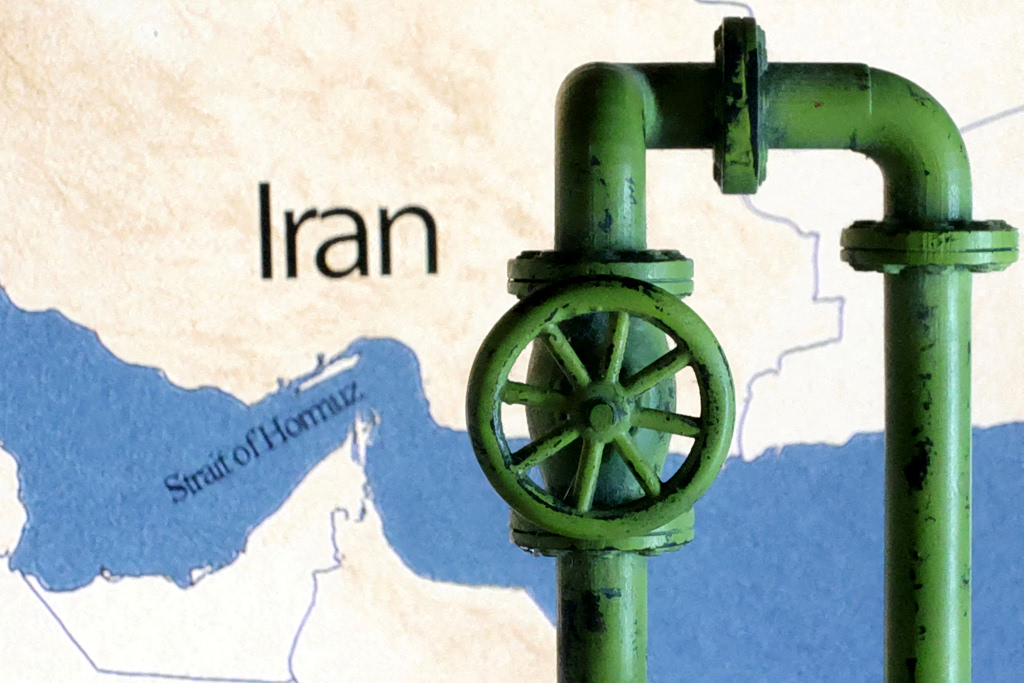
FILE PHOTO: A map showing the Strait of Hormuz and Iran is seen behind a 3D printed oil pipeline in this illustration taken June 22, 2025. REUTERS/Dado Ruvic/Illustration/File Photo
The possibility of Iran’s permanent role in the administration of the waterway is alarming the Gulf’s energy producers, who rely on the strait for the bulk of their exports, and to energy consumers across Europe and Asia.
The U.S. is still pushing publicly for a free and open strait. But Iran isn’t showing a willingness to loosen its grip. In the waterway Wednesday morning, Iran was broadcasting via marine VHF radio that ships without permission to cross from the Revolutionary Guard navy risked being destroyed, according to a recording a crew member shared with The Wall Street Journal. The message was addressed to all vessels in the Persian Gulf and Sea of Oman.
“The Strait of Hormuz has definitely become as important as the missiles and the nuclear program for them,” said Danny Citrinowicz, the former head of the Iran department for Israeli defense intelligence. “For them, control is a must.”
Iranian Foreign Minister Abbas Araghchi said traffic through the waterway during the two-week cease-fire will be under the oversight of Iran’s armed forces. The comments, on social media, were reposted by Trump and the White House.
The Trump administration’s acknowledgment of the demands risks entrenching Iran’s dominance over a significant portion of the world’s oil supply—about 20 million barrels a day, or some 20%.

Only six weeks ago, ships moved freely through the strait before the war without any military coordination with Iran. The new arrangements are altering the balance of power in the Persian Gulf and expanding Iran’s global influence despite the battering it suffered in the five-week war.
Gulf energy producers are strongly opposed to any arrangement that would require making payments to Iran. Mediators expect Iran’s demand to complicate talks in the coming weeks toward a permanent cease-fire.
“Today, control over the Strait of Hormuz offers a different kind of leverage,” wrote Hamidreza Azizi, a visiting fellow at the German Institute for International and Security Affairs, in an analysis published this week. “One that is immediately visible in global markets, continuously exercisable, and less dependent on prolonged negotiation cycles and diplomatic processes.”
Shippers say Iran is already establishing a system of fees. In recent weeks, it has worked to formalize a tiered approach with ships carrying Iranian oil or goods passing freely, ships from friendly countries paying some sort of toll, and ships from countries aligned with the U.S. or Israel blocked altogether.
“Until something is relatively more formal than what it’s been, it’s going to be on a ship-by-ship basis, in which case it’s still going to be almost zero flow for the oil market,” said Neil Crosby, head of oil research at Sparta, an oil analytics firm. “That means it’s status quo.”
Those ships that are allowed to pass sail to the north of the regular channel through a corridor between Iran’s Qeshm and Larak islands, hugging the Iranian coast on their way to the wider waters of the Gulf of Oman.
Shipping operators say fees are set around a week in advance and depend on the size of the vessel, with payments ranging to $2 million for a supertanker that can carry around two million barrels of oil, brokers and shipowners said.
Iran’s parliament has approved a new management plan for the strait that includes fees and Iranian approval of transits, according to Iranian state broadcaster IRNA.
Tehran has presented mediators with demands for transit fees that it would split with Oman, the country that shares the opposite side of the channel with the United Arab Emirates. Levies would depend on the size of the ships and bundle basic transit fees, security escort charges and administrative processing fees.
Oman, a country that opposed the U.S. and Israeli attack but also suffered attacks by Iranian missiles and drones, hasn’t agreed to go along with the plan.
Iran is already charging some fees in Chinese yuan, mediators said—a step that has alarmed regional officials as threatening reduced Western and allied influence over oil markets.
Officials from Gulf Arab countries have objected that Iran’s proposal violates international treaties, such as the United Nations Convention on the Law of the Sea, that guarantee freedom of navigation.
Institutionalizing tolls would be tricky. While Egypt and Panama charge tolls for their canals, international maritime law doesn’t allow governments to charge fees for passage through natural waterways such as the Strait of Hormuz, the English Channel, Gibraltar and Malacca.
Iran also is subject to U.S. and European sanctions that have all but cut it off from mainstream financial networks.
Secretary of State Marco Rubio said the biggest challenge once the war ends would be preventing Iran from imposing tolls, which he called illegal and dangerous. But he said the European and Asian countries that depend most on the strait for energy supplies should be the ones to act if Iran tries to impose tolls. The U.S. would be involved in any effort but doesn’t need to lead it, he said.
“This has been the economic catastrophe that everybody could have predicted, that everybody was predicting, but Trump did it anyway,” said Erik Meyersson, the chief emerging markets strategist at the Swedish bank SEB.
“It’s a really interesting juxtaposition where you have this almost complete dominance in the air theater, the air supremacy and then at the same time this complete incapacity over Strait of Hormuz,” he said of the U.S. military presence.
Iran maintains the closure of the strait with the threat of missile and drone strikes on tankers and other ships that need to cross. Shipping and oil-industry analysts say it would take a cease-fire with explicit assurances from Iran that it won’t launch strikes to restore peacetime levels of traffic.
The closure is driving a global increase in food prices and broader consumer price inflation. A week before the war, the strait handled 38% of the world’s seaborne crude oil and 19% of seaborne liquefied natural gas, according to data from the U.N.’s trade agency. It is also a crucial chokepoint for fertilizers and chemicals like helium, which is used to make semiconductors.
Crew members stuck in the Gulf said Wednesday they haven’t received any clear guidance from Iran—or their local agents—on whether it is safe to pass.
Most shipping lines and oil companies are likely to wait before risking sending ships through the channel while they watch to see whether the cease-fire will hold, how it will be implemented, and what regime is ultimately put in place to govern the strait.
“That alone is enough uncertainty to keep a lot of shipowners there staying still, because that’s not a clear answer or anything,” said Bridget Diakun, a senior risk and compliance analyst at Lloyd’s List Intelligence, a shipping industry firm in London.
Vance to Lead U.S. Delegation for Negotiations With Iran
Vice President JD Vance will lead the U.S. team in talks with Iran on Saturday in Pakistan’s capital, Islamabad, the White House said. Vance called the cease-fire between the U.S. and Iran a “good first step,” but warned that “the Iranians have got to take the next step.” Iranian Foreign Minister Abbas Araghchi said the cease-fire with the U.S. must include a pause in Israel’s conflict with Hezbollah in Lebanon. White House press secretary Karoline Leavitt said Lebanon wasn’t part of the cease-fire.
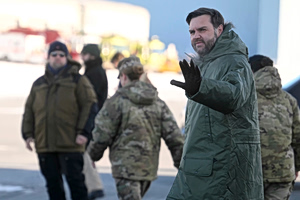
FILE – Vice President JD Vance arrives at Pituffik Space Base in Greenland, March 28, 2025. (Jim Watson/Pool via AP, File)
Leavitt also said President Trump wants the Strait of Hormuz “reopened immediately, without limitation,” and said it wasn’t a “definitively accepted” policy position that Iran would be allowed to charge tolls. Israel wasn’t happy that it got word that a cease-fire deal was finalized at a late stage and wasn’t consulted, though Prime Minister Benjamin Netanyahu said Israel was the winning side in the war.