TOKYO—Japanese Prime Minister Sanae Takaichi led her party to a thumping victory in parliamentary elections, handing her a powerful mandate to deepen ties with the U.S. and rev up Japan’s economy.
The landslide win is a vindication for the 64-year-old conservative, who called the risky snap vote during a snowy Japanese winter only three months after taking office.
Her gamble was that her straight-talking appeal to voters would cement her grip on power amid challenges including sluggish economic growth and worsening relations with Beijing.
Takaichi’s Liberal Democratic Party and its coalition partner, the Japan Innovation Party, were on track to win at least 310 seats in the 465-seat lower house in Japan’s parliament, according to initial results and projections by public broadcaster NHK. That would hand Takaichi’s government a two-thirds majority in the lower house, giving it overwhelming control of that chamber and the ability to overrule the smaller upper house to push through its agenda.
Under Takaichi, the LDP alone was projected to win a majority of seats, according to NHK, a turnaround in the party’s fortunes after more than a decade of coalitions.

Voters enter a polling station during the lower house election in Tokyo, Sunday, Feb. 8, 2026. (AP Photo/Louise Delmotte)
“We stand at a crossroads that will profoundly transform our nation,” Takaichi said Saturday in a message on social media, urging supporters to turn out and vote.
She said on Sunday that she called the election to seek a popular verdict on her economic plans. “We couldn’t run without seeking the people’s trust,” she said in a television interview.
The victory reflects Takaichi’s personal popularity. Voters were enthused by what they saw as her decisiveness and frank style of communication, as well as her optimism and outsider status as a woman in a male-dominated political world. Many braved heavy snowfalls in parts of the country, which had been feared a deterrent to voters.
“I like how Ms. Takaichi is proactive, acts quickly, and sticks to her words,” said Naoya Nakanishi, who was voting Sunday as snow fell near the Tokyo Dome baseball stadium. “She promptly addresses issues directly affecting people’s lives,” he said.
Takaichi also benefited from a poor showing by the newly formed Centrist Reform Alliance, which united two opposition groups to challenge the LDP but failed to ignite voter enthusiasm.
Takaichi is a pro-U.S. leader who has pledged to ramp up defense spending and wants to bolster Japanese industry to make Japan the U.S.’s indispensable partner in Asia.
While other traditional U.S. allies have struggled to respond to President Trump’s enthusiasm for tariffs and disruptive foreign policy, Japan under Takaichi is doubling down on the U.S. alliance, a reflection of Tokyo’s pragmatism and a recognition that loosening ties is unthinkable when confronted with an increasingly assertive China.
“Japan has no option but a close relationship with the U.S. for its security,” said Gerald Curtis, an expert on Japanese politics at Columbia University.
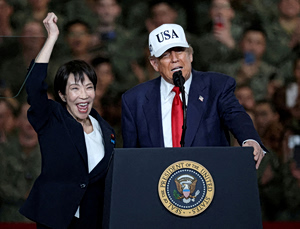
Takaichi and Trump struck up a rapport when the U.S. president visited Tokyo in October, together hailing a new golden age of U.S.-Japan relations. He endorsed her leadership ahead of the election in a message on his Truth Social network, describing her as “strong, powerful and wise.”
She is due to travel to Washington for a summit with Trump next month, where among other things she will be seeking reassurance that the U.S. remains committed to regional security in Asia. The U.S. has around 60,000 military personnel stationed in Japan.
Her trip precedes a planned summit between Trump and Chinese leader Xi Jinping in Beijing in April. Trump’s dealmaking instincts have stoked anxiety in some quarters in Asia that he might be tempted to cede U.S. influence in the region to Xi in exchange for a bumper deal on trade, though U.S. officials say such concerns are unfounded.
The scale of Takaichi’s win suggests voters approve of her handling of China, which has heaped pressure on Japan over remarks she made about Taiwan.
Takaichi said in November that Japan could be dragged into any military conflict over the self-ruled island democracy, which Beijing views as a Chinese territory to be seized by force if necessary. Beijing reacted angrily, saying Taiwan is a purely domestic affair. Reprisals have included squeezing Japanese companies’ access to critical minerals and magnets that are essential to manufacturing. But Takaichi has declined to retract her remarks, saying she was only stating longstanding, if largely unspoken, Japanese policy.
On the domestic front, Takaichi’s main challenge will be to soothe concerns in jittery financial markets that her plans for more borrowing and spending won’t stoke inflation, while also addressing voter dissatisfaction over stagnant living standards.
Jason Douglas is the Tokyo bureau chief of The Wall Street Journal, overseeing the Journal’s coverage of economics, finance, business and politics in Japan.
He was previously the paper’s Asia economics reporter in Singapore, where he wrote about China’s economy and global trade. He joined Dow Jones & Co. in 2007 as a newswires reporter in London after stints in the U.K. business press and newspapers in Northern Ireland.
Junko Fukutome is a news assistant and researcher at The Wall Street Journal in Tokyo. Junko has reported from Tokyo and New York on U.S. and international politics and culture. She has interned at outlets including CNN.
Junko earned her bachelor’s in law from Waseda University and a master’s in journalism from Columbia Journalism School.