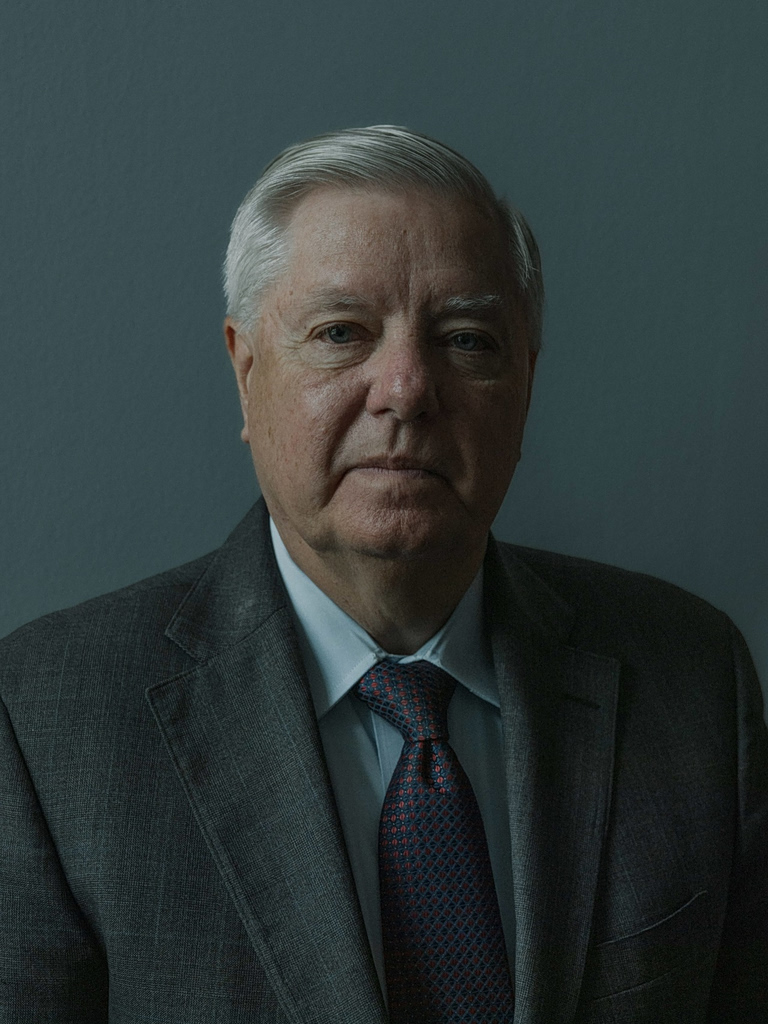
Sen. Lindsey Graham of South Carolina, a foreign-policy hawk who transformed from a fierce critic of President Trump into one of his closest allies on Capitol Hill, has died. He was 71 years old.
The Republican senator, who was the chief congressional proponent of the months-old war with Iran and a staunch supporter of Israel and Ukraine, died after a brief and sudden illness late Saturday, his office said Sunday. He had been in Kyiv on Friday to meet with President Volodymyr Zelensky and had returned home to Washington.
Graham was “one of the greatest people and Senators I have ever known,” Trump posted on social media. “He was always working, and was a true American patriot.” Trump ordered flags flown at half-staff until Saturday evening.
Emergency personnel responded to a medical emergency for a person suffering from cardiac arrest at Graham’s address on Capitol Hill on Saturday evening, according to a recording of police scanner traffic reviewed by The Wall Street Journal.
A Graham spokeswoman said the District of Columbia medical examiner issued preliminary findings that the senator died following a tear in his aorta due to arteriosclerotic cardiovascular disease. The spokeswoman said the death certificate will be pending until all toxicological and microscopic testing is finalized.

Graham spoke to the media in Kyiv, Ukraine, on Friday. Valentyn Ogirenko/Reuters
The death of one of the most influential GOP senators stunned Washington.
“Total shock and disbelief at the loss of a great American,” said Sen. Bernie Moreno (R., Ohio). “My heart is heavy this morning,” said Senate Majority Leader John Thune (R., S.D.).
Graham’s death temporarily leaves the GOP majority at 52-47, and Republicans are also missing Sen. Mitch McConnell of Kentucky, who is out due to health problems . South Carolina’s GOP governor, Gov. Henry McMaster, is expected to fill the Graham seat with a Republican soon. The party is then set to hold a special primary to pick a new nominee, and the general election this fall favors Republicans in the deep-red state.
Graham, who was first elected to the House in 1994 as part of a Republican wave, was elected to the Senate from South Carolina in 2002 and had held the seat since then, forming close ties on both sides of the aisle. While he ran against Trump for the 2016 presidential nomination, he evolved from being an early Republican critic of Trump into becoming one of his most trusted and influential allies.
As one of Trump’s top surrogates as well as a golf partner and frequent adviser, he had unusual access to the president and pressed him to take a hard line against Iran and remain firmly aligned with Israel, for which he was one of the Senate’s strongest backers.
“They say if you break it, you own it. I don’t buy that. You break it when it’s a threat,” Graham said in an interview with the Journal earlier this year regarding Tehran.
CAROLINE GUTMAN FOR WSJ
Democrats and some Republicans on Capitol Hill had criticized Graham for what they saw as his role in goading Trump—who had sworn off “forever wars”—into the Iran conflict. Graham’s effort to get Trump and his MAGA movement to back regime change was “the quintessential political maneuvering beyond all political maneuvering,” Sen. Rand Paul (R., Ky.) said earlier this year.
Graham “was a very strong military person. So am I,” Trump said in an interview Sunday on CNN. “But I think we used it a little bit differently. We probably had a little bit of a different attitude. But we got along on it.” Trump said he had spoken to Graham several hours before his death. The president said Graham told him he was tired from the trip but seemed fine otherwise.
Even those who opposed some of Graham’s policies saw in him an astute politician. He had so many good relationships both on Capitol Hill and around the world that he came to be viewed as something of an indispensable figure in Washington because he was so often at the center of conversations.
“I fought with him like a brother,” said Sen. Chris Coons (D., Del.), a political partner who had dinner with Graham last week in Ankara, Turkey. “But we also came together and worked really hard on things we both cared deeply about.”
One of the major pieces of unfinished business for Graham was bringing about a durable peace in the Middle East. A congressional delegation that Graham helped lead after the Oct. 7, 2023, attack on Israel was part of his broader plan to arrange for recognition of Israel by Saudi Arabia, a defense pact with the Saudis and an avenue toward Palestinians’ control over their own country.
Israeli politicians mourned Graham’s passing. Prime Minister Benjamin Netanyahu said Israel has no better friend than the senator.
A tumultuous childhood
Lindsey Olin Graham was born in Central, S.C., on July 9, 1955, and grew up in the backroom of his family’s bar, where he worked to help them make ends meet—as well as developing both his skills as a pool player and a sharp sense of humor. After his parents died while he was in college, Graham frequently traveled back home to care for his younger sister, eventually becoming her legal guardian.
He earned his undergrad and law degrees at the University of South Carolina. He later served as a military lawyer in the U.S. Air Force and briefly worked in private practice before entering politics, first winning office in the state House and then entering the U.S. House in 1995 and the Senate in 2003. He played a prominent role early in his career when he was named one of the managers of President Bill Clinton’s impeachment trial.
For more than two decades, initially as a close partner of 2008 Republican presidential nominee Sen. John McCain, Graham was among the Senate’s most persistent advocates of American military power, from the wars in Iraq and Afghanistan to strong support for Israel and Ukraine and the recent conflict with Iran.
Graham served in the Air Force Reserve until his retirement in 2015 at age 60 with the rank of colonel. He was awarded a Bronze Star Medal for his “exceptionally meritorious service.”
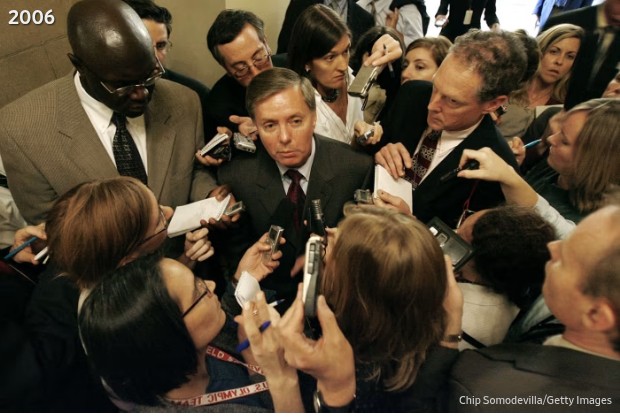
Graham with reporters at the U.S. Capitol in 2006. Chip Somodevilla/Getty Images
Graham ran for president in the 2016 cycle, advocating for a major military offensive in the Middle East, proposing sending tens of thousands of U.S. troops to Iraq and Syria to fight Islamic State militants. He called Trump, who was mounting his own campaign, a “race-baiting, xenophobic, religious bigot.” He tweeted that if Republicans nominated Trump, “we will get destroyed…….and we will deserve it.”
But Graham was relegated to the undercard debates with other low-polling candidates—where he showcased his wit but made little impact with voters, leaving the race before the first primaries.
“I wasn’t the best law student. By the end of this debate, it would be the most time I’ve ever spent in any library,” he said at one debate held at the Ronald Reagan Presidential Library. “I’ve got a lot of friends. We’ll have a rotating first lady,” the lifelong bachelor said in an interview with the Daily Mail about his possible presidency. He suggested his sister could fill the role.
Graham “was always the person you hoped you sat next to at a dinner party. Charming, very, very, very funny—like so funny he truly could have had a career in stand up comedy,” said Meghan McCain, the late Arizona senator’s daughter. She noted that Graham was the last of the “Three Amigos”—close friends and foreign-policy hawks Graham, McCain and centrist Democrat-turned-independent Sen. Joe Lieberman of Connecticut.
Influential voice in Trump era
Graham carried his views about the use of American power into the Trump era, even as an increasingly influential wing of the Republican Party grew deeply skeptical of U.S. involvement in conflicts overseas.
In an interview with the Journal late last year, he credited Trump with making the U.S. much safer than it had been in decades, citing his decision to bomb Iran’s nuclear facilities, take on narcotics traffickers and press NATO allies to spend more on the common defense.
“There is a new sheriff in town, and I like what I see from President Trump,” Graham said.
It was an example of one of Graham’s strengths as a lawmaker—his ability to steer public policy by using flattery and handing out credit to powerful people . Sen. Dick Durbin, an Illinois Democrat who was close to Graham, once joked that the South Carolina senator was able to get Trump to listen to him because “he consistently loses at golf when he plays the president.”

dynamic-chart
Graham had a moderate streak on immigration, joining a bipartisan effort in 2013 on a broad overhaul that passed the Senate but failed to gain support in the more conservative House. He tried repeatedly to effect policies giving Dreamers—the immigrants brought to the U.S. illegally as children—a pathway to citizenship, and almost succeeded during Trump’s first term before hard-liners helped blow up the effort in a dramatic meeting at the White House.
But Graham also staked out increasingly partisan positions as Trump’s MAGA movement gained a firmer grip on the party. In 2018, as he headed toward what was expected to be a tough 2020 re-election campaign and serving as Senate Judiciary Committee chairman, Graham launched a fiery defense of Supreme Court Justice Brett Kavanaugh, who faced an allegation of sexual misconduct during his confirmation process. He later said the episode caused him to abandon a practice of supporting Democratic nominees.
The senator appeared to break with Trump after the Jan. 6, 2021, riot at the U.S. Capitol by Trump supporters, declaring on the Senate floor, “Count me out. Enough is enough.” But the rupture was short-lived. Four months later, he acknowledged Trump’s continued hold over the Republican Party.
“Can we move forward without President Trump? The answer is no,” he said. “I’ve determined we can’t grow without him.”
Even after he rebuilt ties to Trump, some MAGA voters remained skeptical of Graham, and he was regularly booed at events with the president. Some critics said he simply realized he needed to back Trump to remain relevant in GOP circles. Yet senior administration officials cared about Graham’s views—as a gauge of how their positions were being received by the hawkish Republican contingent in Congress, and as a signal of the advice the senator was giving Trump.
At the time of his death, Graham chaired the Senate Budget Committee and remained a regular presence on news programs. He had been scheduled to appear Sunday on NBC’s “Meet the Press.”
Graham criticized Zelensky after the Ukrainian leader’s tough meeting at the White House early in Trump’s second term. But he had been a relatively consistent supporter of the country’s fight against the Russian invasion and an advocate of tougher pressure on Moscow—through a period in which some high-ranking American officials, including Trump himself, have questioned support for Kyiv.
On Friday, Graham was in the Ukrainian capital, where he met with Zelensky on his 10th visit to the country. The senator pressed for stronger air defenses and said the White House had agreed to support a version of his Russia sanctions legislation.
Graham was up for re-election this year for a seat that has been solidly Republican for years. Last month, he defeated Republican primary challengers to advance to November’s general election, a race he was favored to win.
Former President Joe Biden had been close to Graham while serving in the Senate before a public break in 2021 over Biden’s withdrawal from Afghanistan. Biden said Sunday that while they “disagreed often, and sometimes loudly,” he and Graham “did agree on the profound importance of public service.”

A U.S. flag flies at half-staff atop the White House in Washington, D.C., U.S., July 12, 2026. Senator Lindsey Graham, who represented South Carolina for more than two decades, died early this morning at 71. REUTERS/Aaron Schwartz