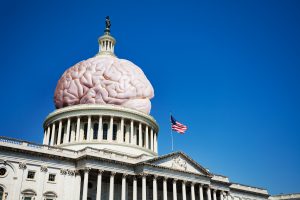
Pound-for-pound, the human brain is the body’s most metabolically costly organ, consuming 20% of our energy and accounting for an outsize portion of our anatomy compared with most other animals.
The reason?
Our neural network, according to one hypothesis, evolved so that it could juggle our expansive social networks.
Humans, it seems, are built to schmooze.
At about 3 pounds, the human brain makes up 2% of our body weight, and three-quarters of this oversize organ is the neocortex, an area responsible for complex cognitive functions like memory, language, problem-solving and self-awareness.
These abilities enable people to navigate the complex relationships of families, friend groups, sports teams and workplaces, and cultivating a wide network confers health benefits.
“When people are more socially connected, they have increased survival rates,” said Julianne Holt-Lunstad, a professor of psychology and neuroscience at Brigham Young University. “There’s reduced risk for cardiovascular disease, stroke, Type 2 diabetes, depression and dementia.”
But the high cognitive demands of maintaining these beneficial social bonds places a limit on the number of stable relationships we can maintain, according to British psychologist Robin Dunbar .
To better understand these limitations, Dunbar examined our monkey, lemur and ape cousins—and found a connection between the size of each primate’s neocortex and the size of its stable social groups.
The data showed a neat line between the two variables: the larger the neocortex, the larger the social group.
His peek into primate brains came from neuroimaging and reviewing studies that documented how grooming practices enable primates to cultivate relationships. These bonds create security, facilitate social hierarchies and forge alliances that are linked to higher survival rates for individuals and their offspring.
Dunbar found, for example, that chimps’ average social group size was around 50 .
Based on the relationship between the size of the neocortexes of more than 30 primate species and the size of their respective social groups, he extrapolated the likely size of human social groups.
The answer: 150.
This number, Dunbar believes, has held steady since the advent of our species, and is unchanged even in the digital age of social media. To test his theory, he dived into historic texts and archaeological data, and even studied church congregations.
He found that 150 was reflected in eclectic groups including hunter-gatherer kinship networks, Bronze-Age communities, Anglo-Saxon villages in medieval Europe, Mormon wagon trains in the 19th century and modern German trailer parks.
Like the social circles of other primates, human relationships are hierarchical. Dunbar likens them to ripples on a pond.
The innermost circle is just five people—friends or family members—that you feel emotionally closest to. These are the shoulders you cry on, the people you contact at least once a week. Then comes a layer with 10 additional good friends you see at least once a month. About 60% of your social attention goes to these 15 people, Dunbar said.
Farther out is what he calls your “weekend backyard barbecue party group”—a total of 50 people, including the 15 that you see regularly.
Finally, Dunbar describes an outer ring bringing the total to 150 and including an additional 100 people you would invite to your once-in-a-lifetime big events like a wedding or “wouldn’t feel embarrassed about going up to them and slapping them on the back if you bumped into them at 3 a.m. in the departure lounge at Hong Kong Airport.”
If contact becomes less frequent with the members of any given social tier, Dunbar said, “they slide inexorably down through the layers. And after a few years, they drop out of your solar system and become acquaintances.”
These are folks like the neighborhood barista or most colleagues at the office. “Maybe you’d have a beer with them now and again,” Dunbar said, “but you’d never invite them home.”
He estimates people have 350 acquaintances on top of their 150-person network. Beyond that, he thinks that most of us can recognize an additional 1,000 people—like President Trump—by sight. But they might not recognize you.
“Those outer layers beyond 150 are kind of one-way relationships,” Dunbar said. “The key to the 150 and the layers within is that they’re reciprocated.”
Other researchers think the number is even bigger. In 2021, a group of Swedish researchers published a paper saying 150 is an underprediction of social group size, but said no upper limit could be calculated with precision.
A key assumption of Dunbar’s estimate is that human and nonhuman primate groups are subject to the same evolutionary pressures and therefore develop similarly, according to Johan Lind, a biologist at the Center for Cultural Evolution at Stockholm University and a co-author of the 2021 paper.
Yet Homo sapiens, for the most part, are no longer beholden to the basic tenets of survival that dictate our fellow primates’ quotidian lives.
“In nonhuman primates, resource availability and risk of predation are very important determinants of sociality and group size,” Lind said. “There are benefits to being in a larger group when it comes to safety, but then a larger group incurs more competition for food.”
Humans, by contrast, do things like watch sports or go to concerts in enormous groups and then return home to fully stocked fridges.
Lind argues that this should allow for larger social networks.
In an era of Facebook, Instagram, Discord and Slack, logic might also suggest communicating online would enable humans to break through Dunbar’s presumed ceiling of 150. But Dunbar suspects social media hasn’t substantially changed the size or quality of our networks.
“If you look at the frequency of postings on social media, frequency of telephone calls, the frequency of face-to-face contacts, the frequency of texting, you see the same layers,” Dunbar said.
What social-media platforms have done, he said, is keep people in a relationship layer for longer in a way that wasn’t possible before digital media .
But, he added, there is a strong sense that people, given the choice, prefer face-to-face contact.
“It’s difficult to get emotional support from somebody you can’t actually hang on to physically and put your arms around,” Dunbar said. “It’s just not the same.”
Write to Aylin Woodward at aylin.woodward@wsj.com
Illustration source imagery: iStock, Adobe Stock