Shares in SpaceX soared 19% Friday as Elon Musk’s rocket maker pulled off the largest initial public offering ever and one of the smoothest in recent history.
The company, valued at $1.77 trillion when it sold $75 billion worth of shares a day earlier, ended its first day of trading with a market value of $2.1 trillion, putting it ahead of Broadcom and Tesla to make it the sixth-most valuable public company in the U.S.
The offering handed longstanding SpaceX investors and employees billions in collective gains and turned Musk into the world’s first trillionaire. It was powered by an army of individual investors who bought into Musk’s moonshot vision of putting data centers in space to support the rise of artificial intelligence.
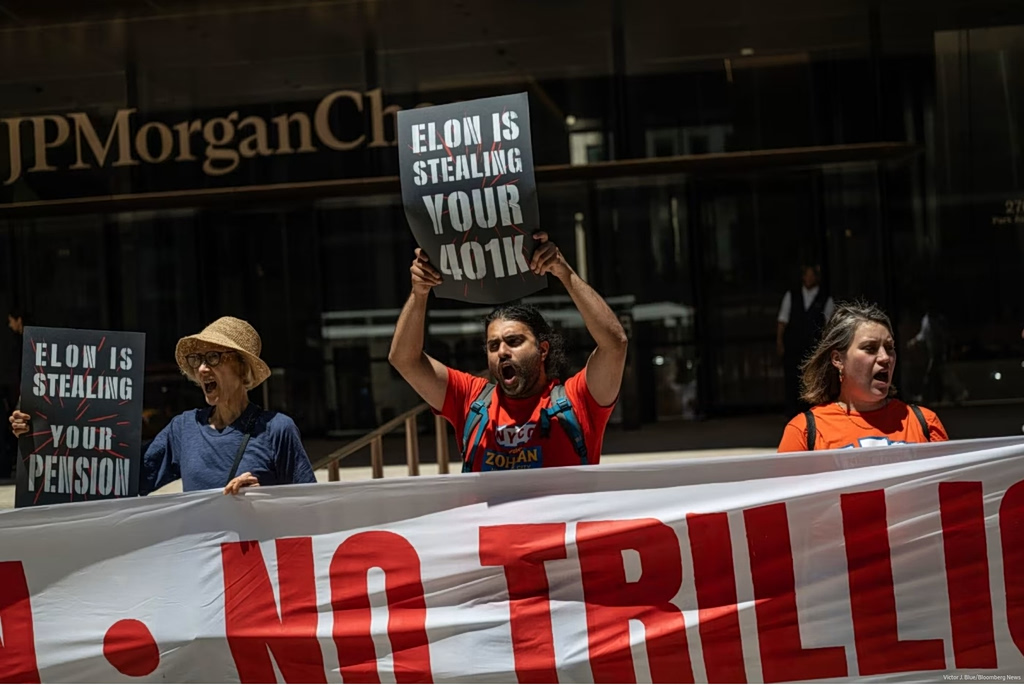
Ahead of the debut, some on Wall Street wondered whether the financial system’s machinery would support the sheer size of the offering and whether investors would show up en masse for an unprofitable venture that sees much of its future revenue coming not from its space or internet businesses but rather from its nascent AI unit.
Corporate-governance advocates criticized Musk for controlling more than 80% of the company’s voting rights, which makes it all but impossible to fire him or make other big changes without his support, and called for halting or boycotting the offering.
In the end, the IPO went about as well as it could. Shares, trading under the ticker SPCX, opened on the Nasdaq Stock Market a little before noon 11% above the IPO price of $135. They hovered about 20% to 30% above it for much of the day—which is the first-day “pop” bankers pricing IPOs typically target—and closed at $160.95. The nearly two dozen banks involved in the offering will now enjoy slices of the roughly $500 million offering fee that many spent years pursuing.
The offering is a good omen for SpaceX’s AI-focused rivals Anthropic and OpenAI, both of which recently filed paperwork that sets them up to stage similarly megasize offerings later this year.
The IPO drew heavy demand from big institutional investors such as BlackRock , but also individuals, who in many cases didn’t get anywhere near the number of shares they requested through brokerages. Pierluigi D’Amore, 29 years old, said he got one of the 10 shares he requested, and even though he describes the valuation as “a little over the top,” he plans to buy more.
“I don’t think it’s going to matter in 10 or 20 years,” he added. “You’ve got to think long-term.”
Meanwhile, some analysts struggled to comprehend SpaceX’s ballooning valuation. The revenue growth it would need to achieve to back up the valuation is “borderline comical,” CFRA Research senior analyst Keith Snyder said Friday.
SpaceX entered a market that had been whipsawed by uncertainty over the Middle East conflict and on edge about whether an AI-fueled stock surge went too far in some corners. On Friday, signs of progress on a peace deal helped drive indexes back toward records, with the Dow Jones Industrial Average adding 0.7% and the Nasdaq 0.3% higher.
SpaceX’s fast-track inclusion in some indexes, such as the Nasdaq-100, will mean investment funds tracking those benchmarks will scoop up its shares in the coming days.
For Musk, the offering was the finish line of a sprint that began last year. After founding SpaceX in 2002 with proceeds from the sale of the internet company PayPal , Musk showed little interest in taking SpaceX public as it slowly grew to become one of the world’s most valuable private companies.
That all changed in the middle of last year as the AI race heated up and Musk realized SpaceX would need large amounts of capital for its ambitious plans. He also saw the IPO as a way for his fledgling AI company, xAI, to catch up with rivals. SpaceX acquired xAI earlier this year after xAI had acquired his social-media platform X last year. (Some Musk observers expect a merger between SpaceX and Tesla to be next.)
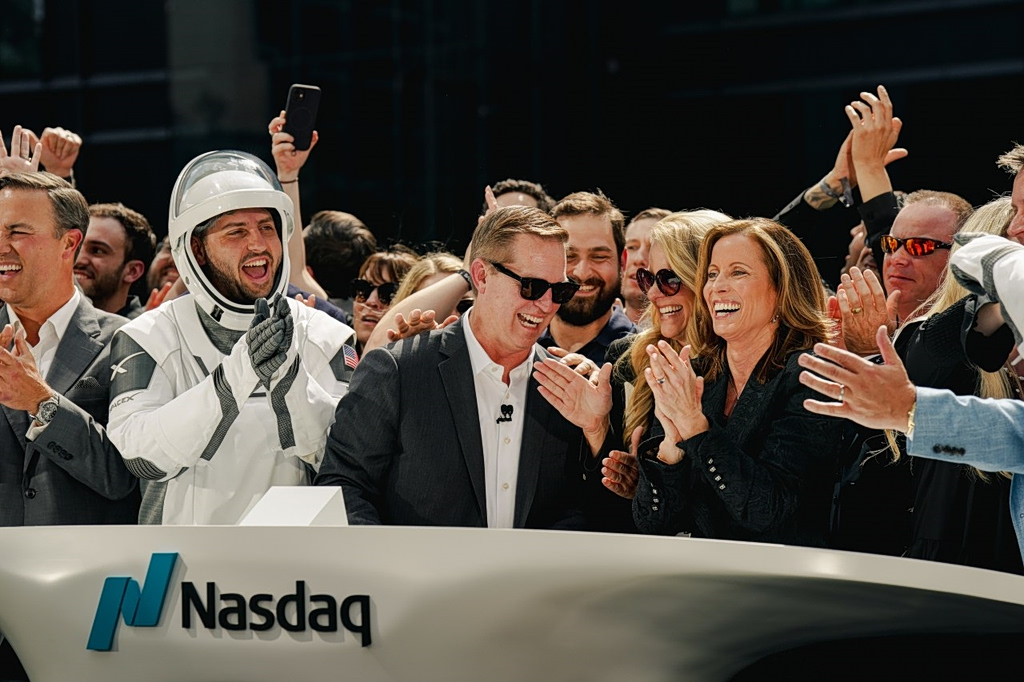
As SpaceX executives including President Gwynne Shotwell and Chief Financial Officer Bret Johnsen rang the opening bell Friday at New York’s Nasdaq Stock Market, Musk joined by video from Starbase, Texas , the newly incorporated company town where SpaceX is based, surrounded by SpaceX employees.
After the market closed, the Times Square Ball that drops each New Year’s Eve instead rose to mark the occasion and was lighted in orangish-red colors to represent Mars. Two people donned astronaut suits. JPMorgan Chase was hosting a party Friday evening at its Midtown Manhattan headquarters, which was to be lit up with a SpaceX light display after dusk.
SpaceX struggled in its early days. Its first three rocket-launch attempts failed, and the company nearly went bankrupt. A big break came in 2008, when NASA awarded it a major deal to transport cargo to the International Space Station.
In the years that followed, SpaceX demonstrated the power of rocket reusability with its Falcon 9 vehicles and used them to deploy Starlink, the biggest internet satellite fleet in history. In 2020, SpaceX launched two NASA astronauts from Florida to the space station, marking the first human flight from the U.S. in nearly a decade at the time.
The U.S. government is SpaceX’s largest single client , with revenue from the government totaling $4 billion in 2025 and expected to sharply climb over the next few years.
The notoriously private company detailed its finances for the first time when it unveiled its IPO paperwork in May.
SpaceX lost $4.9 billion last year on revenue of $18.7 billion, and the losses widened in the first quarter. The company has three units: The space business had $4.1 billion in revenue last year and about $657 million in losses. Its Starlink satellite internet business pulled in $11.4 billion in revenue and turned a profit. Meanwhile, xAI had $3.2 billion in revenue and $6.4 billion in losses.
SpaceX touted in the filing that it sees a total addressable market, a business term for potential revenue opportunities, of $28.5 trillion, the largest such figure of its kind. Most of that—$26.5 trillion—is in AI.
The AI business is in need of major investments to develop the huge orbital data-center network that aims to provide computing resources SpaceX could use itself and sell to other AI companies. The project depends on technologies that haven’t been fully proven yet, including its new Starship rocket.
While Musk plots out his plans for AI in space, the action now is on the ground. He spent billions of dollars to erect a supercomputing complex in Memphis to support the company’s Grok AI assistant. But Grok has struggled to catch up with the competition, leaving it with excess computing capacity, some of which it recently rented out to competitors to create a stream of billions of dollars in revenue almost overnight. But it has also raised questions about xAI’s ability to win at AI and whether Musk is ceding ground to the competition.
Write to Corrie Driebusch at corrie.driebusch@wsj.com , Becky Peterson at becky.peterson@wsj.com and Micah Maidenberg at micah.maidenberg@wsj.com