DUBAI—A new rhythm of war has taken hold in the Persian Gulf nations, with businesses attempting to adjust to disruptions and residents getting used to Iranian missile-attack warnings that persist, albeit at a diminished pace.
Despite this relative lull in the tempo of Iranian attacks, the growing belief across the Gulf is that things will soon turn for the worse before getting better.
President Trump’s latest attempt at diplomacy with the Iranian regime has, so far, failed to produce meaningful results. With thousands of U.S. troops heading here , and Iran warning of new blows against the Gulf’s infrastructure, the Middle East is bracing for an even more serious conflagration, with potentially devastating economic consequences.
“The deep distrust between all the parties will make an immediate cease-fire next to impossible,” said Hamad Althunayyan , a professor at Kuwait University. “The parties are still invested in this conflict. I don’t think we’ll see de-escalation anytime soon.”
The United Arab Emirates, which bore the brunt of Iranian missile and drone attacks, holds no illusions about a negotiated settlement with the current Iranian regime, which is increasingly dominated by the Islamic Revolutionary Guard Corps. The focus should be not on reaching a cease-fire, but on a “conclusive outcome” that addresses the full range of Iranian threats to the region, from nuclear to missiles to proxy militias, U.A.E. officials say.
By attacking mostly civilian targets in the U.A.E. and blocking navigation in the Strait of Hormuz over the past month, the IRGC is behaving as a terrorist organization, said Noura Al Kaabi , a minister of state for foreign affairs. “They need to be held accountable. They are holding the world hostage,” she said in an interview.
An Iranian regime that remains under IRGC control is no longer acceptable, Kaabi added. “We want to have a normal neighbor,” she said. “Do we want to get a generation that is used to being threatened by our neighbors? I don’t think this is a reality that we want to leave to our next generations. We want a guarantee that this will never happen again.”
To be sure, not all the Gulf nations have similar determination. Oman’s foreign minister Badr Albusaidi described Iranian strikes on cities like Dubai, Manama and Doha as “the only rational option” in response to the U.S. and Israeli bombing campaign . Oman was the only one of the six Gulf monarchies that refused to sign this week’s joint statement condemning attacks by Iran and its proxies.
Qatar, which hadn’t been targeted by Iran for several days until an intercepted salvo on Friday, and is now reopening schools, has signed the statement but adopted markedly more conciliatory language toward Tehran. The Qatari prime minister’s adviser, Majed Al Ansari , said Tuesday that Iran will remain a neighbor and therefore a way to coexist must be found, making it important to find a negotiated solution.
Still, the biggest Gulf states—Saudi Arabia and the U.A.E—as well as Kuwait and Bahrain are becoming increasingly hawkish. While Saudi officials refrain from public statements, they have made it clear that they view the IRGC-dominated Iranian regime as an existential threat to the kingdom, diplomats say.
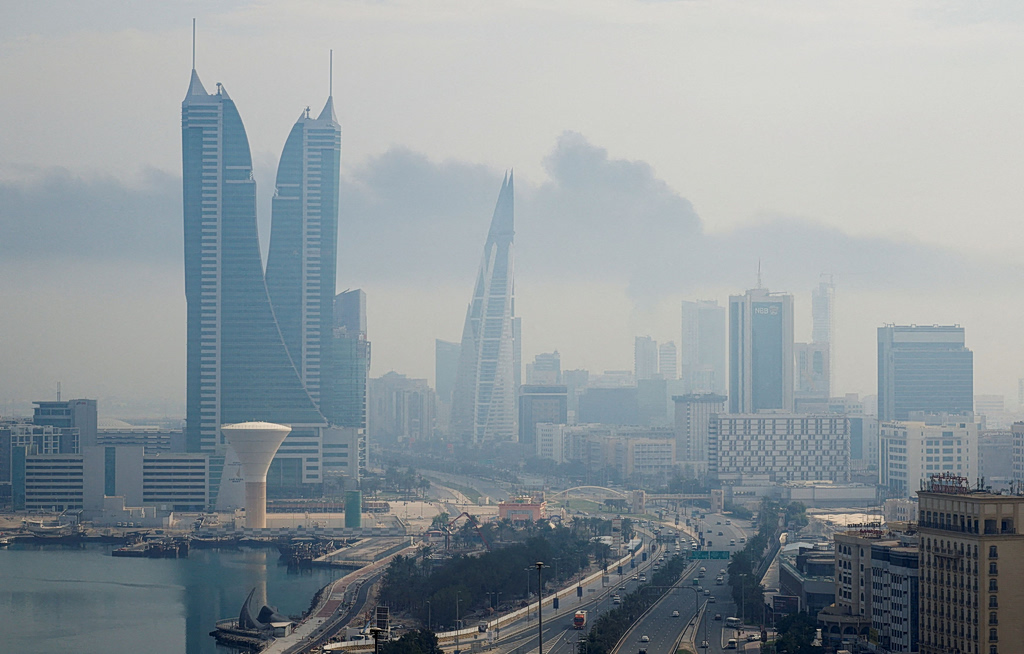
Smoke rises following a reported Iranian drone strike on the fuel storage facility of Bahrain International Airport, amid the U.S.-Israeli conflict with Iran, in Muharraq, Manama, Bahrain, March 12, 2026. REUTERS/Stringer TPX IMAGES OF THE DAY
“All the Gulf countries agree that this war is unnecessary,” said Althunayyan of Kuwait University. “But the divergence that we are seeing is that the strategic patience of some of these countries is diminishing by the minute. And if the Iranian aggression intensifies, these states will have no option but to confront the threat, neutralize it and re-establish deterrence.”
Iran has already pledged to hit power plants, water desalination facilities and oil installations across the Gulf should the U.S. target its electric generation infrastructure, as Trump pledged last weekend before announcing a five-day delay for diplomacy, a deadline that he extended by 10 days on Thursday.
The Iranian regime also threatened massive retaliation against the Gulf should the U.S. military—perhaps with the assistance of some Gulf states—seek to seize Iranian islands in the Gulf and near the Strait of Hormuz. The U.A.E. claims sovereignty over the islands of Abu Musa, the Greater and the Lesser Tunb that Iran took over in 1971. The Pentagon is considering sending some 10,000 ground troops to the region, in addition to the 5,000 soldiers and Marines already dispatched to the Gulf in recent days.
“There is no doubt that the region is entering a phase of uncertainty regarding its future,” said Sultan Mohammed Al Nuaimi , director-general of the Emirates Center for Strategic Studies and Research, a think tank in Abu Dhabi. “The trajectory appears to be either a move toward further military escalation, recently reiterated by President Trump, or a continuation of difficult negotiations unlikely to achieve their intended outcomes.”
While the U.S. and Israel say they scored major successes in decimating Iran’s ballistic missile capabilities , launches continue. On Thursday, two people in the U.A.E. were killed by debris from a missile interception, the first fatalities in nearly two weeks. It’s doubtful that Iran retains the capacity to deliver on its threats of fully knocking out electricity and water infrastructure in the U.A.E. and other smaller Gulf states, military analysts say. Still, Tehran can certainly cause more damage to Gulf cities, especially if it starts using here the multiple-warhead ballistic missiles that have targeted Israeli population centers in recent days.
As the war continues and schools in the U.A.E. remain closed, switching to online education, some expats with families have temporarily left the country. Otherwise, however, life goes on. Businesses and government offices maintain regular schedules. Some restaurants are packed—even though conversations around the table inevitably turn to war-related matters, and sometimes to fears about what the future may bring.
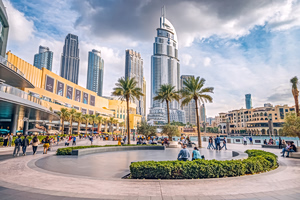
In the Dubai International Financial Center, the neighborhood of glitzy skyscrapers that was attacked, without casualties, by Iranian drones some three weeks ago, many banks and companies that initially told staff to work from home have reopened. “Now that it’s calmer, people are back,” said Jacob Benny , who works for an audit firm and was eating his lunch in a DIFC cafe. “Hopefully there will be peace talks, it will be the end of this, and calm will return.”

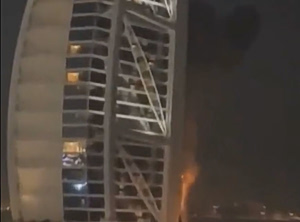
A damaged building in DIFC Dubai, after debris from a successful interception caused minor damage to the facade, amid the U.S.-Israeli conflict with Iran, in Dubai, United Arab Emirates, March 13, 2026. Picture taken with a mobile phone. REUTERS/Stringer
Peace talks or not, the IRGC remains in control of the Strait of Hormuz, choking oil and gas exports from the Gulf states and disrupting global energy markets. The war has severed key logistics routes, scared away tourists from cities like Dubai and dramatically reduced air traffic throughout the region. Dubai’s sprawling gold market is deserted, in part because buyers from abroad no longer come, and in part because of dramatic fluctuations in gold prices. “Nobody’s buying. It may take three-four months for things to come back,” said merchant Jagdish Soni.
Ahmed Galal Ismail , chief executive of the Dubai-based Majid Al Futtaim conglomerate that operates supermarkets, shopping malls, hotels, cinemas and other businesses across the Middle East, said that while businesses that relied on visitors were heavily impacted, those that cater to residents have proved resilient. Some 200,000 people visited the company’s cinemas in the U.A.E., and half a million across the Middle East, during the recent three-day Eid holidays, he said, a number comparable to previous years.
In the U.A.E., initial supply-chain disruptions caused by the Iranian stranglehold over the Strait of Hormuz have been mitigated by alternative routes, such as the country’s ports on the Gulf of Oman, and road traffic via Oman and Saudi Arabia, Ismail said. Covid-age investments in local dairy, chicken and vegetable production that reduced dependence on imports also paid off. Meanwhile, the resumption of flights by Emirates airline means that the supermarkets are as fully stocked with fresh and luxury imports as before the war.
“In all foods today, variety is largely available,” Ismail said in an interview. “Maybe, if you are looking for an Australian Wagyu beef of a certain grade, that may be in short supply. But that would be momentarily, in a particular store at a particular point in time.”
Still, he added, the days ahead are full of extreme uncertainty: “It’s a kind of situation where it’s difficult to predict how long it will last—and, more importantly, how it would eventually end.”
Write to Yaroslav Trofimov at yaroslav.trofimov@wsj.com