The Trump administration’s peace plan for Ukraine demands sweeping territorial and security concessions from Kyiv while offering Moscow major economic and political incentives, including U.S. recognition of its claims to parts of Ukraine, to halt the nearly four-year-old war.
The White House has been pursuing a deal to end the conflict since President Trump took office in January, but the details of the terms he and his top aides were offering Russian President Vladimir Putin and Ukrainian President Volodymyr Zelensky have been kept largely under wraps until now.
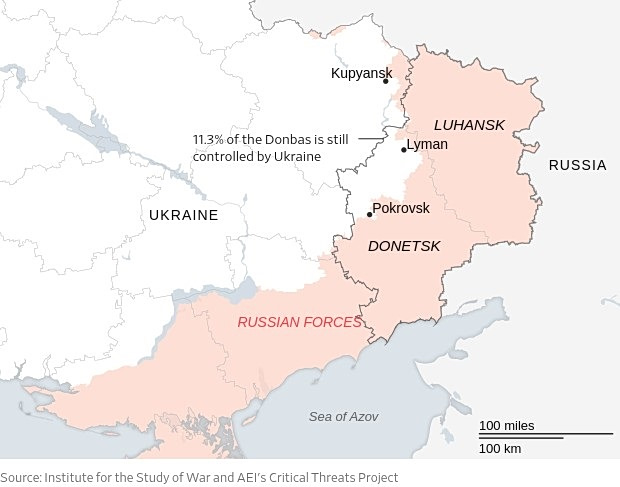
A draft of the blueprint posted online that the White House confirmed was authentic calls for Ukraine to cede the eastern Donbas region now under its control to Moscow and accept Russia’s de facto control of other parts of Ukraine where the front line would be frozen.
Ukraine’s military would be capped at 600,000 personnel and its goal of joining the North Atlantic Treaty Organization would be foreclosed.
Taken together, the proposals seek to address many of Putin’s longstanding demands for ending the war. The inducements offered to Ukraine are far more limited, reflecting Trump’s prioritization of ending the bloodshed over maintaining U.S. support for the target of the Kremlin’s 2022 all-out invasion.
Many of the White House ideas were so at odds with longstanding Ukrainian positions that some analysts called the blueprint a nonstarter for negotiations.
In addition to the 28-point plan, a separate U.S. document lays out security guarantees White House officials are prepared to offer Ukraine in case Russia renews the war, including “intelligence and logistical assistance” or “other steps judged appropriate” after consultations with allies. It doesn’t commit the U.S. to provide direct military assistance, a copy of the document reviewed by The Wall Street Journal shows. The guarantees would last 10 years and could be extended.
If the overall deal is adopted, Russia would be invited to rejoin the Group of Eight, and promised, on a case-by-case basis, the lifting of sanctions that have deprived the Kremlin of hundreds of billions of dollars in revenue. Washington and Moscow would collaborate on artificial intelligence, data centers, energy deals and rare-earth mining in the Arctic, under the 28-point plan.
“This plan was crafted to reflect the realities of the situation, after four years of a devastating war, to find the best win-win scenario, where both parties gain more than they must give,” White House press secretary Karoline Leavitt said in a statement.
U.S. officials said they were carefully coordinating the terms of the deal with Kyiv. Rustem Umerov, secretary of Ukraine’s national security and defense council, had endorsed “the majority of the plan” in talks with U.S. officials, Leavitt said.
Zelensky, who has sought to align himself closely with the White House since a clash with Trump in February , took a conciliatory stance after a briefing on the plan Thursday, saying he was ready to work with the U.S. on halting the war.
A senior Ukrainian diplomat told the United Nations Security Council that Ukraine opposed ceding territory to Russia and other provisions of the plan. “Ukraine won’t accept any limits on its right to self-defense, or on the size or capabilities of our armed forces,” said Khrystyna Hayovyshyn, Ukraine’s deputy permanent U.N. representative.
In addition to provisions aimed at halting the fighting, the proposal calls for Kyiv to agree to hold elections in 100 days, which could see Zelensky ousted as he and his administration stumble through a mounting corruption scandal at home.
Top Trump administration officials have worked on the blueprint over the past month and discussed it with Ukrainian counterparts in recent days. The proposal was a working document and would likely be altered during negotiations with Russia and Ukraine, U.S. officials said.
Kremlin spokesman Dmitry Peskov on Thursday said the Russian and U.S. sides were not actively engaged in discussing a cease-fire and that any deal needed to address the root causes of the war—Moscow’s shorthand for its displeasure over NATO’s eastern expansion, Ukraine’s pro-Western tilt and the West’s dismissal of Russia as a great power.
Moscow would have to promise not to re-invade Ukraine, forging a nonaggression pact with Kyiv and Europe and not placing troops in land Ukraine unilaterally surrenders. But the regions of Luhansk, Donetsk and Crimea, would be “recognized as de facto Russian,” the document says, including by the U.S.
A family rehabilitation program would also be set up, an attempt to address Ukraine’s outrage over the forced abduction and disappearance of thousands of Ukrainian children into Russia. Ukraine would retain the right to join the European Union.
In a provision aimed at Ukraine neighbors worried about the threat from Moscow, the plan says, “It is expected that Russia won’t invade neighboring countries.” European governments were neither included in the drafting of the plan nor briefed on its contents as of Thursday evening, European officials have said.
Meanwhile, the U.S. would reap benefits from Ukraine’s reconstruction, which would be partly funded by the World Bank. The U.S. would rebuild Ukraine’s gas pipelines and help create a fund for artificial-intelligence projects and data centers in Ukraine. A peace council, chaired by Trump, would oversee the implementation.
The U.S. plan also calls for dividing up the power distribution from Ukraine’s Zaporizhzhia nuclear plant between Russia and Ukraine. Moscow seized the plant, Europe’s biggest, in the first days of the war.
The framework seeks to dictate what happens to the $300 billion in immobilized Russian central-bank assets, the bulk of which are held in Europe.
European leaders are working on their own counteroffer for how to end the war on alternative terms and are looking to persuade Ukraine to back its plan, which is designed to be more favorable to Kyiv. Europe hopes to have the plan ready within days, but Kyiv has so far not committed to joining it.
Sen. Lindsey Graham (R, S.C.), a staunch Trump ally, hadn’t been shown the 28-point plan but said “any peace deal probably should come before the Senate,” adding: “I think they need to read us in on what they are going to do.”
A senior U.S. official said that Ukraine significantly changed one of the 28 points in the version that appeared online. In an apparent move to expose alleged corruption, the draft had called for an audit of all international aid Ukraine had received. The language was changed to say all parties will receive “full amnesty for their actions during the war.”
Write to Alexander Ward at alex.ward@wsj.com , Lara Seligman at lara.seligman@wsj.com and Laurence Norman at laurence.norman@wsj.com