Ninety-nine is suddenly the magic number for New York City apartment developers.
A city government program enacted in 2024 offers a tax exemption to developers of most apartment buildings that have fewer than 100 units and include some affordable housing.
Anyone building bigger than that has to abide by stricter requirements to get the same tax break. They have to pay construction workers at least $40 an hour, or more than double the standard minimum wage. The tax program also requires more units be rent-stabilized and affordably priced.
More developers are seizing on a loophole to secure the tax benefit for larger projects, without being subject to the wage and affordable housing stipulations.
These property developers are assembling complexes with hundreds of apartments, but they are slicing them up into 99-unit pieces when seeking permitting approval from the city.
Real estate owners then sew these buildings together with a joint facade, interlocking floor plates, and sometimes connecting hallways. They might share amenities so that tenants in one building can access the co-working space, gym or child-play area in another.
“If you look at one, you wouldn’t think that they’re separate buildings,” said Ben Grunwald, the chief operating officer of J Frankl Architects, which has designed a number of these projects. Sometimes, “you don’t actually have to exit one building to go into the other building.”
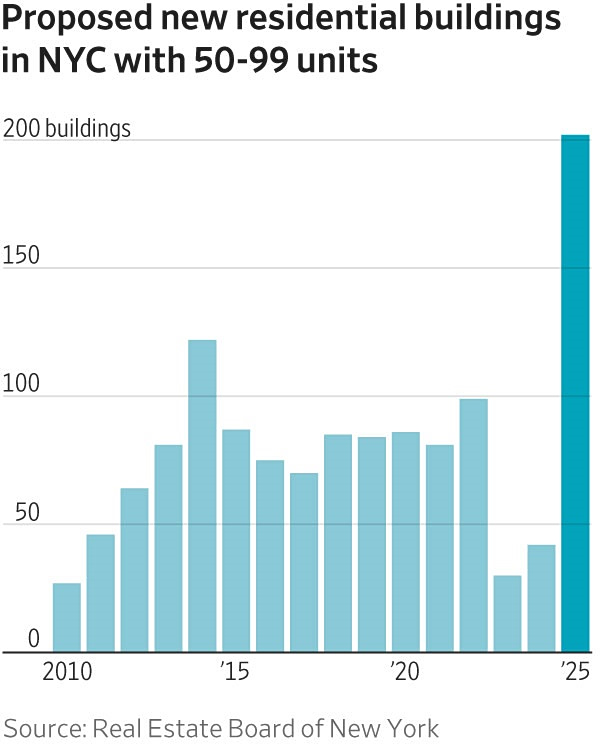
In 2025 alone, developers submitted 202 permit applications for buildings with 50 to 99 units, according to the Real Estate Board of New York, an industry trade group. That is roughly triple the average from 2020 to 2024.
Overall, at least 42 projects stitching together buildings with 99 units or fewer are in various stages of development across the city, permit data shows. These properties are concentrated in Brooklyn, the Bronx and Queens where it is easier to find large swaths of land.
It is all legal. But critics say this maneuver goes against the spirit of the new tax program, known as 485-x, which was enacted by the New York state legislature for construction projects in New York City.
Construction labor unions are lobbying New York officials to put an end to what they see as developers using sleight of hand to get big apartment projects done without paying workers more and adding more affordable units, which are for tenants making between 60% and 80% of the area median income.
“These are not really 99-unit buildings,” said Gary LaBarbera, the president of the Building and Construction Trades Council of Greater New York.
New York City’s Department of Housing Development and Preservation, or HPD, is in charge of implementing the tax program, but any change would require state government approval.
“We’re taking a very close look because we’ve heard these concerns about whether there are loopholes in the law,” said Deputy Mayor for Housing and Planning Leila Bozorg in an interview. “Right now, we’re not looking for changes to the program.”
A spokeswoman for New York Gov. Kathy Hochul said that “the state does not have a regulatory role” in the tax law but sees lowering home prices as a top priority.
Developers say they have long wrestled with the high costs of land, labor and construction in dense urban areas that make it difficult to make housing more affordable. Grappling with dire housing shortages, city officials across the U.S. have worked to cut red tape and offer tax incentives to spur the private sector to produce more units at lower costs.
The regulation is the strictest in a long line of New York City affordable housing tax programs. Previously, developers operated under a more lenient program that offered a tax break for affordable housing projects of fewer than 300 units without construction wage requirements. And their affordable apartments were allowed to fetch higher prices.
Real-estate developers and investors said that—without opting for 99 units—the new tax program would make apartment development financially untenable in a city that desperately needs more housing. New York City multifamily construction starts were 38% lower in the first quarter of 2025 compared with the same period in 2024, before the new regulation was passed, according to data firm CoStar .
“It’s a joke,” co-CEO of real-estate brokerage Real New York Robert Rahmanian said of the regulation . Now, “all the developers we speak to, especially in Manhattan, say they need to limit themselves to 99 units.”
Even if a developer wanted to build a property with more than 99 units, they would struggle to find the investors and lenders to finance it. S3 Capital, a construction lender, has financed more than 50 projects intending to use the new law. None of them have been above 99 units.
“The numbers just don’t work,” said Matan Kurman, S3 Capital’s head of investments. undefined Developers recognize that building large apartment complexes in small pieces comes with expensive redundancies. Each property has to have its own entrance, elevator shaft, emergency exits and lobby—a long list of repeat costs.
But compared to the extra rules for 100-plus-unit buildings, “it makes more economic sense,” said Jim Whelan, president of the Real Estate Board of New York. “You can’t expect folks to do things that are economically irrational.”
Write to Rebecca Picciotto at Rebecca.Picciotto@wsj.com and Peter Santilli at peter.santilli@wsj.com