In a stark warning to the world, the World Meteorological Organization (WMO) has confirmed that atmospheric carbon dioxide (CO₂) levels surged by a record 3.5 parts per million (ppm) between 2023 and 2024 — the largest annual increase recorded since tracing began in 1957. This jump pushes average global CO₂ concentrations to 423.9 ppm in 2024, locking in additional long-term warming and driving more extreme weather risks.
The average global concentration reached 423.9 ppm in 2024, up from 377.1 ppm when the bulletin was first issued in 2004.
The WMO warns that the continuing build-up of greenhouse gases is “locking in” additional warming and worsening the risk of extreme weather events worldwide.
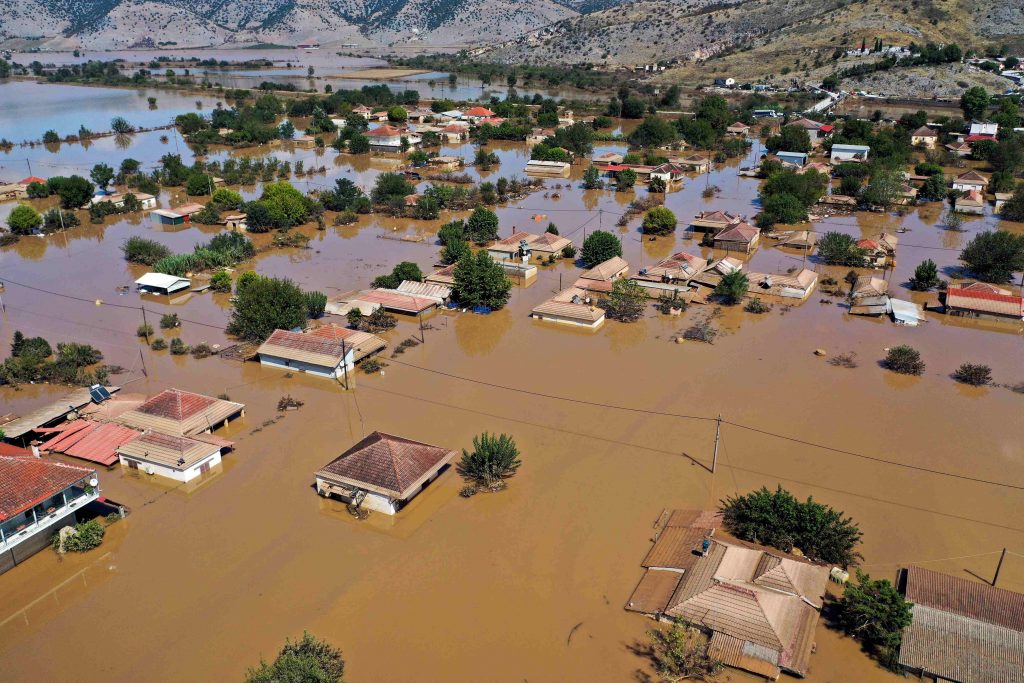
Flooded land in the Greek village of Vlochos, seven days after storm Daniel near Karditsa on Sept. 11, 2023. Photo: Nick Paleologos, SOOC
What’s behind the surge in CO2 levels?
The WMO attributes the record jump to a mix of human-driven emissions, widespread wildfire activity, and a decline in the planet’s natural ability to absorb carbon through land and ocean “sinks.”
Historically, about half of all CO₂ released from fossil fuel combustion and land-use change is absorbed by three sinks — forests, soils, and oceans.
But that balance is weakening as warming reduces ocean solubility and droughts stress vegetation, leaving more CO₂ in the atmosphere, says WMO.
“There is concern that terrestrial and ocean CO₂ sinks are becoming less effective, which will increase the amount of CO₂ that stays in the atmosphere, thereby accelerating global warming,”
said Oksana Tarasova, WMO senior scientific officer coordinating the bulletin’s research.
“Sustained and strengthened greenhouse gas monitoring is critical to understanding these loops.”
The year 2024, which was also the warmest year on record, was also influenced by a strong El Niño event, which tends to amplify global heat and suppress natural carbon uptake.

Image of coral bleaching. Credits: Reuters
Tripling of growth rates since the 1960s
The WMO notes that the pace of atmospheric CO₂ accumulation has tripled since the 1960s, rising from an average of 0.8 ppm per year then to 2.4 ppm per year between 2011 and 2020.
This long-term acceleration reflects how human activity continues to overpower nature’s capacity to stabilize the carbon cycle.
Other greenhouse gases also hit record highs
CO₂ levels are not the only new records.
The two other major long-lived greenhouse gases — methane (CH₄) and nitrous oxide (N₂O) — also climbed to unprecedented levels:
Methane: 1,942 parts per billion (ppb), 166 percent above pre-industrial levels
Nitrous oxide: 338 ppb, 25 percent above pre-industrial levels
These gases, though present in much smaller quantities than CO₂, are far more potent at trapping heat, multiplying the planet’s energy imbalance.
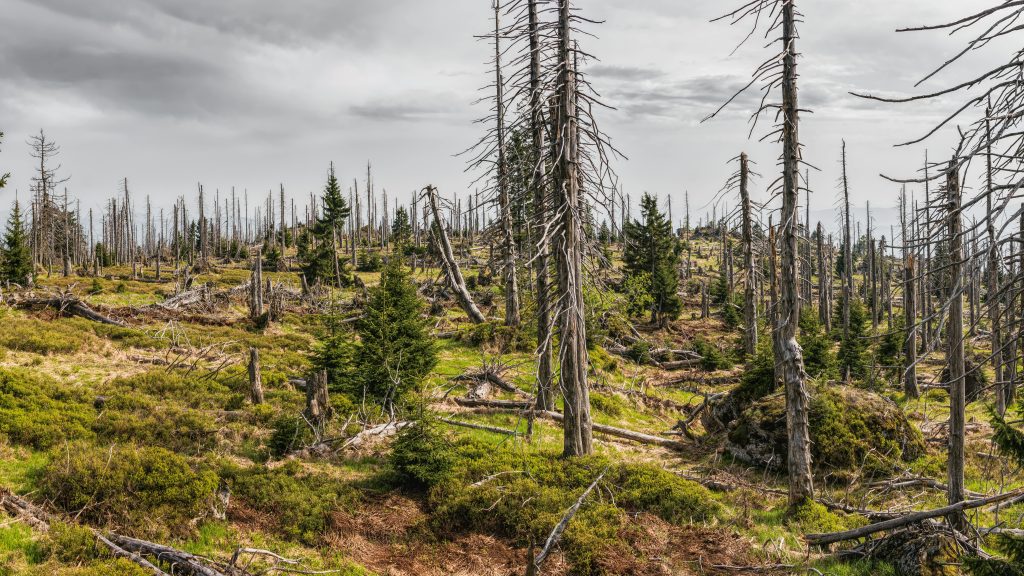
Image of dying pine tree forest. Photo by Kennst du schon die Umkreisel
A climate system under strain
“The heat trapped by CO₂ and other greenhouse gases is turbo-charging our climate and leading to more extreme weather,”
warned Ko Barrett, WMO Deputy Secretary-General.
“Reducing emissions is therefore essential not just for our climate but also for our economic security and community well-being.”
Scientists caution that unless emissions decline sharply, the world risks self-reinforcing climate feedbacks — where weakened carbon sinks, rising temperatures, and ecosystem disruption feed one another.
Monitoring ahead of COP30
The WMO published its bulletin ahead of COP30, the next UN Climate Conference scheduled for Belém, Brazil, in November 2025.
The agency emphasized that sustained global greenhouse gas monitoring is vital for tracking progress toward climate goals and guiding national action plans.