The Atlantic Meridional Overturning Circulation, or AMOC, is a system of currents that carries warm, salty water northwards into the North Atlantic. There, the water releases heat, cools, becomes denser and sinks, forming deep currents that flow southwards. In this way, the AMOC helps regulate climate patterns across the Atlantic and influences temperature, rainfall and atmospheric circulation.
Climate models have long projected that the AMOC is very likely to weaken during the 21st century. But they have disagreed widely on how much. Recent scientific projections, known as the SSP2-4.5 scenario which is the average of CMIP6 climate models, pointed to a slowdown of 32 ± 37% by the end of the century, compared with 1850–1900 levels.
The new study, published in Science Advances by Valentin Portmann, Didier Swingedouw, Omar Khattab and Marie Chavent, uses observational constraints to narrow that uncertainty. Its best-performing method estimates that the AMOC could weaken by 51 ± 8% by 2091–2100, which is around 60% stronger than the multimodel mean.
The authors link much of this correction to biases in climate models, especially surface salinity biases in the South Atlantic and sea surface temperature biases in the North Atlantic.
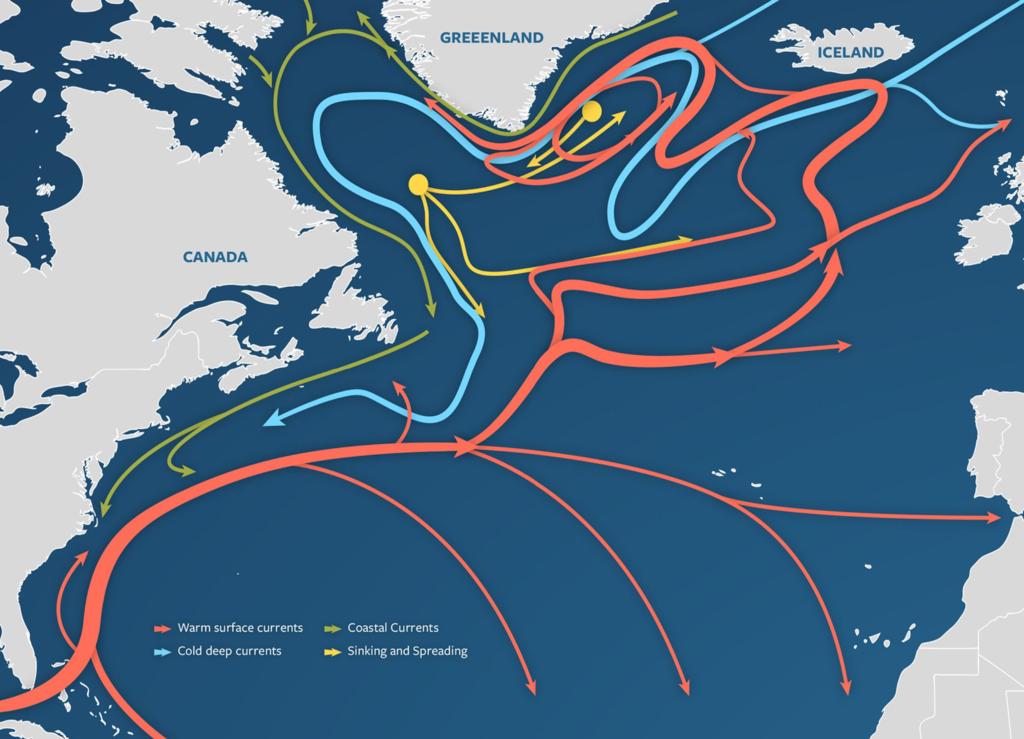
Illustration by Eric S. Taylor, © Woods Hole Oceanographic Institution
The paper does not say simply that Europe will become colder or hotter. Instead, it warns that a substantially weaker AMOC could significantly alter future climate projections.
Earlier modelling studies help explain what that could mean. Research in Climate Dynamics found that a large AMOC slowdown or collapse can produce widespread cooling across Europe, especially in winter, alongside broader changes to rainfall, river flows and vegetation productivity.
Other studies point to serious risks beyond temperature. Research on European hydroclimate has linked AMOC collapse with drier European summers and stronger drought pressure, while a Nature Food study found that an AMOC-collapse scenario could cause major disruption to arable farming and agricultural output in Great Britain.
The new study does not model a full collapse. But by projecting a far stronger weakening than previously expected, it suggests that governments may need to reassess adaptation plans for Europe and other regions affected by Atlantic climate shifts.