The oceans quietly power some of the world’s most important forecasting systems. They help scientists track marine heatwaves, predict storms, monitor fisheries and understand how climate change is reshaping the planet.
U.S. Government cuts funding for Ocean Monitoring
Now, concerns are growing among researchers after the United States began scaling back parts of one of its largest ocean observation networks.
The Ocean Observatories Initiative (OOI), funded by the U.S. National Science Foundation, operates more than 900 sensors across the Atlantic, Pacific, Arctic and Southern Oceans. According to the Associated Press, the network has received roughly $386 million in public investment since its launch and provides a continuous stream of data used by scientists around the world.
Funding cuts are now forcing parts of the system to be dismantled. The first removals are underway, raising concerns about the future availability of critical ocean observations.
The U.S. National Science Foundation has pushed back against suggestions that the program is being cancelled. In a statement, the agency said that “all previously collected OOI data will remain accessible through the OOI Data Center” and described the changes as part of a broader effort to adopt “a nimbler approach” to research infrastructure.
Several US-based oceanographers contacted by To Vima International Edition said they agree the system needed to be upgraded, but that they have no information on what will replace the existing sensors.
“The weather patterns off the coast of New England can change suddently and violently, and without these sensors and weather buoys, boats will have no idea what is coming at them,” added another researcher.
Meanwhile, researchers quoted by The Guardian warned that cuts to ocean-monitoring systems could leave the world “flying blind” at a time when climate risks are accelerating and demand for environmental intelligence is growing.
The issue extends far beyond the United States. Modern climate forecasting depends on a global network of satellites, buoys, research vessels and underwater sensors. Ocean data collected in one part of the world is routinely used by scientists and forecasting agencies elsewhere.
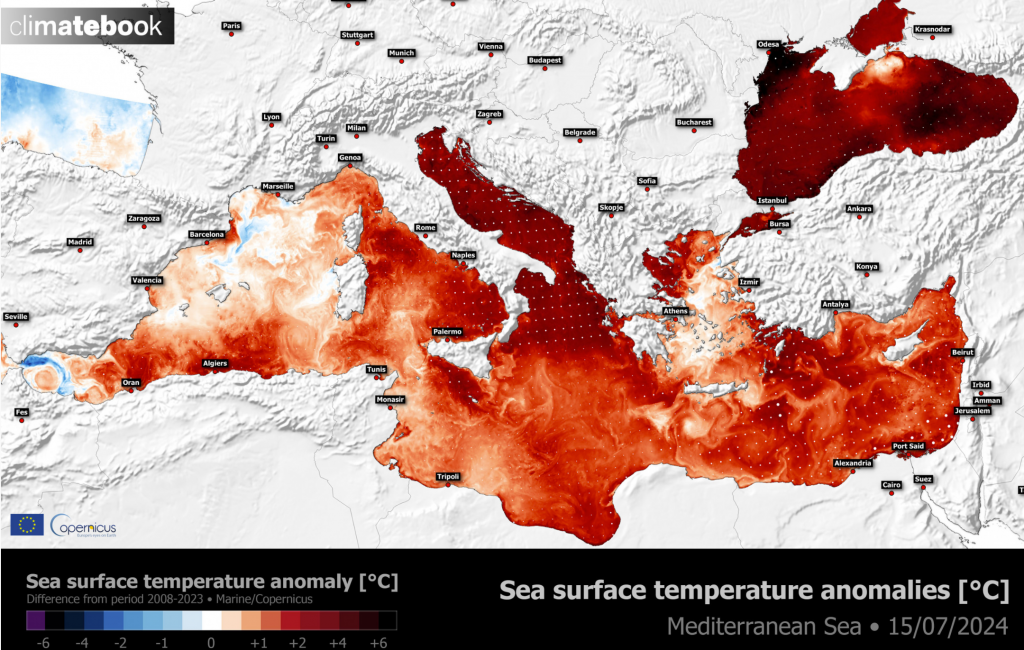
Data derived from Copernicus satellites and published by Climatebook.gr
Researchers warn that reducing observation capacity could affect understanding of ocean heat content, marine heatwaves and large-scale climate patterns and the tracking the slowing of the Atlantic Current. Those concerns come at a time when oceans absorb roughly 90% of the excess heat trapped by greenhouse gases.
Europe has been preparing a response
The European Union is investing €92 million in OceanEye, a new initiative designed to strengthen marine observation capabilities and reduce dependence on external data sources. Europe currently collects about 25% of the world’s ocean observations and aims to increase that share to 35% by 2035.
Announcing the initiative, European Commissioner for Startups, Research and Innovation Ekaterina Zaharieva said OceanEye would “unlock the full potential of ocean observation, supporting innovation and creating a more sustainable future for the planet.”
That being said, the efforts of the EU will not be enough to account for U.S. weather data going offline.
The debate is particularly relevant for Europe, Mediterranean countries and particularly Greece.
The Mediterranean is among the fastest-warming seas in the world. Rising sea temperatures have been linked to marine heatwaves, biodiversity loss, pressure on fisheries and growing risks for coastal communities. Accurate ocean monitoring is also increasingly important for shipping, tourism and weather forecasting.