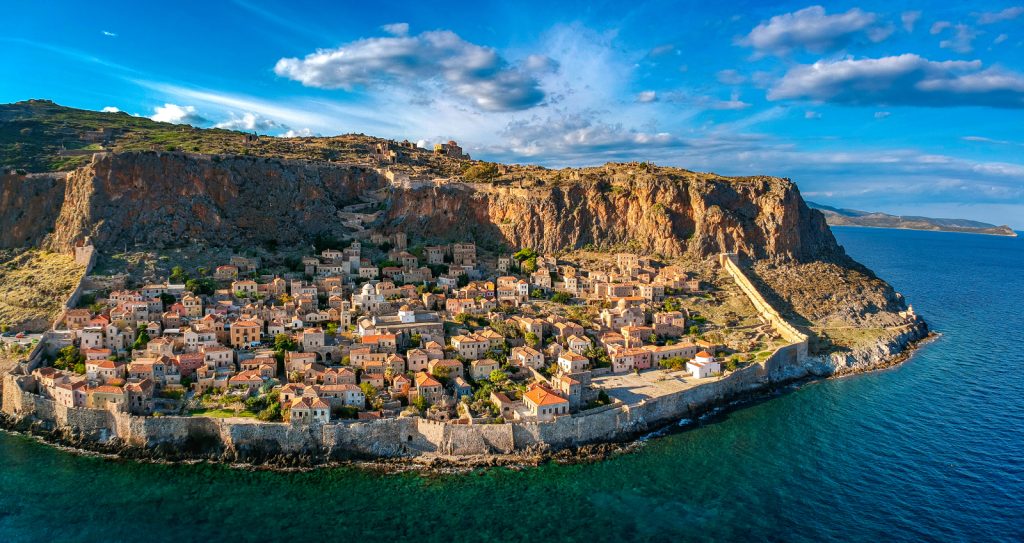
The medieval fortress of Monemvasia in Greece has once again drawn European attention, this time over concerns regarding the planned cable car project. Europa Nostra, the largest pan-European organization dedicated to cultural heritage protection, released a 41-page technical report highlighting potential risks the cable car poses to the site’s authenticity and its UNESCO candidacy.
Previously, Europa Nostra had identified Monemvasia as one of Europe’s seven most endangered monuments for 2025, largely due to the cable car project. The new report, titled “7 Most Endangered 2025 – Castle of Monemvasia, Greece – Technical Report”, carries the telling subtitle: “it will dominate aesthetically – while serving little practical purpose.”
Critique of Planning and Functionality
The report scrutinizes every aspect of the project, from approval decisions and budget allocations to tender procedures, environmental impact studies, timelines, goals, and maintenance projections. Experts argue there is no documented rationale for selecting the Rock of Monemvasia as the installation site, despite the Ministry of Culture citing accessibility as a strategic priority.
The report also highlights missing cost-benefit analysis, unclear justification, and absence of priority ranking, questioning the decision-making process behind the project.
Funding Concerns
The Monemvasia cable car project is funded through the Recovery Fund, under a measure linked to “art as prescribed therapy” and the “Silver Economy.” While such initiatives may indirectly promote social cohesion, the report notes they diverge from the project’s original objectives, which focused on mixed-use transport, fire prevention access, and transport of restoration materials.
Experts warn that the scale and impact of the cable car could jeopardize the strategic priority set by the Peloponnese Region to have Monemvasia inscribed on the UNESCO World Heritage List.
Field Research and Local Engagement
In July 2025, a Europa Nostra delegation visited Greece, held an open meeting in Athens with the Hellenic Society for the Environment and Cultural Heritage (ΕΛΛΕΤ), and conducted on-site inspections in Monemvasia. They also met with local residents and stakeholders. However, requests for meetings with the Ministry of Culture and the local municipality went unanswered, a point emphasized in the report.
Preserving Access vs. Heritage
The Monemvasia cable car controversy raises a fundamental question: how can modern accessibility needs be reconciled with the duty to preserve the authenticity of centuries-old monuments? Europa Nostra’s report sends a clear warning, but whether the Greek authorities will respond remains to be seen.