How much sound can the Herodion endure?
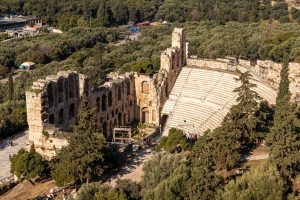
That is the question now being put to the monument itself. For the first time in its nearly 19-century history, the Odeon of Herodes Atticus—the Roman theatre at the foot of the Acropolis in Athens—will be given a “voice” through an original scientific study.
“The monument hears far more than we do,” said Dr. Ioannis Timagenis of the Acoustics Laboratory team during a recent presentation to Greece’s Central Archaeological Council. The research is being carried out under Professor Miltiadis Katsaros at the School of Architecture.
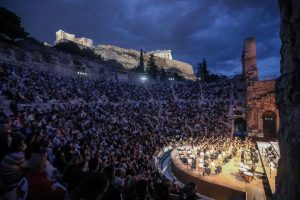
Until now, a sound limit of 90 decibels had been set empirically. But early findings reveal something striking:
the actual sound levels during performances are twice as intense on the sound scale as previously assumed.
And it’s not just about volume.
Researchers emphasize that continuous exposure—the constant “excitation” of the structure due to frequent use—is just as critical for the monument’s long-term preservation.
What the research is already revealing
Initial data show that the stage area reacts uniformly to sound sources. The next phase will focus on how the southern wall of the monument is affected by vibrations during performances, as well as by airborne noise.
The goal is clear:
to establish a regulatory framework that allows the Herodion to continue hosting events—without compromising its structural integrity.
A new face for a historic landmark
But the Herodion is not only gaining a “voice”—it is also set to gain a new face.
A three-year restoration project, scheduled to begin in mid-July, will significantly change both the monument’s appearance and how visitors experience it.
Today, the site is accessible mainly during performances as part of the Athens Epidaurus Festival (Greece’s flagship summer cultural festival). Once the works are completed, the Herodion will be open to the public more broadly, like other monuments on the Acropolis hill.
Hidden mosaics to re-emerge
One of the most exciting developments:
the mosaic floors of the stage building, long hidden from public view, will be revealed again.
These mosaics are known only to archaeologists through a handful of photographs, as they were covered after excavation. Once restored, they will be:
- Protected under shelter
- Accessible to visitors during the off-season (November–April), when no performances take place
What will change visually
The transformation will also be visible to the naked eye:
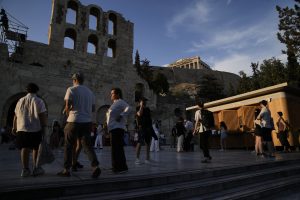
- All modern additions (ticket booths, bars, shops) will be removed
- The entrance plaza will be expanded with a 30-meter-long balcony that doubles as seating
- Visitor facilities will be relocated beneath it, creating a new gathering hub
- Access will improve, especially from the currently underdeveloped southern grove
Additional upgrades include:
- Five new rows of seating at the edges of the upper tier
- Removal of unsightly lighting scaffolding, replaced by a unified semicircular structure
- Restoration of the stage floor
- A second exit at the upper level leading to the Acropolis promenade
- A new drainage system