Although Christmas films have never really been part of Greek cinema tradition, things have been changing in recent years. Two years ago, actor Yiannis Tsimitselis made a notable directorial effort with the film Kourabiedes apo chioni, while this year one of the most promising Greek releases of the festive season is Ta Kalanta ton Christougennon, the personal vision of its screenwriter and lead actor, Loris Loizidis.
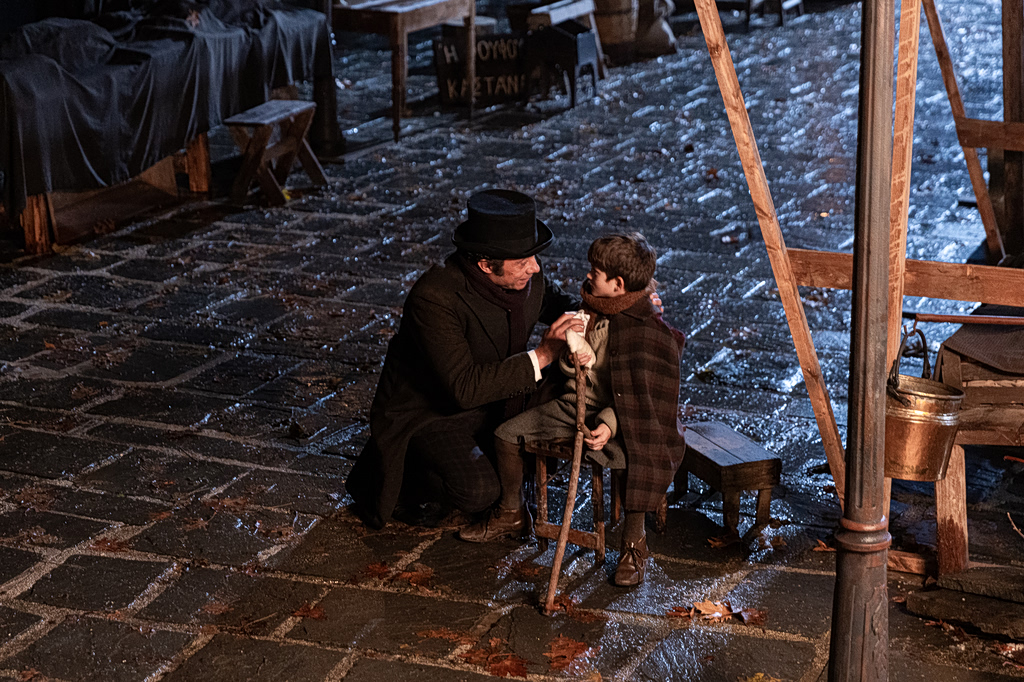
Directed by Christos Kanakis, the film is a variation on Charles Dickens’ 1843 novel, A Christmas Carol, with Loizidis playing the miserly Lykourgos — another version of Ebenezer Scrooge — who gradually changes after a series of strange encounters lead him to understand life’s true values.
Speaking to To Vima, Loizidis said that while writing the script his goal was to bring the viewer to the point of feeling transported to another era and briefly becoming a child again, yet at the same time realizing that “they’re not watching something old but something modern, seen from a different angle. Above all, I want them to leave the cinema full of emotion and carrying the messages they should.”
As for what he wanted to bring to the character of Lykourgos as a performer: “Apart from ensuring no one realizes that the protagonist isn’t actually an 80-year-old but a young man, I wanted him to be more grounded and authentic — from the beginning all the way through his transformation.”
A difficult equation
For Christos Kanakis, A Christmas Carol was an exceptionally demanding undertaking — from the period costumes and sets to the obligation to honor Dickens’s classic tale, which has been adapted for the screen (and well beyond) countless times.
“I had to faithfully preserve the atmosphere and spirit of the 1900 era, while also maintaining elements that convey a Greek identity,” the director told To Vima. Together with the rest of the team, Kanakis decided that the film would on one hand remain true to its historical framework, but on the other — precisely because this is a fantasy tale — there was room, perhaps even a duty, “to incorporate additional elements that would give it a more magical, familiar and contemporary tone.
This balance between respect for the original and creative freedom, between English tradition and Greek sensibility, was by far the greatest challenge — but also what made the film’s journey truly exhilarating.”
Equally enthusiastic about this creative journey is the Greek actor Giannis Bezos, who plays one of the ghosts crucial to Lykourgos’s transformation. “Whenever you take on the role of a ghost, the real challenge is giving substance to something that existed in the past but is no longer there. Of course, we should say that all this happens under the sign of comedy,” Bezos told To Vima.
“For me it was a very entertaining and revealing experience, and I have to say — because good work deserves recognition — that the way the shoot was conducted was more than excellent in every respect.”
Northern Greek villages set the background
The film’s producer, Marinos Charalambous, told To Vima that location scouting from the outset focused on villages and towns in northern Greece, because winter is always more pronounced there. “Our film is set at Christmas, so the landscape of the outdoor scenes had to evoke an authentic winter atmosphere effortlessly,” he said.
“A second key requirement concerned the era in which the story unfolds — the fact that the film is a period piece set around the early 20th century. Once again, we needed places that could, with the right production design interventions, convincingly appear as villages or small towns of early-1900s Greece.”
For Charalambous and his team, Zagorochoria proved the ideal choice. “Beyond the stunning landscapes and picturesque villages, the local communities embraced the entire effort and supported the production in every way, creating a warm and highly collaborative environment.”
Production designer Liza Tsouloupa worked in the same spirit, pointing out an important detail: “At the time when this tale is set, Christmas in Greece wasn’t celebrated the way we know it today.” That alone became her biggest challenge: “A Greek Christmas film without the classic Christmas décor.”

A sense of magic, achieved naturally
This, of course, worked hand in hand with the film’s audiovisual effects, which, though essential, were never meant to dominate. “From the beginning we decided we didn’t want to rely exclusively on CGI,” said Kanakis. “We tried to create as many effects as possible practically, within the shoot itself.”
The director refers to small lighting tricks, mechanisms and production-design elements that allowed the team to create “a sense of magic in a natural way. It gave the film a materiality and authenticity we felt were necessary for the world of the story.
Visual-effects technology helped us only where needed — to expand that world, enrich it or make it more supernatural, without losing the era’s atmosphere. Digital effects functioned as complements, enhancing the fairy-tale element without overpowering it.”
The music was also a challenge. “Even before I saw the first edit, I had looked at photos from the shoot and was struck by the film’s aesthetic,” composer Mikes Bilis told To Vima.
“It was clear that there was a very strong visual universe. And yes, everyone more or less knows the story — but I didn’t want to linger solely on ‘the bad Lykourgos’.” Bilis tried to approach the character from a different angle. “I wanted to look at how this man began, and how a pure child can be shaped by life into someone lonely, stingy and misanthropic…
That was my guiding thread. The whole score moves along a fine line balancing humor, darkness and love — making you feel that something is always suspended in midair, yet beneath it all there’s a quiet, steady heartbeat.”
INFO: The film, titled, Ta Kalanta ton Christougennon is now playing in most Greek cinemas (Feelgood Entertainment).