A major restoration effort has brought renewed attention to one of Greece’s most imposing Bronze Age sites following restoration work on the southern gate and part of the Cyclopean walls of the Gla citadel, in south-central Boeotia (Viotia) prefecture, due north of Athens.
Perched above the northeastern edge of the drained Copais (Kopaida) Lake basin, Gla has long stood as a testament to Mycenaean engineering and ambition. Dating to the 13th century BC, the vast fortified complex once functioned as a powerful administrative and economic hub, closely tied to the region’s large-scale drainage works, considered today as an advanced feat that transformed marshland into arable terrain.
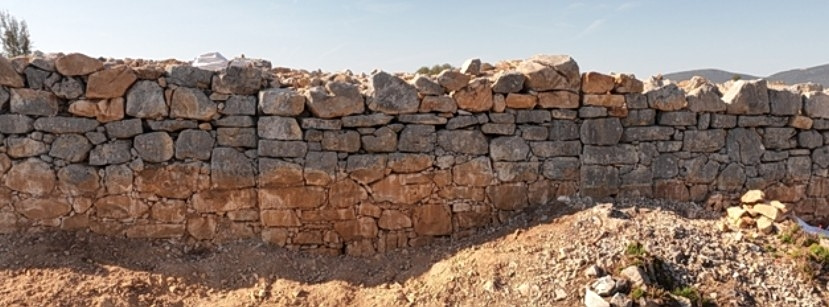
The latest restoration, carried out by the culture ministry’s directorate of prehistoric and Classical antiquities, forms part of a broader plan to enhance the site’s accessibility and historical legibility. By stabilizing the southern gate and sections of the massive Cyclopean fortifications—so named for their enormous stone blocks—the project not only improves structural safety but also allows visitors and researchers to better understand the citadel’s original form and function.
In a statement, Culture Minister Lina Mendoni said the works began in 2022 with 2.5 million euros in funding from the Recovery and Resilience Facility. She emphasized that the goal extends beyond preservation, namely, to reconnect Gla with the natural and cultural landscape of the area and present it as a unified, visitable archaeological site. The project, she added, represents a significant achievement in both scientific and technical terms, while also contributing valuable expertise for future restoration of Mycenaean monuments.
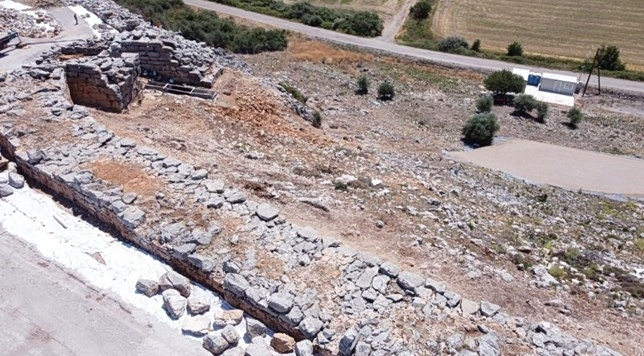
Gla itself remains unique in scale and character. Rising 20 to 40 meters above the flat plain, the rocky, triangular plateau spans roughly 50 acres), with steep slopes and a relatively level summit. Its position was no accident, as in antiquity, it formed part of a sophisticated network of embankments, sinkholes, and an artificial tunnel that drained excess water toward the Gulf of Larymna, integrating defense with hydraulic engineering.
Though the ancient name of the site was not recorded—ancient traveler and geographer Pausanias makes no mention of it—it survives today under the name Gla, also locally known as Palaikastro or simply “the castle.”