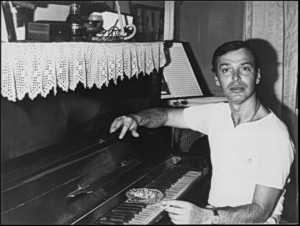
One of Greece’s most versatile and daring performers, showman extraordinaire Giorgos Marinos passed away this week, leaving behind a legacy of artistic freedom and inclusivity. He was 87.
For decades, Marinos captivated audiences with performances that defied convention. His shows blended satire, storytelling, song, and theater into a captivating mix of cabaret and stand-up comedy that became uniquely his own. With wit, finesse, and audacity, he pushed the boundaries of Greek live entertainment and redefined the country’s fledgling nightclub scene.

Beyond his artistic flair, Marinos was admired for his boldness and uncompromising nature. At a time when silence and stigma surrounded homosexuality in Greece, he was among the few public figures to speak openly about his private life. In interviews, he often said he felt a deep responsibility to appear with dignity and pride, representing a community that faced discrimination and exclusion.
Marinos was born in 1939, in the neighborhood of Votanikos in Athens, where he grew up with his mother. His passion for performance began early, a calling that would later lead to an artistic career spanning decades and multiple mediums, including theater, cinema, and television.
He collaborated with some of the most prominent figures in Greek culture, including composer Manos Hadjidakis, poet Nikos Gatsos, and beloved cinema and theater stars Rena Vlachopoulou, Dimitris Horn, and Maro Kontou. Marinos was also among the first entertainers to introduce live performance-style shows to Greek television.

One of the defining chapters of his career unfolded at the legendary Medusa nightclub, where he performed from 1973 to 1992. For nearly two decades, his nightly appearances transformed the venue into a cultural happening spot. There, Marinos’ electrifying performances blended humor, social and political commentary, and theatrical spectacle, drawing devoted audiences and reshaping Greece’s nightlife culture.
Throughout his career, he also supported and mentored younger performers, encouraging new talent and serving as a role model and inspiration for generations of entertainers who followed.
Away from the spotlight, Marinos lived quietly and was known for his deep love of animals. In his later years, he resided in a nursing home.
Reacting to his passing, Greek Culture Minister Lina Mendoni described him as “an emblematic artist who fully displayed his talent and was loved by the public like few others.”
“He generously gifted us with his talent,” she said, calling him “the first great Greek showman, an artist who uniquely combined acting, imitation, music, and song.”
Mendoni also highlighted his broader social impact, noting that Marinos was among the first public figures in Greece to speak openly about his personal life, helping challenge stereotypes and contributing to greater acceptance.
“We owe a lot to Giorgos Marinos,” she said. “We will always remember and honor him for his valuable contribution.”
With his charisma, courage, and singular style, Giorgos Marinos leaves behind more than a body of work, he leaves a legacy of artistic and personal freedom that changed Greek entertainment forever.