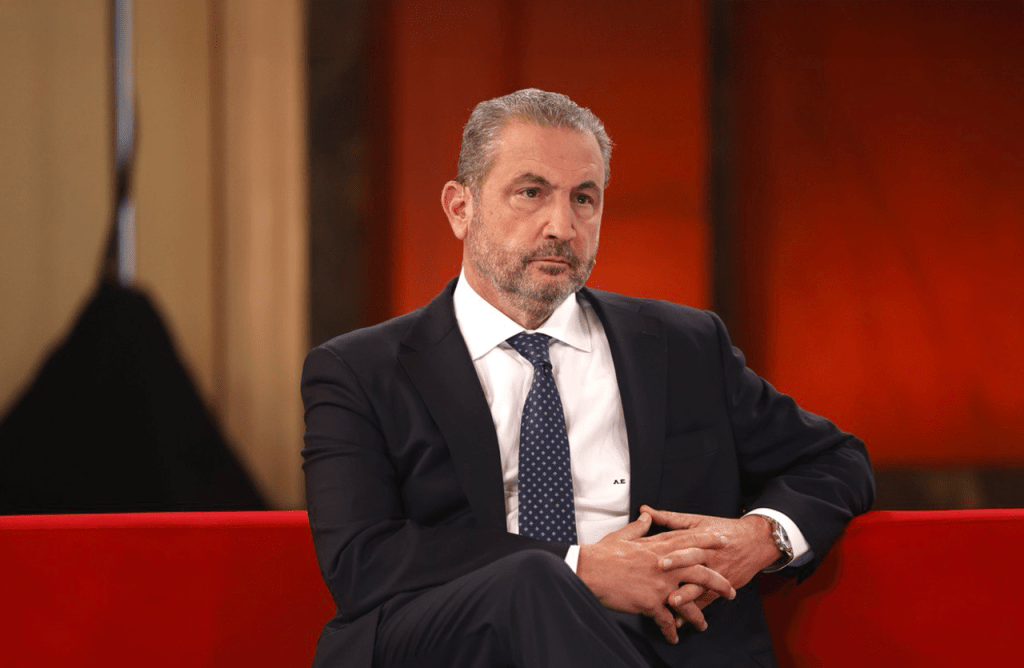
Speaking at the World Economic Forum in Davos, AKTOR Group Chairman and CEO Alexandros Exarchou delivered a forceful appeal for Europe to move faster on liquefied natural gas imports and cross-border infrastructure, warning that hesitation could undermine the EU’s planned ban on Russian gas from 2028.
Exarchou framed the debate largely as a strategic choice between U.S. LNG and Russian pipeline gas, arguing that once Russian supplies become illegal, concerns over price comparisons lose their relevance. His remarks come amid a more complex global LNG landscape, where multiple suppliers and shifting price dynamics are expected to shape the market over the coming years.
A Warning on Europe’s Credibility
Addressing a panel that included Greek Deputy Minister of Foreign Affairs Harry Theoharis, Romania’s energy minister Bogdan-Gruia Ivan and the U.S. Ambassador to Greece Kimberly Guilfoyle, Exarchou criticized what he described as contradictory signals from Brussels and some EU member states.
For years, he said, Europe made a deliberate choice to rely heavily on Russian gas, a dependency that became a strategic weakness after the outbreak of the war in Ukraine. While the EU has now decided to prohibit Russian gas imports starting in 2028, Exarchou questioned whether all member states truly act as if that decision is final.
“If sanctions mean that Russian gas will be illegal, then there is nothing to debate about price,” he said, calling on European governments to secure long-term LNG contracts while supply is available.
Is the Choice Really Binary?
While Exarchou emphasized U.S. LNG as the most viable alternative, global LNG markets extend well beyond a single supplier.
Price concerns, frequently cited by governments and companies, are also sensitive to timing. Market conditions later in the decade may differ substantially from those seen today, as new export capacity comes online and global supply expands. This broader context complicates arguments that frame Europe’s energy choices as a strict decision between U.S. and Russian gas.
What the IEA Sees Ahead
International Energy Agency projections point to a global LNG market that is set to expand significantly over the coming years. The agency notes that final investment decisions for new LNG projects accelerated in 2025, paving the way for a wave of additional supply and easing pressure on international prices over time.
By the end of the decade, around 300 billion cubic meters of new annual LNG export capacity is expected to come online, increasing global supply by roughly 50%. About half of this capacity is being developed in the United States, with a further share in Qatar, followed by Canada and other producers.
The IEA observes that LNG has increasingly become the dominant means of trading natural gas over long distances since Russian pipeline flows to Europe were curtailed. Europe is expected to absorb part of the new supply, alongside China, although the agency notes that demand growth in both regions may be tempered by continued investment in renewable energy, efficiency measures and, in some countries, nuclear power.
As additional volumes enter the market, a growing share of LNG is expected to flow toward more price-sensitive regions in South and Southeast Asia. Under current policy assumptions, the IEA projects that not all new supply will be immediately absorbed, leaving a modest surplus toward the end of the decade — a factor that could influence pricing and contract dynamics for importers.
In parallel, the agency cautions that future gas demand will also depend on the pace of the energy transition and on the industry’s ability to curb methane emissions, underscoring the range of variables likely to shape LNG markets in the years leading up to 2030 and beyond.
The Vertical Corridor Proposal
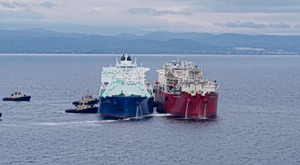
A central element of Exarchou’s intervention was his call for EU subsidies for the so-called Vertical Corridor, a gas transport route intended to move LNG imported through Greece northward into Southeast and Central Europe.
He argued that without public funding, key investments, including additional floating storage and regasification units and upgrades to existing pipelines, may not be completed in time. Without such infrastructure, he warned, Europe risks renewed dependence on Russian gas in the future if price becomes the dominant factor once again.
Greece’s Strategic Ambitions
The Greek government has positioned itself as a strong supporter of the Vertical Corridor. Theoharis said Athens has worked consistently to advance the project, emphasizing that energy resilience depends on diversification of supply and robust infrastructure.
He also linked future energy demand to the expansion of digital technologies and artificial intelligence, arguing that gas infrastructure remains strategically important even as Europe increases investment in renewable energy.
From the U.S. side, Ambassador Kimberly Guilfoyle reiterated Washington’s support for Greece as an entry point for American LNG into Europe, stressing the shared objective of reducing the continent’s reliance on Russian energy.
Exarchou’s Market Perspective
Exarchou’s intervention also reflects AKTOR’s growing role in the LNG market. Greece recently signed its first-ever long-term contract for U.S. liquefied natural gas, a deal described by officials as a milestone in the country’s energy relationship with the United States.
The agreement was signed by ATLANTIC – SEE LNG TRADE S.A., a joint venture established by AKTOR and state-owned DEPA Commercial, with U.S. producer Venture Global. The 20-year contract, which takes effect in 2030, will supply American LNG to Greece for onward distribution through the Vertical Corridor, linking Greece with Bulgaria, Romania and Ukraine.
Sources: ot.gr, IEA