Greece is set to join the group of countries with active hydrocarbon production prospects in 2026, as a series of exploration and energy deals begin to move from planning to execution.
Agreements signed in 2025, most notably the entry of Chevron into Greek offshore exploration and the expansion of ExxonMobil activities, are expected to deliver their first tangible results over the coming year. Together, these developments signal a new phase for Greece’s energy sector, spanning both upstream hydrocarbons and liquefied natural gas (LNG).
ExxonMobil Joins Offshore Exploration in the Ionian
One of the most significant recent developments is ExxonMobil’s entry into the offshore “Block 2” concession in western Greece. The exploration and production rights for the 2,442.1 square-kilometer offshore area were originally held by a consortium of Energean and HELLENiQ ENERGY.
Under an agreement signed in early November, ExxonMobil acquired a 60% stake in the concession, with Energean holding 30% and HELLENiQ ENERGY 10%. Energean remains the operator and will lead exploration activities.

If regulatory approvals proceed as planned, the first exploratory drilling is expected at the “Asopos” target between November 2026 and January 2027. The drilling is set to take place in waters around 850 meters deep, with well depths potentially exceeding 4 kilometers. Seismic data point to potential natural gas reserves of up to 200 billion cubic meters, though these estimates will need confirmation through drilling.
Chevron Expands Greece’s Offshore Footprint
Greece’s hydrocarbon prospects were further strengthened with the arrival of Chevron, another major U.S. upstream player. In partnership with HELLENiQ ENERGY, Chevron won exploration rights for four offshore areas: South Peloponnese, A2, South of Crete I, and South of Crete II.
Seismic surveys are expected to begin in the last quarter of 2026, in line with seasonal windows for offshore research. The initial phase will involve 2D seismic imaging across a total area of 47,000 square kilometers, equivalent to the combined size of the four blocks. Depending on results, more detailed 3D seismic surveys could follow in 2027, focusing on areas showing promising geological structures.
LNG Deals Add a Second Energy Pillar
Alongside upstream exploration, Greece is also advancing its ambition to act as a regional transit point for LNG into the Balkans and Eastern Europe.
At the P-TEC energy forum in Athens on Nov. 5–6, the consortium AKTOR – DEPA Commercial signed agreements to move natural gas through the so-called Vertical Corridor, a network of pipelines linking Greece with Balkan markets and Ukraine.

Second day of proceedings of the Partnership for Transatlantic Energy Cooperation (P-TEC) summit, at the Zappeion Hall, Friday, November 7, 2025. (Sotiris Dimitropoulos/EUROKINISSI)
Their joint venture, ATLANTIC – SEE LNG TRADE, signed a 20-year LNG sale and purchase agreement with Venture Global, starting Jan. 1, 2030. The deal provides for at least 0.5 million metric tons of LNG per year, with the option to increase purchases to about 1.5 million tons annually, and potentially more by mutual agreement. The LNG will be delivered to Greece and resold into Central and Eastern European markets.
This marks the first long-term LNG supply contract with a U.S. supplier in Greece’s energy history.
The Role of the Vertical Corridor
The effectiveness of these LNG deals depends heavily on the Vertical Corridor, which enables gas flows from southern entry points to northern markets.
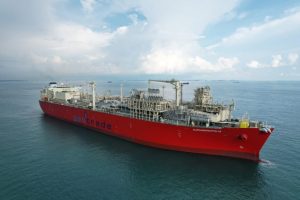
The corridor is already active. Metlen has delivered the first cargo of U.S. LNG to Bulgaria via the Alexandroupolis floating LNG terminal. The AKTOR–DEPA Commercial scheme is expected to follow, with initial LNG deliveries scheduled to arrive at Revithoussa or the Alexandroupolis FSRU in January under an agreement with Ukraine’s Naftogaz.
With the European Union moving to ban Russian gas imports, U.S. LNG is expected to play an increasingly dominant role in regional and European markets, placing Greece at the intersection of upstream exploration and downstream energy transit as 2026 unfolds.