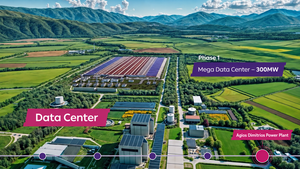
Greece is trying to establish itself as a regional digital hub for Southeast Europe and the Eastern Mediterranean, and investors are now racing to build the data centers that ambition requires. The pressing question is no longer how many projects will be announced. It is whether the country can supply the electricity to run them, and in the places where companies want to build.
A recent PwC study on data center siting in Greece maps the problem. The rise of artificial intelligence is driving a threefold to fivefold increase in the computing power required, according to the study, and new facilities could be up to 10 times larger than existing ones. A large conventional data center needs 20 to 50 megawatts, while facilities built for AI applications can reach hundreds of megawatts or even 1 gigawatt.
Greece had about 21 data centers in operation in 2025, with a combined installed capacity of just 44 MW. Of that, 34.1 MW was in Attica, the region that includes Athens. Investor interest now ranges from 1.4 to 2.2 GW, PwC says, and connection terms have already been granted for about 330 MW in Attica alone.
Attica attracts about 65% of that interest, thanks to its telecommunications infrastructure and proximity to major customers. PwC ranks the region first in investment appeal but only eighth in available grid capacity through 2034. Western Macedonia, Thessaly, Central Macedonia and Central Greece all have more room on the grid.
PPC and Amazon Web Services Look to Kozani
PPC’s planned complex in Agios Dimitrios, in the Kozani area of Western Macedonia, shows where the capacity is. PPC, Greece’s largest electricity company, is developing the project under a binding partnership with Amazon Web Services. The first phase calls for a 300 MW data center on the grounds of the old Agios Dimitrios lignite power station, with the potential to expand to 1 GW. The initial investment is 1.2 billion euros.
PPC also plans renewable energy and storage projects to power the hub. Including those, the company’s total investment plan in Western Macedonia is estimated at 5.75 billion euros.
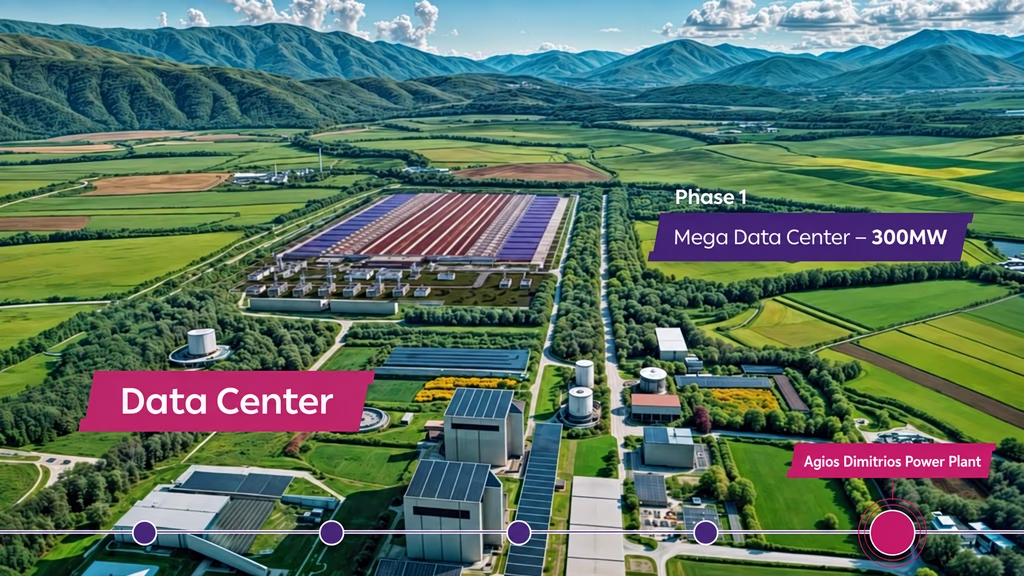
Western Macedonia offers existing energy infrastructure, technical expertise and, most important, the largest grid headroom of any region PwC examined, about 630 MW through 2034. The project could also open a new chapter for the region, long the center of Greece’s lignite mining and power generation and now moving beyond it, turning a traditional energy region into a hub of the digital economy.
In Attica, PPC and EDGEX are developing a facility with an initial capacity of 12.5 MW and the potential of reaching 25 MW. Microsoft is investing nearly 1 billion euros in three facilities in Spata and Koropi, where its first company-owned data center, rated at 19.2 MW, is under construction. In Paiania, Data4 is investing more than 300 million euros in two data centers that can draw up to 90 MW, and is weighing a third. In Spata, Dromeus Capital and Apto are planning a project worth 300 million euros, with 46 MW of capacity at full buildout.
The energy equation
According to PwC estimates, demand for data center grid capacity across Europe, the Middle East and North Africa will climb from 18 GW in 2025 to 58 GW in 2034. About 5 GW of that additional demand could be directed to Southeast Europe.
The capacity of Greece’s power system to support data centers could grow from 1.9 GW to 2.9 GW by 2034, according to estimates cited in the study. But much of that capacity lies outside Attica, where about 65% of investor interest is concentrated.
Whether Greece succeeds in attracting data centers depends on coordination with the Independent Power Transmission Operator (IPTO) and the Hellenic Electricity Distribution Network Operator (HEDNO), which run the country’s high voltage and local grids. It also requires investment in the networks, clear connection rules, competitively priced green energy and incentives to move projects outside Attica.
Source: TA NEA