 Μake us preferred on Google
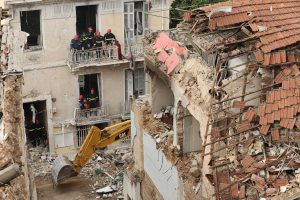
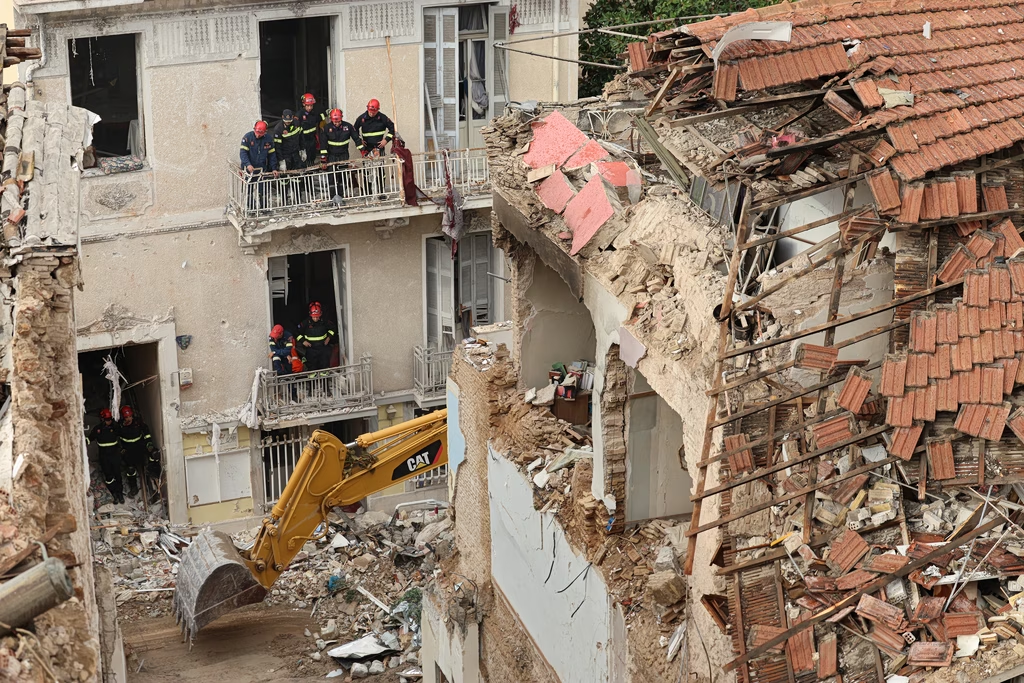
 A building in Plaka, one of Athens’ busiest tourist neighborhoods, was destroyed by an explosion that killed six people and caused enormous property damage.
Investigators are examining the natural gas installation on the second floor for a possible leak. According to experts, something as small as a spark or the flip of a light switch could have ignited the gas and triggered the blast.
Professor Dimosthenis Sarigiannis, an environmental scientist who serves as director and board chairman of the National Hellenic Research Foundation, told NEWS 24/7 that the familiar rotten-egg smell we associate with natural gas actually comes from tracer molecules.
Natural gas has no color or smell on its own, so these chemical compounds are added to it on purpose as a safety measure. Without them, people would have no way of smelling a leak, leaving them exposed to the danger of an explosion or poisoning.
For this reason, the professor advises anyone who notices the smell at home to report it right away. A leak from an individual natural gas boiler can quickly turn into a very dangerous situation.
He added that the tracer molecules themselves only cause discomfort. Scientifically speaking, they are mildly neurotoxic, and that effect is what people experience as discomfort.
What Greek Law Requires
Devices that detect a gas leak the moment it occurs do exist, but the law does not require them for every household appliance.
It is worth noting that the term “boiler” here also includes the separate water heaters many households add to other heating systems, such as heat pumps, to get hot water. In Greek, both are referred to by the same word.
Whether a safety system is mandatory depends on the boiler’s location and on the requirements set out in the installation’s approved technical study.
Boilers placed on balconies or other outdoor areas, such as semi-enclosed spaces, do not require a safety system under the regulations, because fresh air circulates naturally. Standard indoor kitchens with a window or an air vent are also exempt.
A safety system becomes mandatory, however, when the installation is in a basement or in an enclosed space that lacks proper natural ventilation.
Every indoor gas installation needs a technical study signed by a licensed engineer. The study must be submitted to and approved by the relevant Gas Distribution Company (EDA / Enaon) before the gas is connected. In it, the engineer lists the protective measures required for that particular space.
Certifications to Check For
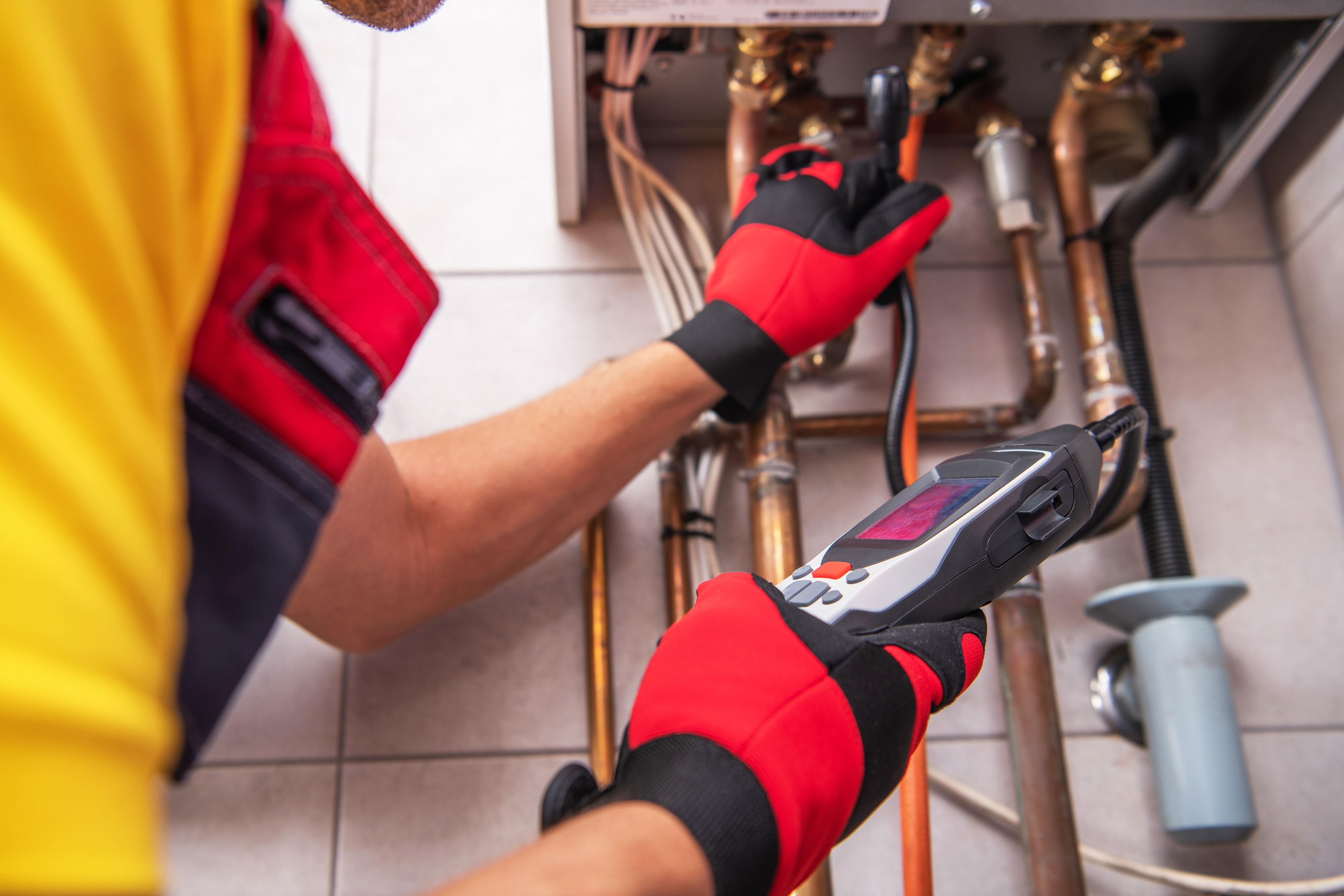
Gas leak detectors should be installed close to the points where a leak is most likely, and they must have two certifications.
The first is ATEX (ATmosphères Explosibles), which applies to continuously operating gas detectors in fixed home installations that run on electricity or batteries. ATEX is the framework for two major European Union directives on safety in explosive atmospheres. An explosive atmosphere is defined as a mix of air and flammable substances, such as gases, vapors, mists, or dust, that can ignite under certain operating conditions.
The EU warns that so-called “voluntary certificates” from unauthorized organizations are being sold on the market. Only designated “Notified Bodies” are allowed to issue valid certifications.
The second is EN 50194, the European standard for electrical devices that detect flammable gases in homes. It also applies to continuously operating detectors in fixed home installations powered by electricity or batteries.
Put simply, ATEX addresses how the equipment performs in an explosive atmosphere, while EN 50194 addresses how the home detector is built and how it works.
Expert Recommendations
Official organizations advise having a specialist inspect the installation once a year and setting up a complete system made up of two devices: a detector and a solenoid valve.
The detector goes near the boiler or stove and connects, either by cable or wirelessly, to the solenoid valve. The valve is fitted on the main gas supply line, typically beside the meter or where the pipe enters the building.
When the sensor picks up gas, long before it reaches explosive levels, it sets off a loud alarm and, on Wi-Fi models, sends an alert to your phone. At the same time, the gas supply is cut off automatically.
Safety rules require the valve to be a manual-reset type. Once it shuts because of a leak, it stays closed even after the air is clear. A technician has to inspect the problem, fix it, and then reopen the valve by hand.
How Much It Costs
The complete system costs between €60 and €120. Installation by a plumber or gas technician adds €50 to €100. Wiring the detector to the solenoid valve and connecting the power supply costs another €30 to €60, and this is usually done by the same technician.
For safety reasons, only a licensed gas installation technician may fit the solenoid valve onto the supply line.
Altogether, expect to spend between €130 and €220 for full protection.
Other Safety Options
Many Airbnb listings mention that the property has a carbon monoxide (CO) detector. These devices are installed in rooms with fuel-burning appliances such as boilers, fireplaces, or stoves, and they sound an alarm when they detect this invisible, odorless, and dangerous gas. Prices start at around €25.
Smart (IoT) detectors are another option. They connect to Wi-Fi or to a smart home’s central alarm panel and cost between €160 and €280, including installation. If a leak occurs while no one is home, they send an alert to your phone. They can also be set to cut power to specific outlets to prevent sparks, or to turn on a ventilation system.
For apartment buildings and commercial properties, central detection systems are available, along with multi-zone panels. These connect several sensors, placed in different apartments or areas such as basements and boiler rooms, to a single control panel.
Source: News247.gr