 Μake us preferred on Google
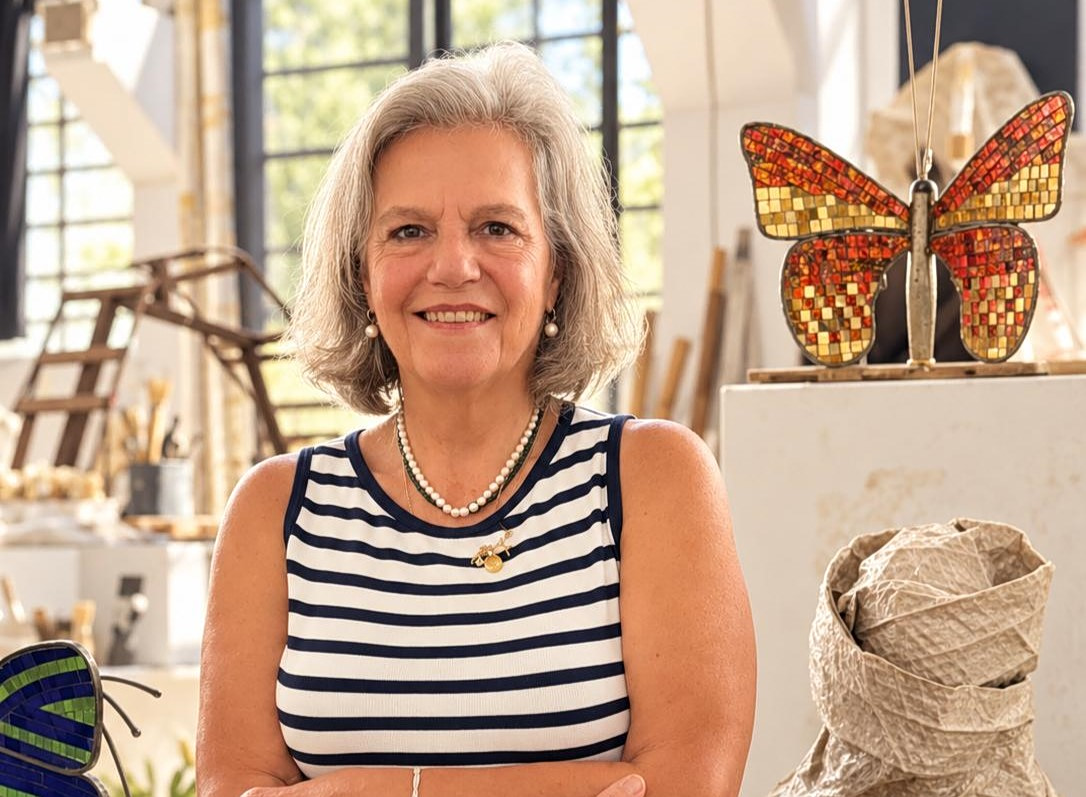
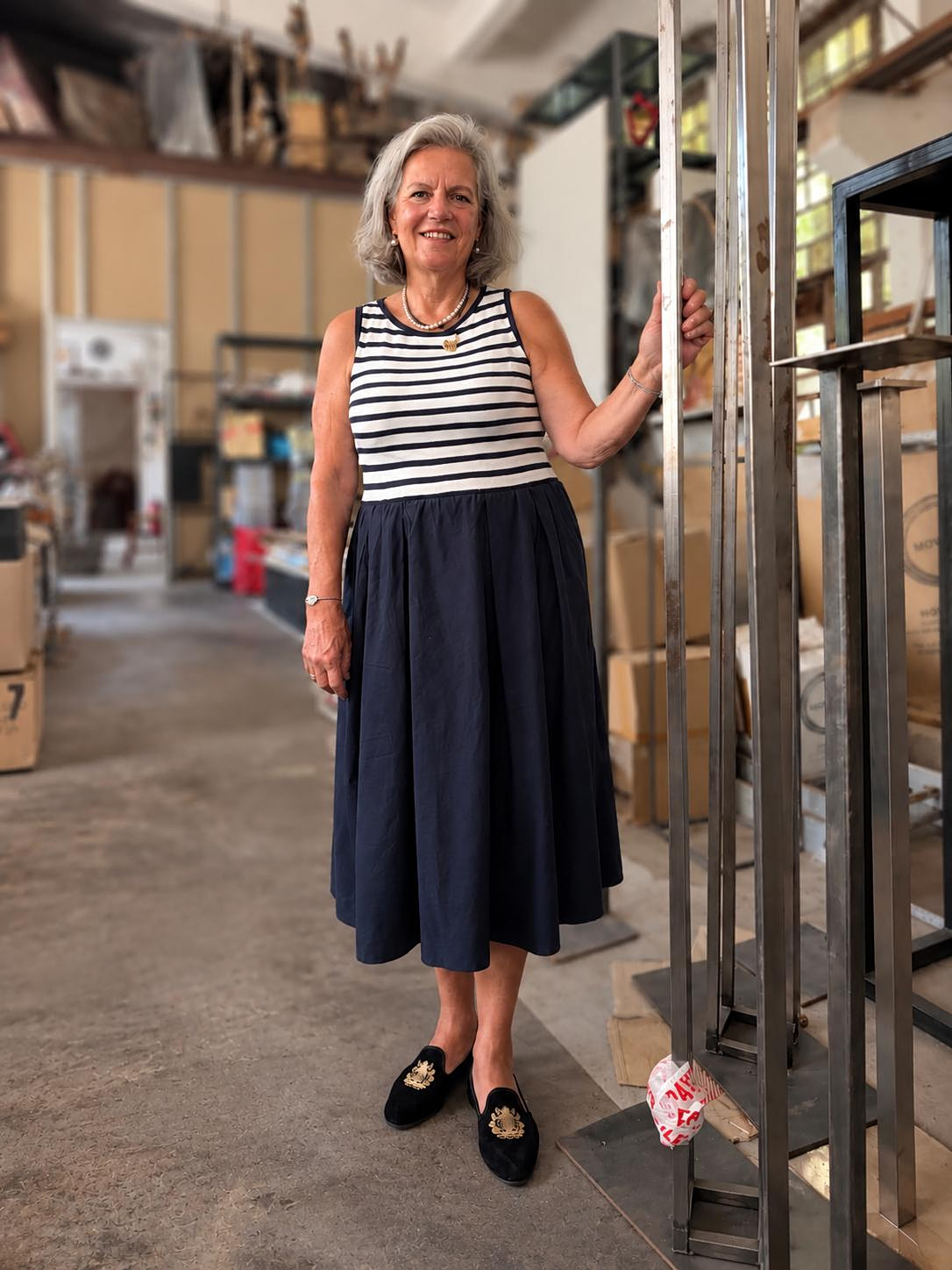
 In Afroditi Liti’s studio, it takes a while for the eye to decide where to linger. Sculptures, metalwork, birds, foliage, miniature figures—fragments of an oeuvre decades in the making coexist with works by George Lappas, the sculptor with whom she shared years of her life. Nothing seems arranged as mere décor to welcome a visitor, which may be why the space reveals so much about the people who lived and worked in it. There is a haphazard curation at play: a strange beauty that has emerged from use and time, from things that were moved around, set down somewhere, and ultimately stayed put.
Her hospitality has something of the generosity of the space about it. Chilled soft drinks, sweets, and delicious nibbles were already in place on the table when we sat down to talk on that beautiful September afternoon. The conversation lasted much longer than we had anticipated. It ranged back to her childhood and the first time she felt clay in her hands, moved on to Yannis Pappas, the National Archaeological Museum, and her teaching years, touched on Maria Callas, and returned once more to the trees, birds, insects and the constant curiosity that clearly continues to inform her work to this day.
At some point during this afternoon conversation of rare beauty, she remarks that she is able to connect moves whose rationale she hadn’t fully understood at the time. Perhaps the same is true of the things around us. At first glance, they look like traces of different eras and people. But as time passes, they begin to interconnect, revealing something of a life lived through art without ever considering it finished. After so many decades involved with sculpture, with studies and scholarships in Greece and abroad, exhibitions everywhere from Europe to the United States and China, awards and distinctions, a long tenure at the National Archaeological Museum, and over twenty years of teaching at the Athens School of Fine Arts, Afroditi Liti continues to work. In the end, this probably says more about her than any retrospective ever could.
PANOS KOUGIAS/TO BHMA INTL EDITION
– You have said you remember wanting to paint ever since you were very young. Looking back at your career today, do you feel you remained faithful to that initial impulse?
I didn’t betray the things that captivated me, not at all. Actually, I grabbed hold of them, tried to understand how they worked and get a handle on the very concept of art and what it means. That’s what I spent many years of my life doing. I’ve totally liberated myself from that issue now, and I’m very glad I have. I feel that I am at a different stage in my life.
And I’ve enjoyed the journey to get here. I’ve always adored sculpture. Perhaps because, as a child, visits to museums with my parents brought me face to face with devotional sculptures, with deities, with people who achieved greatness, with sculptural groups that existed somewhat beyond the human realm. They piqued my interest, and I’d examine them closely. These were demanding. You couldn’t easily figure things out or find answers. But eventually, something happens in your life, after a tremendous amount of work and endless searching, when you’ve stayed true to yourself—that’s critical. And I did keep the faith—I was dedicated to my quest. And I still am—more so, I’d say, than ever before.
Today, I can connect moves whose rationale I didn’t really understand when I made them. That’s what I wanted to do, so I did—it was as simple as that. But now, many of my questions are gradually being answered. It’s like I am writing my autobiography. The work contains all the facets of the course of human life, and especially my own: political and religious issues, human relationships, observations, and, above all, Man’s relationship with nature. Man is inseparable from nature.
– When did you realize that sculpture would be your path? Is there a specific moment you remember?
I remember it very well. Until then, I didn’t know that these “gods”—which is how I saw the sculptors who made these things—could also be human beings. When I entered the School, in the preparatory year, they told us a sculpture studio had been set up. I went down right away, and they had us model a head in clay. The armature was ready, and within an hour, I’d modeled the head of the person posing for us. The professor came over and asked me: “How many years have you been sculpting? How did you do that—just walk in and finish the head?”
PANOS KOUGIAS/TO BHMA INTL EDITION
I hadn’t known until that moment that I had it in me to become a sculptor. I used to paint constantly, incessantly, mostly subjects from nature. But from that very first moment on the preparatory course, I knew it would be sculpture I pursued. I learned amazing things from my teacher, Yannis Pappas, and I would attend the other teachers’ classes, too, whenever I could. I also attended the painters’ classes, always showed my portfolio, and had wonderful discussions with all the professors at the School. But I chose sculpture the moment I stepped into the studio for the first time.
– The human figure was fundamental to your training. What made you move away from a strictly anthropocentric sculpture later on?
I never really abandoned it. Rather, I think I was overexposed to the study of the human figure. So much so that, at a certain point, I changed tack. I wanted sculpture to be more than a study from life. There is so much going on in a sculpture, and I had to find my own personal idiom to be able to articulate these multiple elements. Following a short break after the School of Fine Arts, I made my leaf. I needed the works to be enormous, but I didn’t want their size to be intimidating, which is why I opted for fragmentation. Through the use of mirrors, I wanted them to bring the whole world inside themselves, to shine, to appear to be in motion, to have color, and include a leaf’s arterial pathways. I am still striving and experimenting.
PANOS KOUGIAS/TO BHMA INTL EDITION
– What still resonates with you today from the teaching of your professors at the Athens School of Fine Arts? What is still there in your work, even as a germ of an idea?
Structure. I’ve always liked there to be an immense structure within. The structure of man and the soul, of movements and thoughts. The things you take in, how you take them in and make them part of yourself, then how you express them. I don’t think you can create something powerful and personal without that. Besides, I view art alongside poetry, cinema, song, and music. It’s all one and the same for me. They all inhabit the same sphere. Now, I enjoy the luxury of being able to make my own readings. I am interested in the other side of things, the side someone else might not even notice. I might see it very clearly, and that might be the side I want to engage with.
– Did you have support from your family, as a child who showed such a strong inclination toward painting from so early on?
Let me tell you a story. I adored pictures. Back then, there were these really small cards showing paintings, and I was obsessed with them. I was about three and a half years old, and I knew where the money was kept in the house. I took it all, went to the shop that sold these pictures, and bought as many as I could. I went home, hid under the dining room table, spread the pictures out around me. I can still remember the pleasure I felt in the company of all those little angels, beautiful girls, couples, swings—images that evoked Watteau. Of course, I was discovered and they took me back to the shop to return the pictures. It was a punishment, but not a punishment meant to warn me off art and pictures. Quite the opposite. My parents embraced this love of mine. They started buying me books, which I adored.
PANOS KOUGIAS/TO BHMA INTL EDITION
From my earliest years at primary school, I remember the volumes from Melissa Publishing about the great painters. The works of Seurat and Van Gogh lived inside me—and they still do. I would sit for hours when I got back from school, looking at them, reading, and making up stories in my mind. After I turned eleven, my father would help me go out and paint landscapes. Initially, because I couldn’t go out on my own, he’d tell me to paint still lifes. Later, he would take me out with my easel, wait until I was finished, then take me back home. No matter the sun, the heat, or the cold—I painted day and night. But I did it because I liked it. My parents never told me to do this or that.
– Your work also displays a great sense of freedom with regard to your medium. Didn’t you ever want to confine your work to a single, recognizable form?
No! I never cared whether I’d be labeled a sculptor or something else. I wanted sculpture to break away from the stereotypes and move toward true art. Nor did I care whether I’d make any money or not. Research has been a lifetime endeavor. In the first critique ever made of my work, they told me: “My dear, these things just aren’t done anymore. It’s video, photography or nothing.” And I replied: “Come back in thirty years and we’ll discuss it. You’ll see then what it is I want to do.” I was twenty-two years old. I had a vision; I knew what I wanted, what I was seeking. But I never dwelled on people’s reactions. I wasn’t interested in words. It was actions I cared about.
– You worked for many years at the Archaeological Service and the National Archaeological Museum. How did that experience affect the way you viewed cultural heritage?
I believe luck has helped me tremendously in my life. Many times, something I’ve thought about which interests me has just appeared in front of me—and always after my initial thoughts have had time to mature. It was just such a stroke of luck that led me to the exams to become a museum sculptor, just as I was preparing to go abroad on a scholarship from the School of Fine Arts. My teacher, Yannis Pappas, told me to go and get a letter of recommendation from the museum across the street. There, they told me about the competition, and I ended up taking the exams. I’d already worked two or three summers on digs with the Archaeological Service, because I really loved the whole idea of it. At the same time, I had a passion for cultural heritage. In the School library, I’d read UNESCO pamphlets on monuments from all over the world and study how different countries approached and conserved their cultural heritage. Some were in Italian and, seeing how fascinated I was by them, my mother suggested I learn Italian so I could read them. I studied the language for five years and learned all the relevant terminology. Then luck struck again: the exam topic was something I knew inside-out. I passed and was appointed to the National Archaeological Museum. I already knew the Museum very well because I’d been going there for years to sketch the sculptures. Until that point, however, I had viewed them as an artist. Now I’d have to deal with them in a completely different way. And I decided that I wanted to devote myself to spotlighting cultural heritage.
– You also undertook significant initiatives for the National Archaeological Museum. What do you remember most from that period?
When I joined the Museum, a large part of it was closed. The prehistoric rooms and certain other sections were open, but many remained shut. Driven by my passion, I tried to get the entire Museum open to the public. I involved myself with the garden, the entrance, the floors—things that might seem self-evident today. But most of all, I focused on the Egyptian Collection. When I joined the Museum, Periklis Kourachanis, a young Egyptologist who had been put in charge of the collection, came to see me. He asked me to come and take a look at it. I told him: “I’m going to get the whole thing on display. We are going to open up the Egyptian Collection.” He replied: “The classical antiquities aren’t even open to the public, and we’re going to get the Egyptian artifacts on display! Really?” But I’d already formulated my battle plan. From studying the sculptures, my focus now was on studying how best to display them, so the public could see what I saw in them. Later, when I left for England on a three-year scholarship, I’d study the Egyptian collections wherever I went. On weekends, I would even go to the Louvre to study their Egyptian antiquities. In the meantime, Periklis Kourachanis died suddenly, at a very young age. I told myself I would see the collection exhibited in his memory. I drew up the plans, explained what I wanted, and was given the use of two large rooms, allowing for a highly significant presentation of the Egyptian antiquities. I swayed them, I think, with my argument focused on the profound connection between the Greek and Egyptian civilizations and everything that Greek culture owes to Egypt.
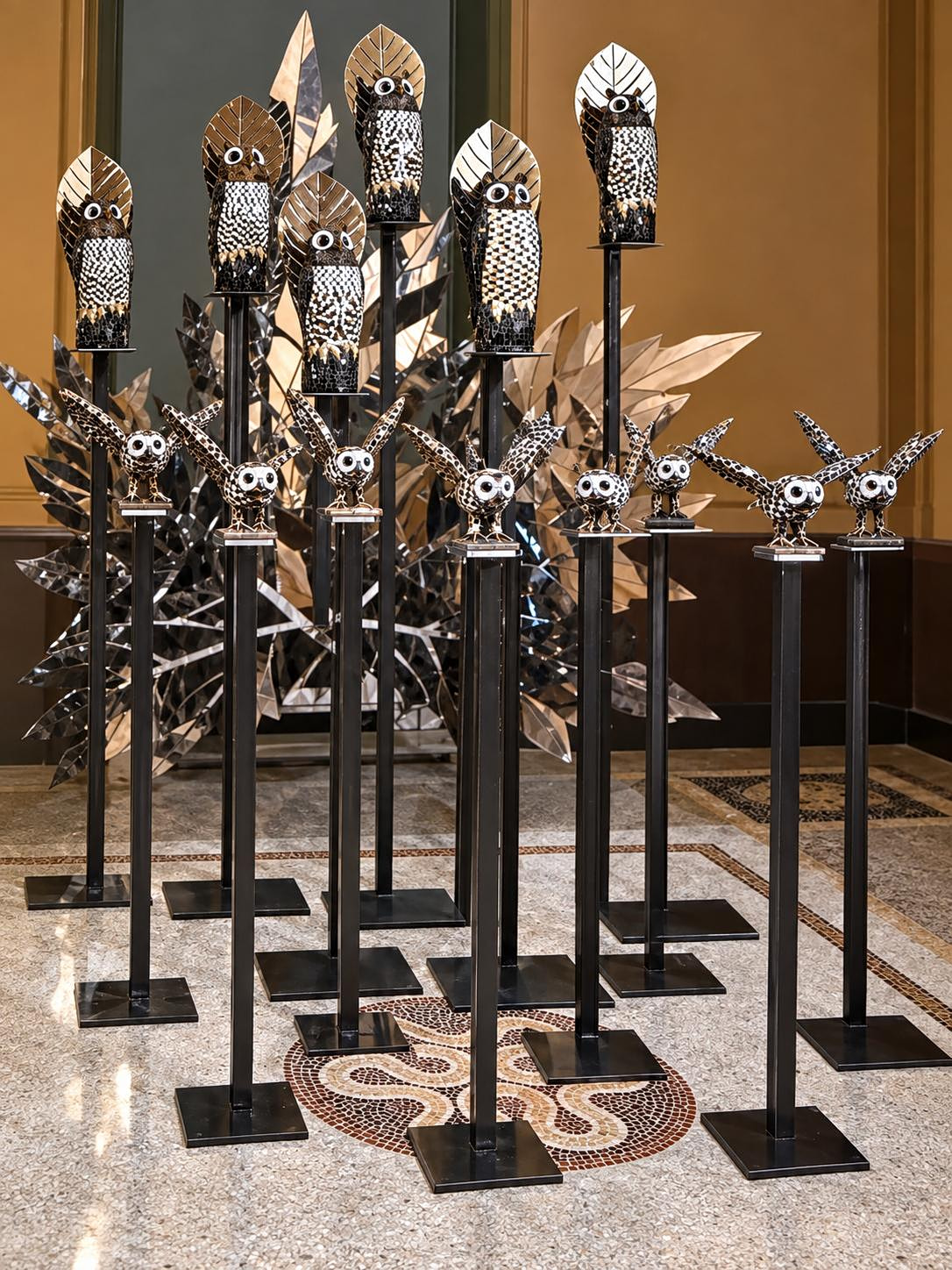
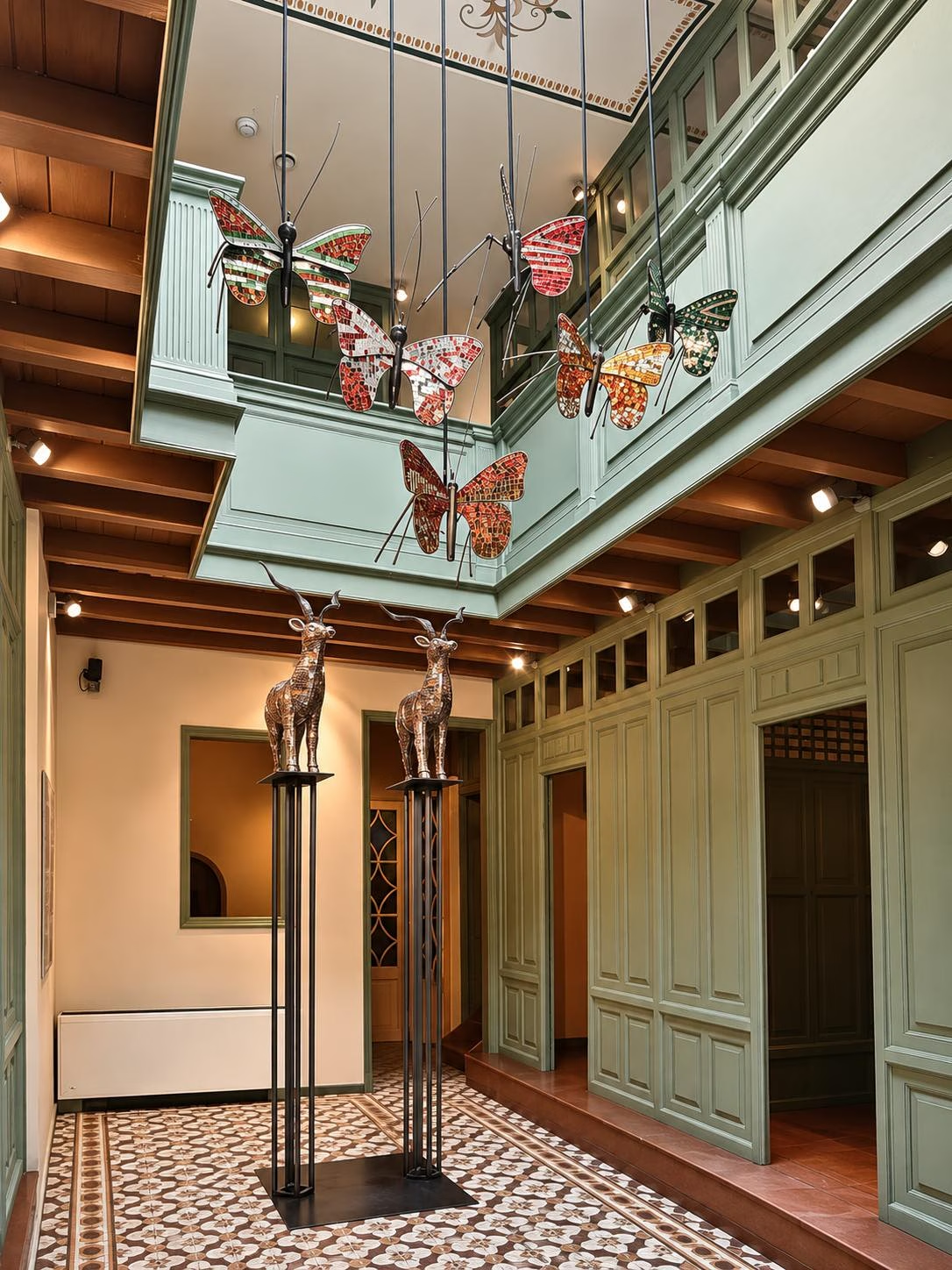
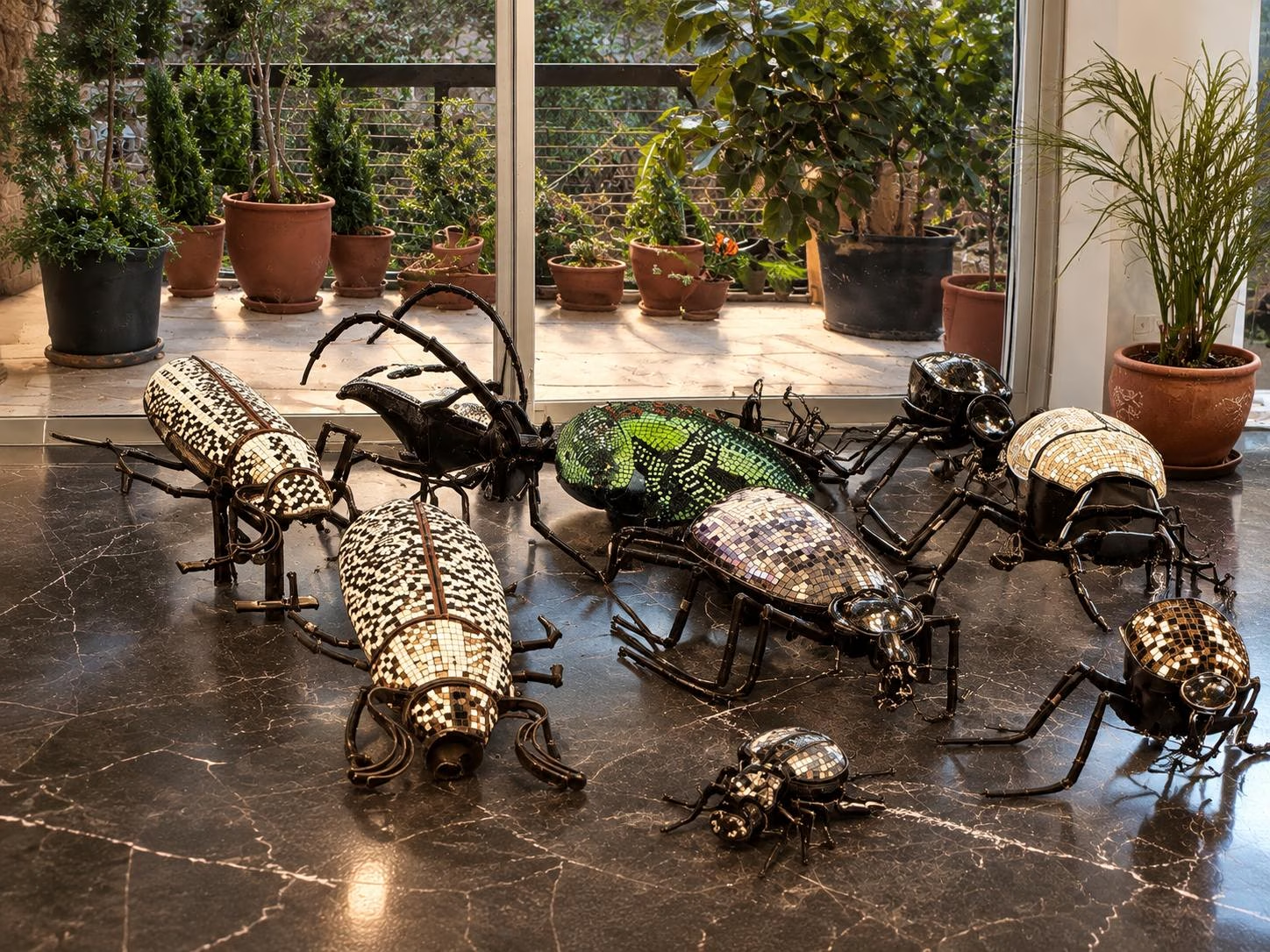
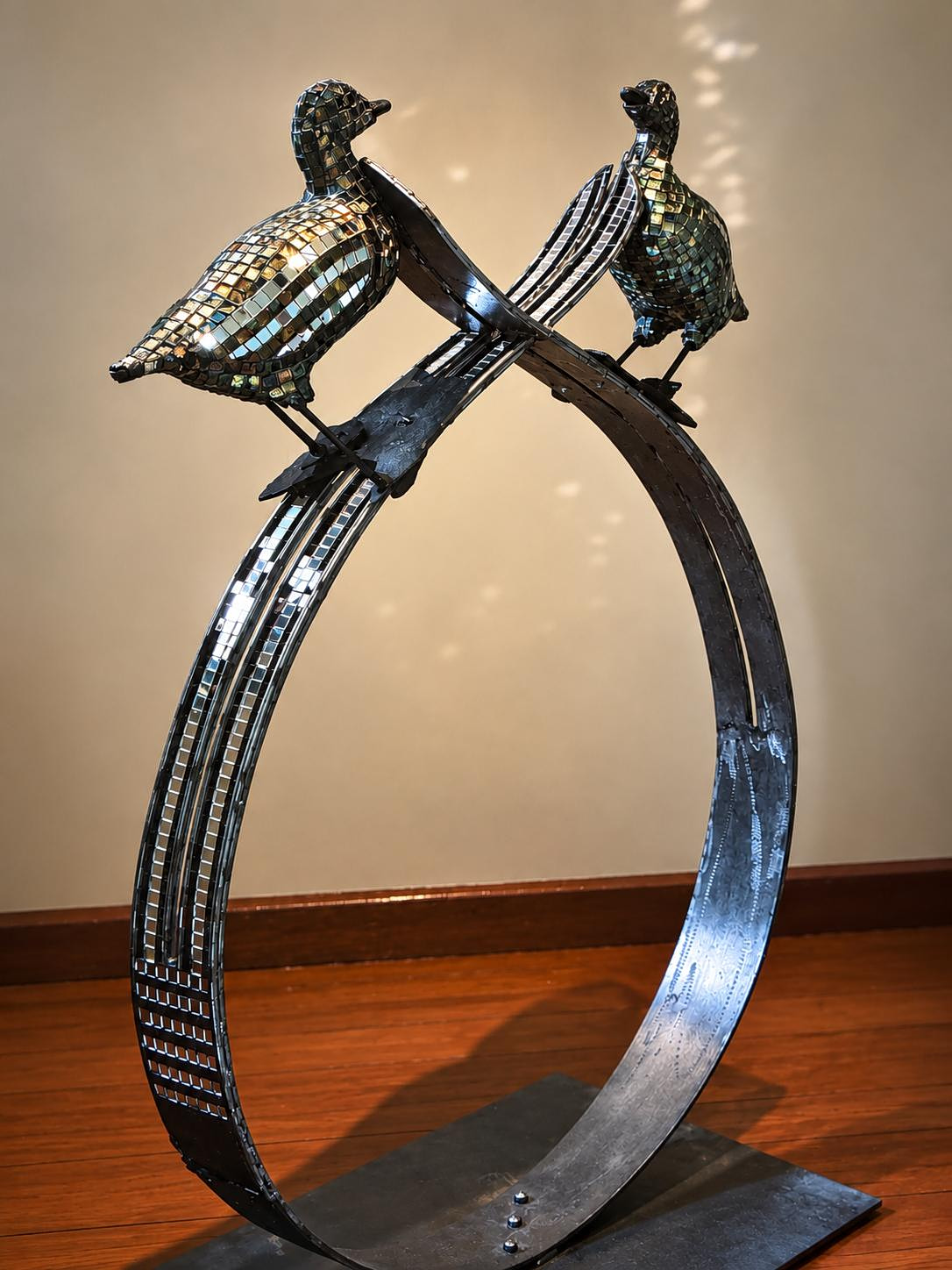
– Nature is forever showing up in your work: trees, fruit, leaves, birds, insects, lizards, owls. Why is Nature so important to you?
All those subjects are metaphorical. I use them as symbols to convey what I want to say. I am also very interested in archetypes. It is not simply that I happened on a leaf and made it. I convey things through its veins and pathways. Which gives me a very broad range of subjects I can speak through.
PANOS KOUGIAS/TO BHMA INTL EDITION
– What is it that inspires you in this symbolic representation of nature?
It’s as if nature comes up and offers me a gift. Like it’s telling me: “This is for you.” Nature comes to me, I don’t go to Nature.. That’s how I see it. All these things, aside from being spiritual, are deeply connected to sensation. A green bottle fly, for instance, can excite me so much with its iridescence that I seek out tesserae in that precise shade of green. You can’t explain these things easily. But you can make them. And we say insect, but what can it contain? The soul, the spirit, power, deities…everything. Things that are beyond human reach, but which we can still depict through certain images, in both sculpture and painting.
– You have worked with extremely diverse materials. How do you decide which material works best for a particular work?
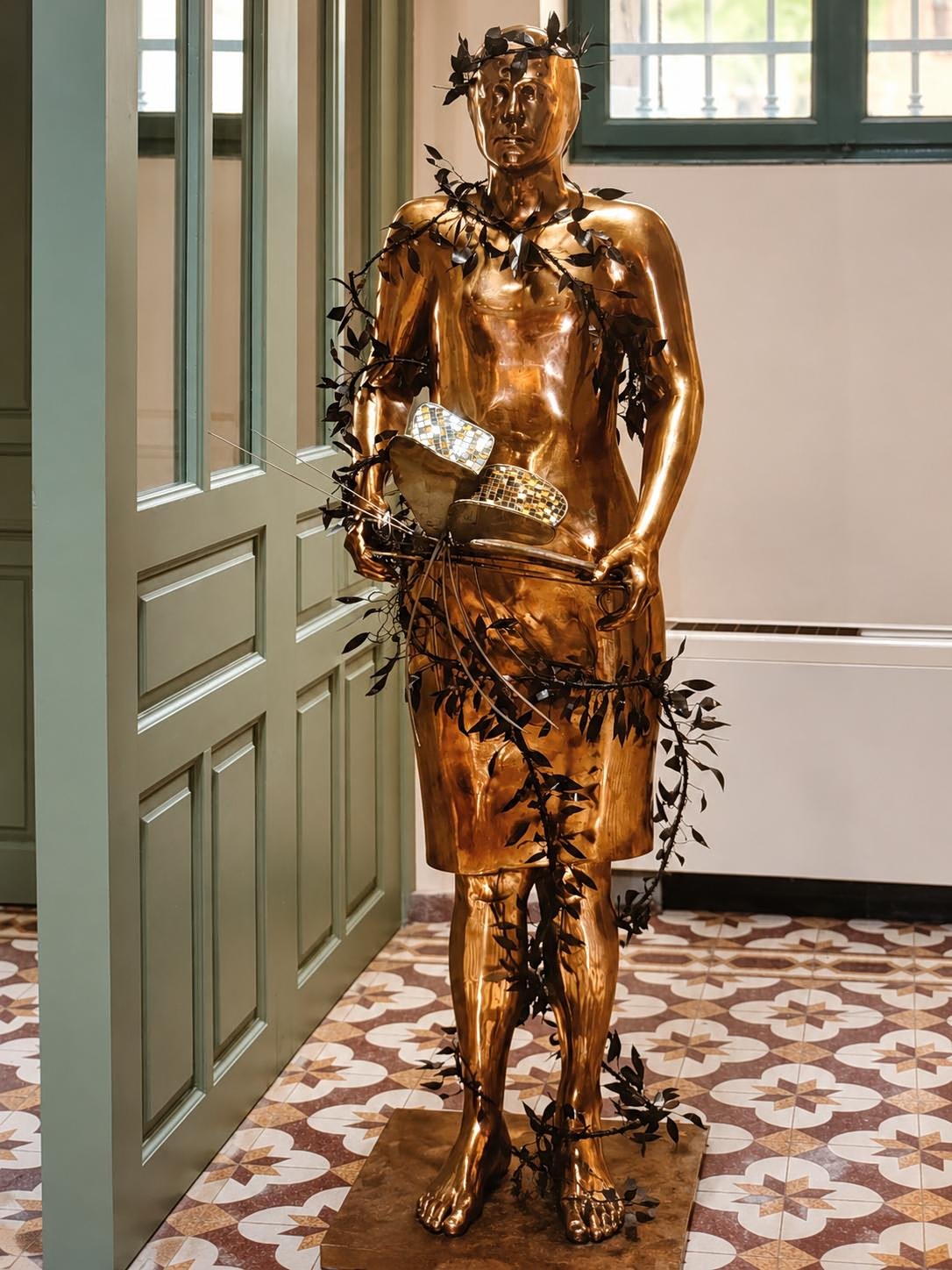
I like materials—all of them. When I was working on my first work, a feather with birds inspired by a favorite fairy tale, a craftsman who was watching me work said: “I’ve been working with metal all my life. I never even imagined such things could be made.” His observation made a tremendous impression on me. Because you realize you can make the slightest thing into whatever you want. The material makes it easier to say what you want. To me, all materials are like wax—they’re my plasticine.
– Is there a thread that runs through the entirety of your oeuvre from one period to another, or does each series start from scratch?
I can answer that today. I don’t think I could have in the past. It’s all one big work. My entire body of work is a single piece divided into sections. Like a book has chapters. That’s how I think of my work. I don’t know if I’ll have time to write the ending, but I’m enthusiastic enough to believe I’ll keep articulating things well as I near the end. Every time I finish a work, I think it’s time to wrap it up. But they just keep multiplying.
– You taught sculpture for more than twenty years at the Athens School of Fine Arts. What can a teacher impart to a young artist beyond technique?
We can help them ponder what art means by discussing it at every opportunity. We can initiate them into the mindset, into the quest to make art. We can point out ways of thinking, ways of looking, by urging them to keep their eyes open to artists and movements both old and contemporary, and to keep track of where things are heading. Teaching requires a lot of work. You have to be there with a method, with a system, so the student knows that what they’re doing is serious. The young people who come to you to learn are very responsible, and they can emerge from the experience as mature artists.
It’s up to teaching to give the youthful soul its wings. Young people come into contact with one another, form small groups, discuss, encourage each other, and strengthen their will to continue. Because it’s not easy. They measure themselves against each other, and this noble rivalry is very important: you see something, you admire it, and you say, “I’ll risk turning my own idea into art, too.” Creating a work of art isn’t easy. To take a song, a piece of lace, yourself and space and turn them into sculpture. To conceive them and attain the level of sensitivity needed to present them with ease. It takes hard work and patience.
PANOS KOUGIAS/TO BHMA INTL EDITION
I remember a student who had been at the School for many years and could never summon the courage to present her graduation piece. She kept telling me, “I haven’t got it yet, I can’t do it.” But she kept coming in and attending classes. One day, I saw her holding a camera behind her back. It was on, and an image was visible on the small screen. I told her to come so we could discuss her piece. When she came in, I said: “I think I can help you now. You’re going to talk to me about the line you see in the sea. You can do your graduation piece on horizons.” She was astounded. “I can’t believe it. How did you know?” she said. And she explained that she had been born in Khartoum and used to sit for hours by the sea staring at the horizons, and later, when they returned to Naxos, she’d go down to the sea again and look at the horizon across from her. She had been preoccupied with horizons her whole life long. So I told her: “Pick up your camera and get to work.” And she did an amazing job. That, for me, is teaching. There is no masterpiece that will just appear if you wait for it. Art is a constant effort.
– I would like us to dwell for a moment on the sculpture of Maria Callas, setting aside all the debate it sparked. What inspired you, and how did you approach such a legendary figure?
Her soul. I studied Callas extensively. The commission began with the Maria Callas Association. They invited me to do something, originally for the museum. Then they asked me to do the full figure, which is how we ended up with a full-length statue. I made a drawing—essentially what you see today—and it passed through the various municipal committees before being presented to the Central Archaeological Council (KAS). The initial proposal was to install it in the Odeon of Herodes Atticus, but I am against placing artworks inside monuments; it’s either a monument or it isn’t. Later, they suggested Roberto Galli Square. I didn’t even know it was called that. I went, saw it, and said: “Very nice, modest. It’s perfect.” There’s the Acropolis opposite. I wanted Callas to converse with the Acropolis. To be like a Kore. For that connection to exist. For me, this woman has all the grandeur of the world within her. There’s also the drapery. I studied El Greco a great deal and the way he handled folds. There is also a connection to the figures in the Byzantine church of Agia Sophia in Thessaloniki. I wanted it to have similar elements and, above all, to look toward the Acropolis. To guide the viewer’s gaze toward that ancient grandeur, too.
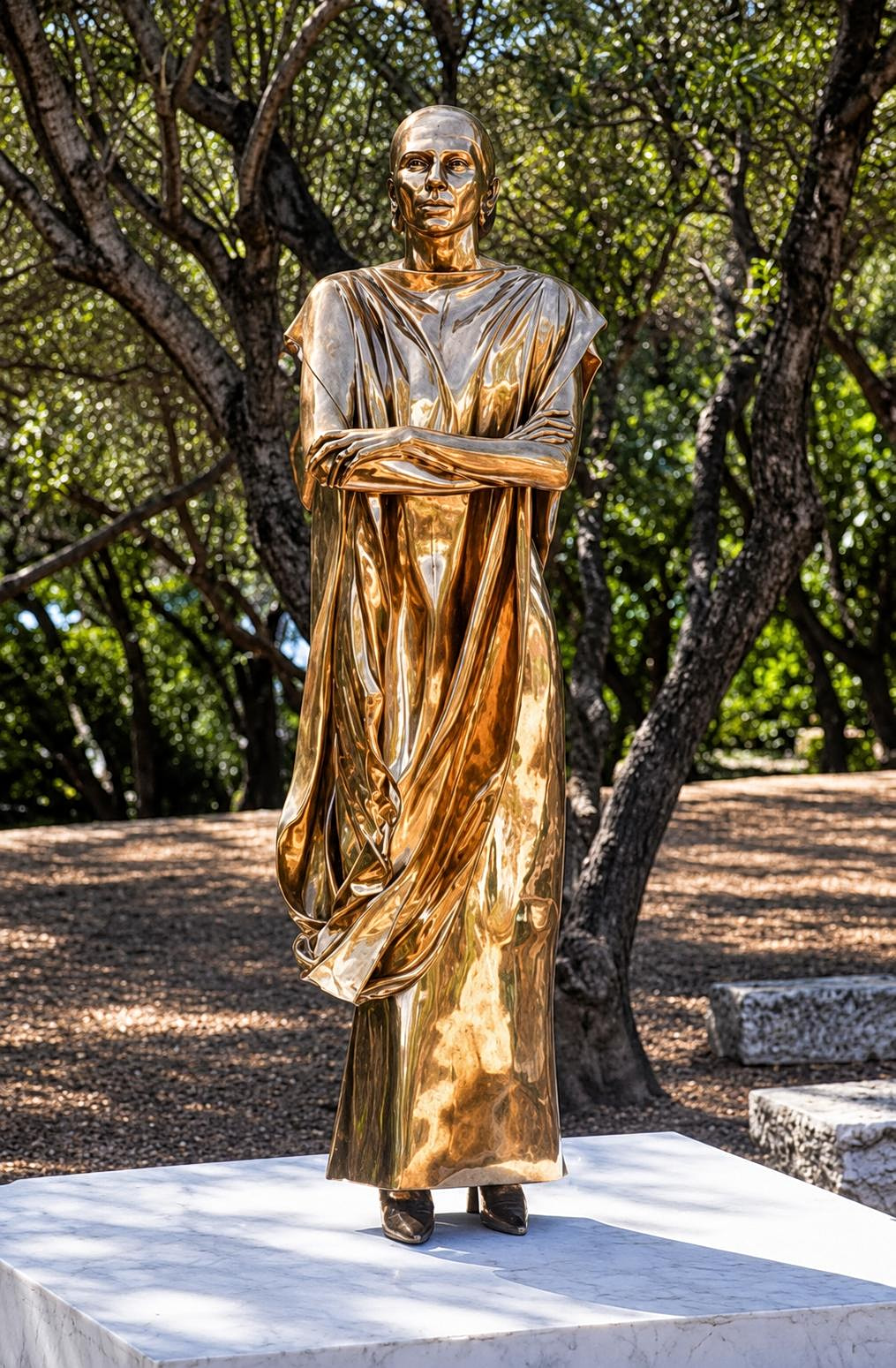
Maria Callas by Afroditi Liti. PANOS KOUGIAS/TO BHMA INTL EDITION
But the construction stage proved an ordeal. I had finished the initial piece and asked for it to be transported in a very specific way, because it was exceptionally finely worked, almost eggshell-thin. When I went to see it, it had been destroyed. There was very little time left now before the delivery date. So I sat down and said: “It’s over, forget about me. I’ll stay here and remake the work.” And I redid it from scratch. She is Afroditi Liti’s Callas. This is how I wanted her, and that was the end of the matter for me. I had no interest in making an effigy. A sculpture is not an effigy. My Callas comes from my studies, from what I have seen, and from what I want.
– What is it like for a creator to see their work cross over into the public sphere and become part of a city’s life?
I consider it a great honor, because an artist might work their whole life long and never get that opportunity. And it certainly gives us courage. I feel very positively about my own sculpture. And because it gives me joy, others share in that joy and it is doubled. I remember a large tree, eight meters tall—my first large tree—which I made when Greece assumed the Presidency of the EU; it was in Porto Carras. I had created a flock of birds, like visitors coming and resting on the tree. And I remember the tremendous joy I got out of the public’s response. It isn’t easy to integrate things like that into a space. It’s one thing to have them in your mind, but quite another to make them real. But that is what I want: for people to enter the space and feel comfortable in it, as if they too could fly in and settle on its branches.
– How do you see art today? Do you feel the public has drifted away, or is it more interested in seeking out art than ever before?
It’s better than ever. People want art; they love it. I believe the exact opposite from those people who say the public has drifted away. They have never followed art as much as they do now. It’s crossed over to a new audience now, beyond the connoisseurs. And that’s really something. More and more young people are reading about art, going out and seeing art, and their families are learning alongside them. Art is permeating everything, and shaping noble feelings, as we said. Greeks are cultivating themselves, traveling, visiting museums. Even if they just look—nothing else is needed. They internalize all those messages.
PANOS KOUGIAS/TO BHMA INTL EDITION
– And Greek sculpture? Where do you think it finds itself today?
It can hold its head up high. I don’t feel we’ve lost momentum, or are working at a lower level. And with more support, it will be even better.
– Is there something new in the works, or something you have in mind? Should we expect something new from you?
Yes, of course. I’m working. I think it will be something very beautiful and, above all, very optimistic. Extremely optimistic about what’s happening in Greece today. I don’t isolate opinions. I see things holistically. I don’t join groups or discussions of that kind. I like to keep free and see things as they are.
– When should we expect it?
Soon, I think. I’ve already made some headway with it.