Greece’s public finances and its households are moving in opposite directions. State tax revenue is running ahead of target, the primary budget surplus is wider than planned, and yet the government continues to rule out even a temporary cut to value added tax or the special consumption tax on fuel. Data on the first half of 2026 budget execution help explain why.
Inflation is doing the tax collecting
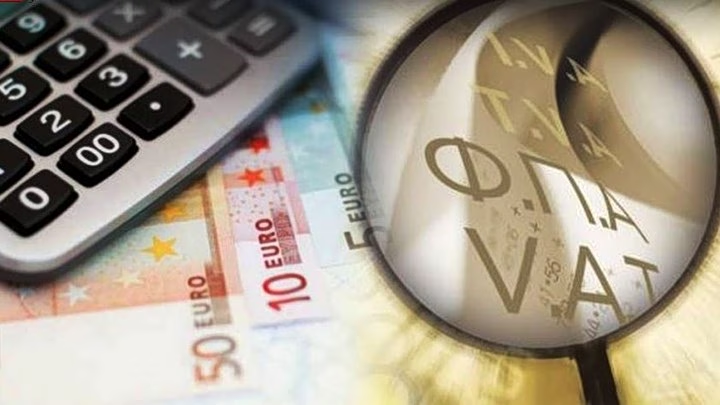
Value added tax, is charged as a percentage of a product’s price. That structure means VAT receipts rise automatically whenever prices rise, regardless of whether people are buying more or less. The higher the cost of everyday goods, the larger the taxable base, and the more money flows into state coffers even as consumers cut back.
That mechanism is now central to the government’s calculations. A cut to VAT would immediately reduce state revenue, and Greek officials are wary of giving up fiscal room just weeks before the Thessaloniki International Fair, the annual trade exhibition where the prime minister traditionally unveils the government’s economic policy program for the year ahead.
The surplus, by the numbers
Net tax revenue for the first six months of 2026 reached 33.4 billion euros, beating the government’s target by 584 million euros. That figure excludes one time proceeds from the concession of the Egnatia Odos highway, the toll motorway that runs across northern Greece, and from the Hellinikon casino resort being built on the site of Athens’s former international airport.
Almost the entire overshoot came from VAT. Receipts totaled 14.6 billion euros, exceeding the target by 573 million euros, meaning nearly all of the extra tax revenue collected in the first half of the year traces back to a tax that climbs automatically as prices climb.
The primary surplus, the budget balance before interest payments on debt, came in roughly 2.5 billion euros above the government’s original plan for the period.
Consumption is actually falling
Taken on its own, the VAT figure could suggest Greeks are spending more. The opposite appears true, and the clearest evidence comes from excise duties. Unlike VAT, excise taxes are charged per liter, per pack or per unit rather than on a product’s price, so they are not affected by rising costs and instead track the actual volume Greeks are consuming.
Excise duty revenue for the first half of the year came to 3.223 billion euros, falling short of target by 233 million euros. The state is collecting more through VAT because everything costs more, and less through excise duties because people are buying less.
Fuel tells the story most clearly. Excise duty receipts from fuel totaled 1.822 billion euros in the first half of 2026, down from 2.033 billion euros in the same period of 2025, a drop of 211 million euros, or about 10 percent, even as pump prices stayed high. Households and businesses appear to be cutting back on driving and fuel use to manage costs. VAT receipts on fuel have barely moved either, since higher prices per liter are being offset by lower volumes, leaving total revenue from fuel close to flat.
Why Athens is holding the line on VAT
Greece’s opposition parties, along with several business groups, have repeatedly called for a temporary cut to VAT on basic goods or to the excise tax on fuel. The government’s position is that such a move would carry a high fiscal cost with no guarantee retailers would pass the full savings on to consumers.
The budget data point to a second reason. The 573 million euro VAT overshoot accounts for nearly the entire tax revenue surplus recorded in the first half of the year. A significant cut to VAT rates would strip away most of that extra fiscal space just as the government prepares for its DEth announcements and works to preserve a high primary surplus.
That leaves Athens choosing between two paths. One is to keep current VAT and excise rates in place, banking the additional revenue to fund targeted benefits, allowances or tax breaks for specific groups. The other is to cut indirect taxes across the board, lowering prices for all consumers at the cost of a smaller primary surplus and less fiscal maneuvering room. The government’s decisions so far point toward the first option.
A fuller picture behind the numbers
One category of tax revenue reflects genuine economic growth rather than rising prices. Personal income tax collections beat target by 311 million euros, a gain officials link mainly to higher employment and a larger number of salaried workers paying tax.
The VAT overshoot tells a different story. If Greeks are paying more for the same goods, or even for less of them, the state can post higher revenue without any real increase in consumption. Public coffers may be filling up, but the numbers behind that surplus point to a more complicated reality.
Inflation is functioning as a hidden tax collector, boosting state revenue through VAT while squeezing the disposable income of Greek households and businesses and forcing them to keep adjusting what they spend day to day. The question facing the government is not simply fiscal. It is whether, in a period of persistently high living costs, the priority should remain a full treasury or immediate relief through lower indirect taxes.