Is Greece’s rural world drifting toward a rupture with the government and the ruling New Democracy party, or is this merely a passing cloud in an otherwise stable relationship?
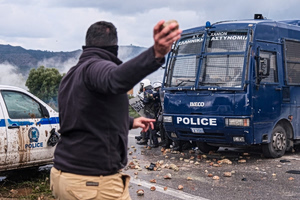
At this year’s farmer roadblocks—a recurring form of protest in Greece—an unexpected banner has appeared. It resembles the infamous Jolly Roger pirate flag, but in a far more cheerful version: a smiling skull wearing a yellow straw hat with a red band. It’s the emblem of Monkey D. Luffy and the “Straw Hat Pirates” from One Piece, one of the world’s most famous and longest-running manga/anime franchises.
In recent years, this flag has become a global symbol of solidarity, social mobilization and defiance against authoritarian power—from Indonesia and Nepal to Mexico and France. Now it has reached the plains of Thessaly, Greece’s agricultural heartland.
This year’s “farmer blockades” seem to be more than a ritual protest. They unfold at a moment when economic hardship and frustration with bureaucracy collide with mounting anger over alleged unfairness and lack of transparency surrounding OPEKEPE—the state body that manages EU farm subsidies.
So again: is the agricultural sector heading toward a real break with the government, or is the turbulence temporary?
How Greece’s Farmers Traditionally Vote
Political science literature tends to support the second scenario: stability rather than rupture.
In most countries, rural populations show socially and politically conservative tendencies. Life far from major urban centers, emphasis on community cohesion, attachment to traditional values, and suspicion toward radical social change are deeply entrenched cultural traits.
In Western countries especially—where agriculture’s share of the economy has steadily declined—farmers tend to favor protective policies against the risks of globalized markets. This often translates into support for conservative, Christian-democratic, nationalist or agrarian parties.
Given this, the “natural home” for Greece’s rural vote would be New Democracy (ND). Yet from the 1980s onward, the Panhellenic Socialist Movement (PASOK) built strong influence among farmers by promoting cooperatives, creating local political networks, and overseeing the distribution of EU agricultural funds under the Common Agricultural Policy (CAP).
SYRIZA, during the financial-crisis era, failed to replace PASOK in these rural strongholds. In the post-crisis years, ND managed to reconstruct a solid relationship with farmers—who represent a small but significant share of the electorate.
Comparing exit-poll data with national election results from the “double electoral earthquake” of 2012 up to the 2023 elections, which delivered ND its second consecutive term, one sees a clear pattern: ND consistently performs better among farmers than nationwide.
Even in May 2012—when ND fell to a historic low of 18.9%—it secured more than 30% among farmers. And by May 2023, almost one in two farmers voted for ND.
What Shapes the Farmer–New Democracy Relationship?
If the relationship seems steady, is it also untroubled? Two qualitative indicators offer a different angle.
First: high prices and the economy have long been the dominant concern for Greek citizens. But the “economic confidence index” of MetronForum 2.0—which combines assessments of today’s economy with expectations for the immediate future—shows something striking.
For two years, overall responses hover at moderately negative levels (around –40 to –45). Among farmers and livestock breeders, however, the index is consistently far lower—dropping below –60 and trending downward.
Since April, in four of six measurements, it fell between –64 and –69 (as of November).
This is a clear sign that farmers increasingly feel exposed to economic insecurity—an exposure that is objectively part of agricultural life.
A second finding adds broader perspective. Respondents are asked to imagine a castle in the desert and place themselves either inside or outside its walls—an image used to gauge perceived social protection or exclusion.
For quite some time now, a majority places itself “outside” this imaginary castle.
Inside or Outside the Walls?
The November survey highlights a consistent social pattern.
Among those who consider themselves upper class, 75% say they feel “inside” the walls.
Among those who identify as working class or farming class, 77% say they feel “outside.”
For farmers, this reflects not only their physical distance from the country’s “center,” but also an economic and political distance. Simultaneously, these groups see themselves as “outsiders”—unprotected amid growing material and symbolic insecurities.
What Does All This Mean Politically?
Culturally and politically conservative rural communities are fertile ground for parties like ND. And indeed, the electoral relationship between ND and farmers has remained positive for many years.
However, the same soil now contains rising insecurity—economic, cultural and existential. Farmers experience themselves as outsiders, vulnerable and distant from decision-making centers. This combination could either reinforce old loyalties or destabilize them.
What political fruits this will bear remains to be seen—depending, among other things, on whether farmers ultimately choose to put on Monkey D. Luffy’s symbolic straw hat.
Stratos Fanaras is President and CEO of Metron Analysis SA.
Research analysis by Yiannis Balampanidis and Penny Apostolopoulou.