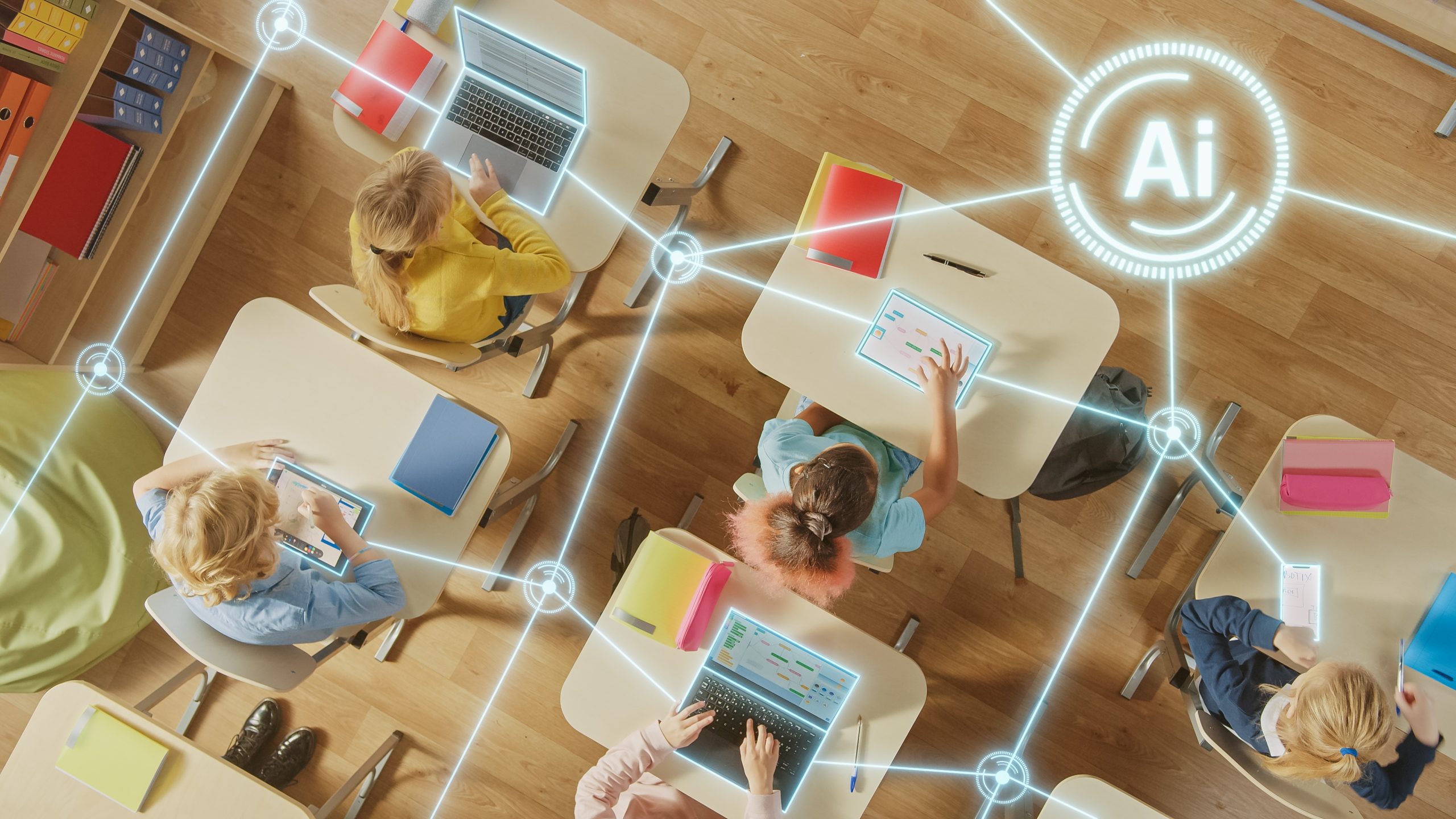
Artificial Intelligence (AI), fueled by recent advances in large language models, is now moving at a breakneck pace and transforming into a multi-billion-dollar industry. In education specifically, the global AI market is estimated at around 7 billion dollars in 2025, with an expected annual growth rate of more than 36% over the next decade. The challenge, then, is how education systems will harness these technologies in ways that truly serve students and teachers. Studies show that about 30% of teachers use Generative AI (GAI) on a weekly basis. In Greece, the situation looks different. When asked whether they use GAI in preparing their lessons, nearly half of Greek teachers reported that they never use it, while around 13% said they use it weekly or more often (see Figure 1). This suggests that we are still at the beginning. Technology promises a lot, but time, appropriate tools, and training are needed for it to become a meaningful part of everyday school life.

One application of GAI is assisting teachers in grading. The rationale is that having an initial evaluation from AI can help a teacher reach accurate and consistent grading in less time. Such tools already exist. A recent study of ours, however, shows that teachers should be cautious since the tools are not necessarily error-free. In research we conducted in Greece with Professor Rigissa Megalokonomou from Monash University and Dr. Panagiotis Sotirakopoulos from Curtin University, we found that teachers were more likely to leave grading mistakes uncorrected when these appeared as recommendations from an AI system, compared to identical mistakes presented as human-made. These failures of oversight demonstrate that while AI promises to help teachers, training and awareness are also required so that human oversight of the technology ensures that the pitfalls of uncritical acceptance are avoided.
Another area of AI application in education is academic and career guidance. Together with Professor Faidra Monachou and Ph.D. candidate Hemanshu Das from Yale University, we carried out an experiment with Greek high school students, examining how they respond to academic counseling advice presented either as coming from a professional advisor or from AI. Results showed that 73% of students report being willing to use algorithmic recommendation systems for their college application. However, students differ considerably in how they approach advice from such tools. The critical factor for adopting recommendations is not the perceived ability of the system but trust in its intentions.
This shows that leveraging AI to guide young people is not simply a matter of technological advancement, but equally a matter of trust and presentation. Our studies teach us that AI in education is not only about technical ability but primarily about human trust and the perception of what the “machine” is doing. Students follow advice when they trust the intentions of the one giving it, while teachers often show excessive tolerance of mistakes from a system they consider objective. In other words, what is needed is not only better algorithms, but an understanding of how humans interact with them. And this interaction, as both international studies and our experience in Greece show, is shaped by the social and cultural context. Concepts like creativity, trust, or fairness are not universal but differ from country to country. Therefore, the use of AI in Greek education cannot simply be copied from other systems but must be based on Greek data and take into account our culture, so that it reflects our own needs and priorities. For this to happen, continued research on Greek ground is essential.
Furthermore, a regulatory framework based on local experience is more likely to foster citizens’ trust and ensure that the new technology operates fairly and with respect for our. Greece has a wealth of human capital working and conducting research on AI, both within the country and in the international academic and business community. This “knowledge reservoir” can support public dialogue and contribute to shaping rules and practices that reflect the needs of Greek education. If properly utilized, it can serve as a bridge between technological innovation and our cultural specificities, ensuring that AI develops in ways that reinforce rather than undermine the work of teachers.
The challenge—and the invitation—is not to fear AI, but to tailor it to our needs so that it becomes a true ally of our schools.
Sofoklis Goulas is an economist and works as an Associate Research Scholar at Yale University in the United States. He has held research positions at the Brookings Institution, Stanford University, and the World Bank. He is a Research Affiliate of the Institute for the Study of Labor (IZA) in Bonn and a Research Fellow of the Foundation for Economic and Industrial Research (ΙΟΒΕ) in Athens. He earned his Ph.D. from the University of North Carolina at Chapel Hill on a Fulbright Scholarship.