“A group of old friends reunites after years apart.”
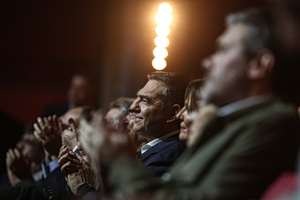
This didn’t happen only in The Big Chill, Lawrence Kasdan’s bittersweet 1983 film about the disappointments and dead ends of the radical generation of the 1960s. In its own way, it also happened at the Pallas Theatre in Athens a few days ago.
The event for Alexis Tsipras’s new book Ithaca—held at the historic Pallas on Voukourestiou Street—was the most “unifying” moment the Greek Left has displayed in years. The frustrations and disillusionment of the revolutionary generation of the 2010s had already been chronicled in Tsipras’s book: a hefty, 700-page reckoning.
But who, exactly, did this reunited “group of friends” bid farewell to at the Pallas—with the same mixture of warmth and melancholy as in the film? Not an old companion. They said goodbye to SYRIZA, the once-dominant left-wing party, and to the era of the “first time Left,” as Tsipras’s 2015 rise to power was known.
The farewell was unspoken among the remaining members and the many splintered ex-SYRIZA factions sitting side by side. It was spoken—clearly—by Tsipras himself, who, from the stage and as the self-styled reborn soul of the group, proclaimed the need for a “new Metapolitefsi.”
(Metapolitefsi refers to the political era that began after Greece’s 1974 transition from military dictatorship to democracy.)
A big chill, indeed.
“The Big Chill” is not the kind of movie that makes you check your watch. The gathering at the Pallas was probably no different. Tsipras has been criticized for many things—often by that same circle of old comrades—but no one, friend or foe alike, has ever denied his stage presence.
But is the charisma of a natural leader, returning somewhat spontaneously as the glue for a fractured political space, enough to launch a “new Metapolitefsi”?
What Is This ‘New Metapolitefsi,’ Anyway?
Is it the vision of a group of former revolutionaries who, armed with the experience of their “first-time failure,” now discover the virtues of pragmatism and moderation?
Or is it yet another chimera—like the one that nearly crushed an entire nation a decade ago?
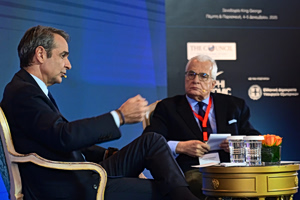
That same day, in a parallel event at the Intercontinental Hotel, Prime Minister Kyriakos Mitsotakis said that, after “reading a few excerpts from Ithaca,” he concluded that Tsipras “was not only the captain who steered the country onto the rocks, but also the one who blamed the crew.”
On the very night one man presented his book, the other chose—through a single sharp line—his rival for the next political shift. That alone could be considered a preview of this “new Metapolitefsi”: a return to a two-pole system. One pole represented by Mitsotakis’s Centre-Right New Democracy—or whoever may succeed him. The other by a more inclusive, pluralistic Left, currently splintered into a thousand pieces, hoping to reunite and reclaim space at the political center.
United—But More Leader-Driven Than Ever
The Tsipras comeback is not only an attempt to reorganize a disintegrated political camp. It is also a full-scale personal restoration effort by a former prime minister who crossed his political desert without receiving even one phone call from his old comrades. In Ithaca, he now openly admits that during his years in power he allowed the “old gang”—the internal party “factions,” as they were then called—to run wild.
If anything shifts in Greece’s political landscape in the near term, it will be precisely this:
on one side, New Democracy remains a party leader-driven by its very DNA.
On the other, the Left is attempting to rebuild itself into a leader-centric formation—not as a matter of identity, but as a method of survival for a “group of friends reunited after years apart.”
Whether this becomes the “new Metapolitefsi” Tsipras envisions—or simply a sequel to The Big Chill—remains to be seen.