Immediately after the announcement of the results of the French municipal elections, the triumphant winner in Paris, Emmanuel Grégoire (elected on a joint Socialist–Green–Communist ticket), emotionally embraces former mayor and, to a large extent, his mentor, Bertrand Delanoë.
With that corridor-style manner once perfected by Socialist mayors, Delanoë leans in and says, “I need to speak to you for a moment, privately.” Grégoire laughs and glances sideways at the cameras: “What is it, then? Are you going to give me the secret codes to Paris’s nuclear weapons?”
The scene, aside from being humorous, is indicative of how political generations change—and of their self-irony. What power, after all, does a mayor really hold today, even of a major city like Paris? Others, elsewhere, make the decisions. It feels as if we are dealing with the smallest scale at a time when the world, on another level, is walking a razor’s edge, constantly on the brink of catastrophe (possibly even nuclear). In wartime, imagine, municipal elections.
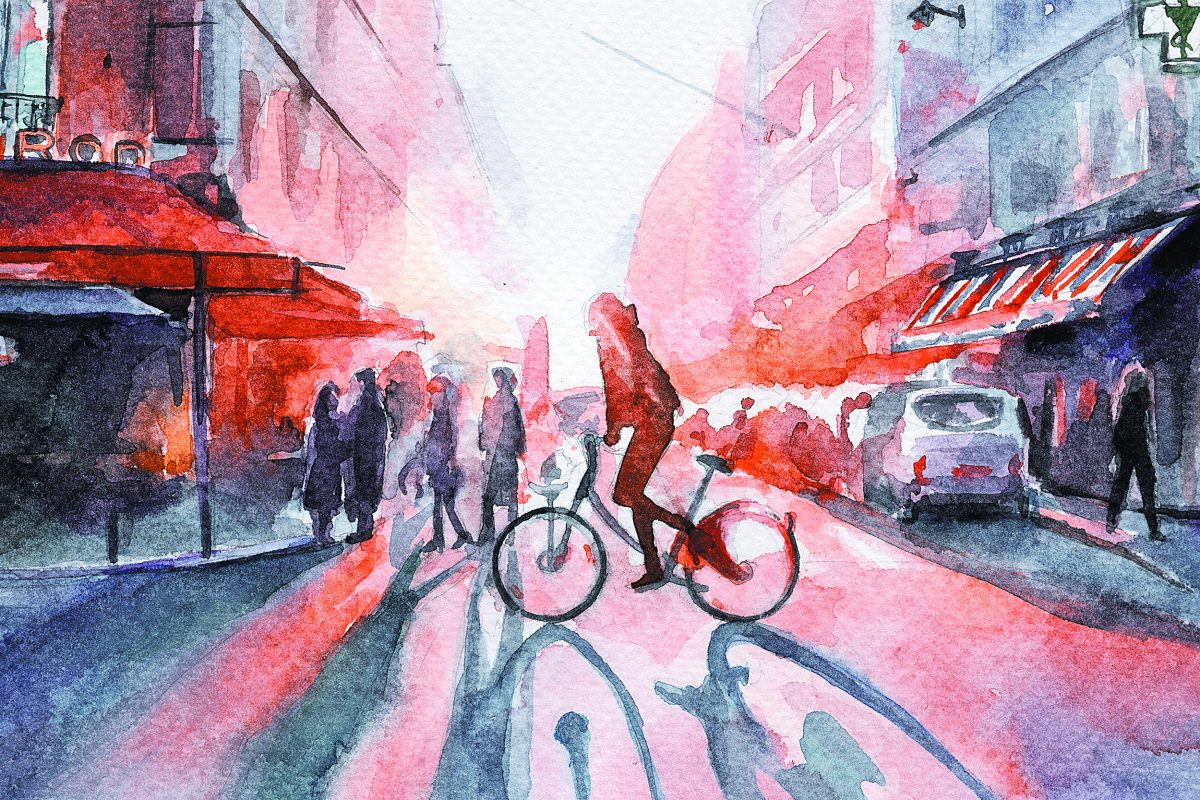
On the other hand, the image that followed—Grégoire riding a municipal bicycle together with his associates, giving his victory speech in front of Paris City Hall, cameras forced to follow them at the same pace, the bicycle lights moving like living things—took on, in my eyes, a strange and unfamiliar power.
Fireflies in the city. It was a scene you could identify with (many people make such journeys every day), and thus it gradually acquired a force much greater than its allegorical meaning.
After decades of undermining and devaluing local governance, after decades in which “mayor and municipal office” meant the absence of accountability and transparent management, perhaps this local scale is ultimately the only remaining arena in which we can rethink what participation means. Perhaps it is also where we must begin if we want to rethink what politics means today.
I say this because, on various levels, the recent municipal elections in France showed how fertile the field of local politics is for highlighting differences, rivalries, fragile alliances—but also, at times, their opposites: concrete positions and clarity.
At the local level, too, one can still recognise the fascist and his ballot list, as well as who supports them, how, and why. At the local level, one sees the connection between a political stake, the intensity and participation around its claim, and its outcome—precisely the connection that is now artificially “lost” at national and supranational levels.
At this level, one can still clearly observe the mechanics of fear and propaganda: how racism is constructed and instrumentalised, how the argument of the “foreign invasion” and of security is used to intimidate and manipulate. At the local level, one can also resist it in a very concrete way, as ultimately happened in cities such as Lyon or Paris.
Perhaps I am grasping at straws, like a drowning person, when I think that a decentralised administration—with as much autonomy as possible in managing programmes related to everyday life (from primary public healthcare and kindergartens to support for vulnerable citizens, anti-racism policies and meaningful social integration)—could be an answer to the political vacuum we face today. But is there another solution?
Because on the other side of Grégoire’s irony—“are you going to give me the nuclear codes?”—there is, of course, the bogeyman who actually holds those codes: the modern Trump, who will gradually end up governing every country, nuclear or not.
I still have in mind an image circulated in the media in recent weeks, showing Trump’s inner circle—Vice President Vance and Secretary of State Rubio—wearing identical oversized black shoes. Apparently, Trump personally buys shoes for his team and requires them to wear them at official meetings. All identical. He even asks them their size in front of everyone in order to place the order.
For some reason (probably because he himself exaggerated his size to boast), Rubio in particular ended up walking, meeting after meeting, in boat-like shoes. An image of a “booted cat” that is not entirely out of step with the atmosphere prevailing in the US president’s court.
The interesting point here is that although this humiliation ritual is designed to project presidential power, it ends up symbolising the opposite: complete political weakening, emptiness. What happens to Rubio—who is not only but must also appear to be a pawn—also applies, at another level, to Trump himself.
He increasingly represents a form of power that pretends to be absolute while simultaneously appearing (and self-admiring, without a trace of irony) as ridiculous. The more buffoonish this omnipotence becomes, the more it reveals what is really happening. The centre of decision-making—and its consequences—has shifted elsewhere.
Fascism, as Pasolini would say, has changed level. The relationship between specific political processes and vast geopolitical movements—including war, the transformation of the global economy, and the exploitation of planetary resources—has become entirely blurred, if not invisible.
The sense of resignation and melancholy this produces, especially in Western countries, is used as a kind of magma of consent, grease in an absurd cycle for contemporary history. As the parallel world of artificial intelligence intensifies this condition, I wonder whether real political resistance will now have to be local, exploratory, slow, and artisanal. Whether we will need to start from the small in order to turn the spotlight back onto the large.
It is obvious that, as things stand, it is far better to watch Grégoire struggling to pedal his bicycle than to try, even for a moment, to step into Rubio’s shoes.
Dimitris Papanikolaou is Professor of Modern Greek and Cultural Studies at the University of Oxford.