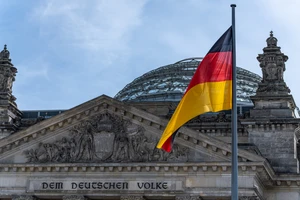
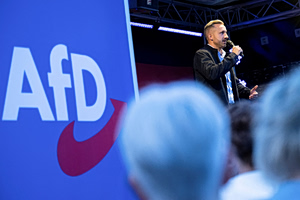
With nearly 44 per cent of the vote, the far-right Alternative for Germany has achieved the best result in its history. While the AfD narrowly missed an absolute majority, its sensational victory has broken one of the Federal Republic’s most important political taboos: parties that reject the liberal democratic order and relativize the crimes of National Socialism must be kept away from power.
The terms now dominating the German debate and international commentary – “turning point”, “political earthquake” and “historic watershed” – are appropriate. The election result will transform politics in Saxony-Anhalt. What has happened in this eastern German state will also have repercussions for the federal government in Berlin and for Germany as a whole.
The governing CDU suffered a historic defeat. The party of Chancellor Friedrich Merz, who had promised to halve the AfD’s support, has now seen its share of the vote cut in half, falling to just 17 per cent. The Social Democrats, the Greens and the Left remained stuck in single digits. The other winner was the Sahra Wagenknecht Alliance, or BSW, which secured 5.3 per cent and could now emerge as kingmaker.
Several factors explain the AfD’s success.
First, the vote was an expression of massive dissatisfaction with the CDU and, above all, with Chancellor Friedrich Merz. Surveys published on election night show that his policies were supported by only nine per cent of voters in Saxony-Anhalt. The election was therefore also a referendum on the federal government. Its consequences will inevitably be felt in Berlin.
Second, the AfD ran a highly professional campaign. Its candidate, Ulrich Siegmund, presented himself as confident, approachable and optimistic. Instead of relying exclusively on anger and protest, he offered voters the promise of a better future. The campaign slogan used in the final days before the vote – “Everything will be fine!” – was simple and effective.
Third, the AfD maintained a clear and uncompromising position on migration, the dominant issue of the campaign. Many of its proposals are unrealistic, and some of its promises will prove impossible to fulfil. After all, this was a regional election, and many important decisions are made at the federal level. Crucially, however, a significant proportion of the AfD’s electorate is not interested in facts or rational arguments. Many voters are driven by distrust of the established parties and by the conviction that the political system has ignored them for too long.
The immediate question is whether the AfD can translate its victory into power. It fell only three seats short of an absolute majority. According to reports, Siegmund is likely to pursue a three-stage strategy. He will first offer talks to the CDU, reigniting the debate over the political “firewall” against the far right. If this fails, he may try to persuade individual deputies from other parties, particularly the CDU, to defect. Finally, he could explore some form of cooperation with the BSW, which throughout the campaign showed greater openness than any other party to working with the extreme right.
For Chancellor Merz, the result is a humiliation bordering on a “political execution”, as one commentator in an Italian newspaper put it. Speculation about a change at the head of the government has already resurfaced and will not disappear. Yet the CDU lacks an obvious alternative. No successor of sufficient stature is in sight, and Friedrich Merz has given no indication that he is willing to step aside. Hendrik Wüst, the premier of North Rhine-Westphalia and a potential successor in some scenarios, faces an election of his own next spring and shows no inclination to move against the chancellor at this stage.
In first reactions, the CDU leadership insists that there will be no cooperation with extremists and no consequences for the chancellor. The coming days and weeks will show how realistic this position is. As became apparent on election night, the outcome in Saxony-Anhalt will also intensify internal resistance to the Federal government’s reform agenda, particularly its social and pension policies. The SPD, the CDU’s coalition partner, is already demanding the withdrawal of disputed measures widely regarded as “unjust” – but which, in the chancellor’s view, are necessary to stabilize the system in the face of demographic decline.
“After the election is before the election,” as a German saying goes. Regional elections in Mecklenburg-Western Pomerania and Berlin are only two weeks away. Until then, the governing parties will try to avoid any decision that could cost them further votes. Meanwhile, the big winner in Saxony-Anhalt will press ahead with its aggressive campaign. “Our vision has become reality. We will take back the whole country,” a jubilant Ulrich Siegmund exclaimed at the end of an election that Germans will not soon forget.
Dr. Ronald Meinardus is a Senior Research Fellow at the Hellenic Foundation for European and Foreign Policy (ELIAMEP).