 Μake us preferred on Google
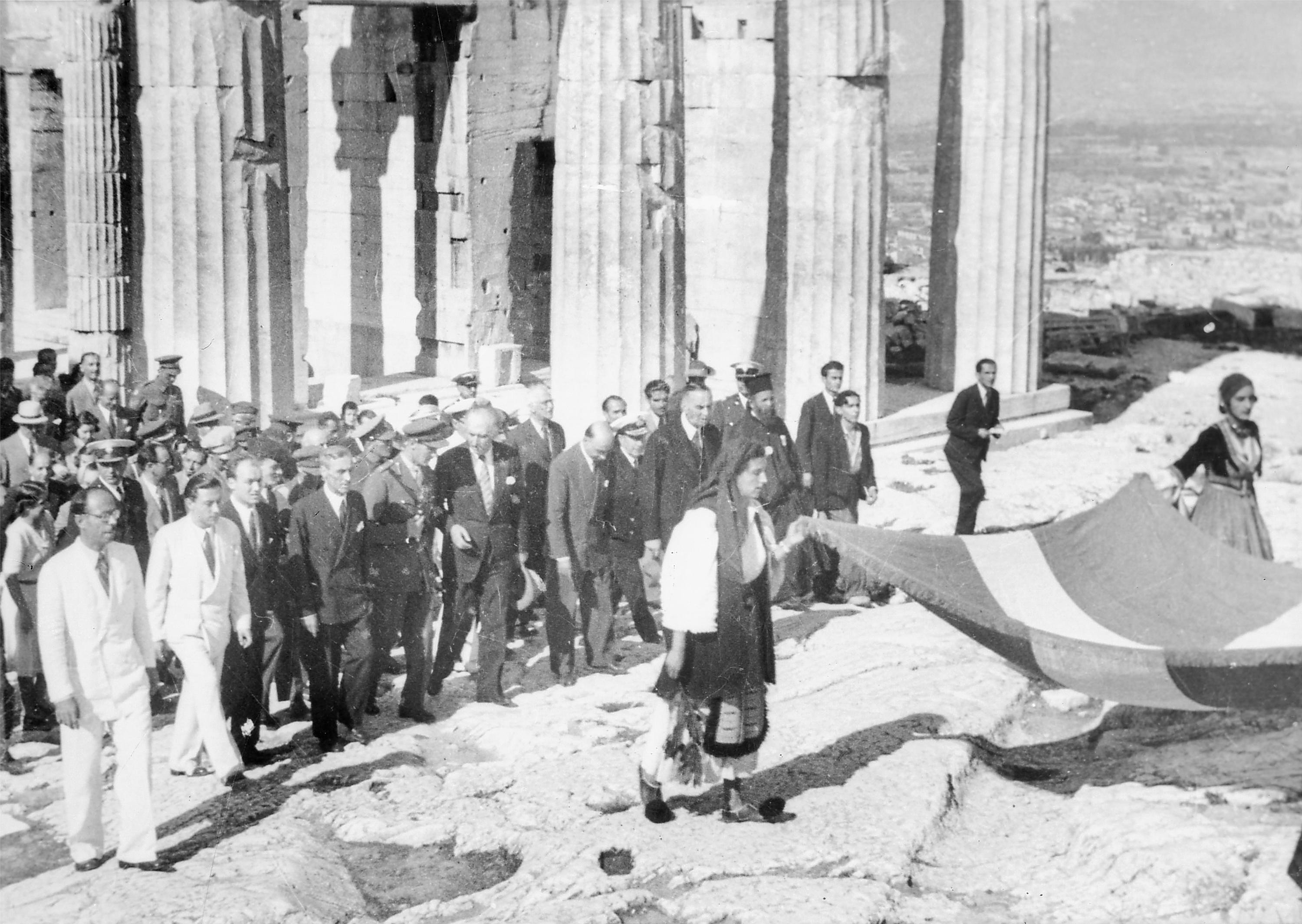
Scholarship thrives on debate. But “Archaeology and Occupation: Greece 1941–1944,” a conference in Athens, provoked a political dispute that reached Parliament before the proceedings even began. The cause was a poster featuring a historical photograph: Nazi Germany’s war flag flying on the Acropolis, with the Parthenon in the background.
Parts of the Greek press described a “storm of outrage” and the “rape of the Acropolis.” The choice of image became all the more politically charged because the conference was held under the auspices of the Greek Ministry of Culture. An opposition lawmaker raised the issue in Parliament. The National Council for the Claim of German War Debts to Greece, known as ESDOGE, demanded that the ministry withdraw its patronage. “If you want my personal opinion, it was wrong to choose this image,” Culture Minister Lina Mendoni said. In a joint statement, the organizers described the disputed photograph as “a historical document.” They had not intended “to cause offense or insult anyone.” The crucial sentence followed: “Following an intervention by the Greek Ministry of Culture, the image was immediately replaced.”
The politically orchestrated uproar initially obscured an exceptional conference that raised original questions and, in some areas, pointed to new directions for research. Over three days, internationally renowned scholars discussed the role of archaeology during the occupation at three venues, each drawing a sizable audience. The conference is part of a multiyear project funded by the German Foreign Office. The project also includes exhibitions titled “Divided Past: German-Greek Relations in Dark Times,” on view at two symbolically significant locations: the National Archaeological Museum and the German Archaeological Institute, or DAI, in Athens. Germany’s ambassador, Andreas Kindl, praised the undertaking as “an excellent example of German-Greek scholarly cooperation.” Culture and scholarship, he said, demonstrated “the dynamism of our bilateral relations.”
The conference program, however, extended well beyond German-Greek relations. Together with the Italian Archaeological School at Athens, or SAIA, and the Institute of Historical Research at the National Hellenic Research Foundation, the DAI confronted a past that remains politically contentious. This collaboration was more than a symbolic gesture. “We are dealing with a less comfortable past than the ancient history we usually study,” said SAIA’s director, Emanuele Papi. The Italian historian Isabella Insolvibile demonstrated at the outset just how uncomfortable that reckoning can be. She challenged the familiar portrayal of “good Italian occupiers” as distinct from the “bad Germans.” Against the reassuring phrase “Una faccia, una razza” — roughly, “We are cut from the same cloth” — she set the brutal reality of the Italian occupation and its war crimes. The Bulgarian occupation of northern Greece was also discussed. The presentations revealed considerable differences in how the three countries address their past: While remembrance of the crimes committed during the occupation has an established place in Germany’s policy toward Greece, comparable approaches have taken far less root in Italy and Bulgaria.
“We cannot change history, but we must examine it as objectively as possible,” said Katja Sporn, the DAI’s director in Athens. For her institute, that means an unflinching examination of the years she described as “the darkest and most problematic period in the institute’s history.” Walther Wrede figured prominently in the discussions. He headed the institute on Fidiou Street from 1937 to 1944 while also serving as the head of the Nazi Party’s foreign organization in Greece. In his person, scholarly leadership and Nazi Party power were directly joined. The presentations made clear that this dual role also shaped the institute’s work.
The Wrede case alone shows how far the conference’s subjects extended beyond specialist questions of archaeology. The Nazis systematically used archaeology to advance their ideological goals. Anyone studying the discipline’s history during this period must therefore also examine power, propaganda and the responsibility of scholars.
Another discussion touched on how archaeology defines itself: How old must an object be to become archaeologically relevant? Military archaeologists already study the material remains of the occupation in Greece, including fortifications, bunkers and underground structures. Jan Driessen, listed in the program with affiliations at UCLouvain and the University of Cincinnati, spoke on “Fortress Crete: A Case for the Archaeological Study of Axis Remains in Eastern Crete.” So many sites survive that he could not possibly list them all, said Driessen, whose research focuses on the eastern part of the popular vacation island. Nektarios Yioutsos, an archaeologist at the Greek Ministry of Culture, also argued for giving the recent past a greater place in the discipline. He studies how the German and Italian occupations affected archaeological sites in Greece. A “reorientation of archaeology” was needed, he said, expressing the hope that the conference would help bring it about. The German military historian Valentin Schneider likewise confirmed growing interest in these remains. He pointed to an increase in “military tourism,” particularly on Crete.
Military archaeology will not become a new field of work for the DAI in Athens for the time being, Sporn made clear. Research into the institute’s own history during the occupation, however, remains part of its work. The next step is to publish the conference papers in the spring and make them available to a wider audience. The examination of this past will thus continue beyond the conference’s three days.
Dr. Ronald Meinardus is a Senior Research Fellow at the Hellenic Foundation for European and Foreign Policy (ELIAMEP).