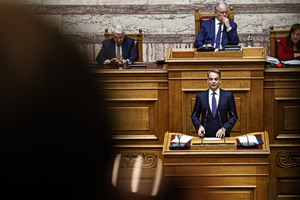
As recently confirmed, Greece is set to move forward in 2027 with the revision of the Greek Constitution, one of the most consequential institutional processes within its political system. Constitutional reform, at its core, is not just a legal adjustment, but an act of institutional self – reflection. It is a moment where governance is reassessed, democratic function is reconsidered, and institutions are recalibrated to reflect evolving realities.
And yet, at the heart of this process lies a paradox. The generation that will live the longest under the revised Constitution may well be the one least involved in shaping it.
Generation Z embodies the effects of prolonged crisis and accelerated change. In Greece, it is a generation shaped by the legacy of the financial crisis, growing institutional distrust, and rapid technological transformation. It has come of age amid economic instability, a global pandemic, geopolitical tensions, and an increasingly fragmented public discourse. These conditions have not pushed it away from politics. If anything, they have sharpened its awareness of how systems function, or where they fall short.
Still, when it comes to the most fundamental political act, the revision of the Constitution, its presence remains limited.
This absence should not be mistaken for apathy. It reflects a deeper structural disconnect between institutional processes and the way younger people engage with public life today. Constitutional revision in Greece remains a highly formalized exercise, unfolding within strict parliamentary boundaries and shaped by party dynamics and legal formalities. For those familiar with constitutional law, this is expected. But for younger generations, it reinforces the perception of a process that feels distant, complex, and disconnected from everyday political experience.
Participation, in this context, is indirect and mediated, far removed from the immediacy and interactivity that define how younger citizens experience public life. The result is not simple disengagement, but a sense that such processes belong to a different political era.
However, a further issue reinforces this gap: limited constitutional literacy. Many young people lack a clear understanding of what the Constitution is, how it functions, and why its revision matters. It is often perceived as abstract and technical, rather than as a living framework that shapes rights, obligations, and the limits of state power. As a result, constitutional reform becomes not only distant in procedure, but also difficult to connect with in meaning.
This distance, both institutional and conceptual, helps explain why an entire generation can be simultaneously affected by, yet removed from, such a critical process.
But this raises a more pressing question. Even if participation were broader, would the constitutional revision truly reflect the concerns of younger generations?
There is a real risk that the 2027 process will focus on changes that are politically convenient rather than socially transformative. Constitutional revisions often center on issues where agreement is easier to achieve, such as procedural refinements, institutional balances, or technical adjustments. While important, they rarely address the deeper anxieties that shape how younger citizens experience the state.
For Generation Z, those anxieties are not abstract. They are embedded in everyday life. The nature of work is increasingly unstable, offering flexibility but little security. Privacy is constantly challenged in a data-driven world. Trust in institutions is fragile, especially in an environment shaped by constant information and scrutiny.
The digital world makes this gap even clearer. For younger generations, it is not separate from reality, but rather a part of it. Political expression, social interaction, and even identity formation all take place in digital environments shaped by platforms and algorithms. Yet constitutional frameworks still treat digital rights as secondary, leaving key issues such as data ownership and digital autonomy largely outside constitutional debate.
Trust also plays a crucial role. Having grown up in a period marked by crisis and uncertainty, many young people do not see institutions as stable anchors of fairness, but as systems that must continuously earn their legitimacy. In this context, constitutional revision is not just a legal process, but an opportunity to rebuild that trust. But trust cannot be created through legal amendments alone. It requires recognition. It requires the feeling that institutions are not only functioning, but actively listening.
If the process remains distant, it risks deepening the very mistrust it could help resolve. The absence of young voices is therefore not just a question of representation, but one of legitimacy. A Constitution that speaks about the future without meaningfully involving those who will live it only deepens the disconnect it seeks to overcome.
At the same time, it would be misleading to interpret this distance as disengagement. Gen Z is not absent from political life. Rather, it is present in different ways. Younger citizens engage through decentralized networks and digital platforms that prioritize visibility and immediacy. They are also increasingly active in structured environments such as forums, youth councils, academic initiatives, and think tanks, where they contribute ideas, shape discussions, and raise awareness on issues that matter to their generation. Our participation is not weaker, just different. More flexible, less hierarchical, and often not aligned with traditional channels of representation.
A constitutional revision that aims to be forward-looking cannot operate solely within the assumptions of the past. It must acknowledge how citizenship itself is evolving, how people engage, express themselves, and relate to institutions. Otherwise, there is a real risk of producing a document that is formally updated, yet disconnected from the society it is meant to serve.
In this sense, the paradox remains unresolved. The generation that will live the longest under the revised Constitution continues to stand at a distance from both its formation and its meaning. Whether that distance can be reduced will depend not only on the content of the reform, but on the willingness of institutions to rethink how legitimacy is built and how they connect with society.
Because in the end, the real question is not whether constitutional change will take place. It is whether it will actually resonate.
Sissy Politopoulou is a core member of the EU Youth Hub at ELIAMEP, and a graduate in International and European Studies with a specialization in International and Humanitarian Law. She coordinates the team’s Social Media and Digital Presence efforts, and also writes for platforms like UnPlug Mag, promoting democracy, youth rights, and civic engagement across Europe.