Even if you are not interested in football, you can easily understand why someone follows a particular team. As a form of socialization and a marker of identity, the question “Which team do you support?” is something like a primary origin—a deeply ingrained connection that usually begins in childhood and remains unchanged throughout adult life. Quite often, it becomes so emotionally intertwined with the experience of growing up that it comes to resemble one’s place of origin, much like the question “Where are you from?” Literally, because most supporters usually come from the city where a team is based. But also metaphorically—through class, politics, ethnicity, or gender—always referring back to that first geography in which one’s sense of self was formed.
Recently, a friend told me that she “supports AEK” because it was the first football team she ever heard referred to in the feminine gender when she was a child: AEK (in Greek, i AEK). Like everyone else I know, she has never changed teams since then—and it is stories like these that make even someone like me, who knows very little about football, admire the sport and its deep roots in our contemporary social life.
When, however, we move on to the question “Which team do you support at the World Cup?” things become more complicated. What happens when your own country’s team has not qualified? How do you choose another team? And why, in this case, must one choose a team at all?
Over the past few days I asked people around me, and every answer was interesting. Emotional ties to a particular country. Historical or political reasons. Identification with a star player. Sometimes even tactical considerations—for example, “They’re the only ones who still play attacking football,” and so on.
“And if that national team gets eliminated?” As you keep asking, you realize that there is always a second choice, and a third, and a fourth, with the reasons becoming increasingly complicated. It is as though, in the end, you simply cannot watch a match without choosing a side, even if only for a single evening.
That is something I understand perfectly from personal experience. Even if I happen, say, to walk into a pub showing World Cup matches these days, I feel the need to pick a side. For a little while, I become an enthusiastic supporter of one of the two teams. I want to experience either victory or defeat. Why exactly, I still cannot explain.
Perhaps I have associated football too closely, as I have already suggested, with the notion of identity—and therefore with identification. Or perhaps because there is no other way to watch a match that can keep you on the edge of your seat for nearly two hours and still end 0-0. Or because by “having a team” you participate much more fully in a ritual, one that is also connected to the senses: sounds, smells, visual stimuli, inside but above all outside the stadium, all of which define this sport more than anything else.
I therefore conclude that by choosing a side, I experience what happens on the pitch within a dramatic framework that far transcends the match itself, just as it also transcends the one-dimensional, masculine, macho, violent, and commercialized side of this long-suffering sport.
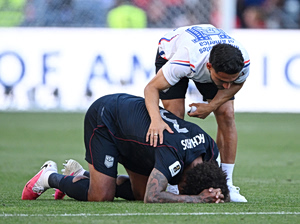
And I remember the final, extraordinary pages of Football in Sun and Shadow by Eduardo Galeano. When the World Cup is over, he writes, “I already miss the unbearable noise of the vuvuzelas. The thrill of the goals, which are not recommended for those with heart conditions. The beauty of the greatest plays, when they return in slow motion, as though to prolong the miracle just a little longer. And also: celebration and mourning. Because football is sometimes a joy that makes you suffer, and the music that once glorified victories capable of raising even the dead now almost resembles the deafening silence of the empty stadium, where one defeated player, alone and motionless, sits waiting at the center of the vast deserted stands.”
Dimitris Papanikolaou is Professor of Modern Greek and Cultural Studies at University of Oxford.