Volodymyr Zelensky did not make a tactical mistake in Istanbul on 4 April 2026. He made a historic strategic error.
By elevating Recep Tayyip Erdogan as a pillar of Europe’s future security architecture, he handed Turkey something it has been building towards for years: control over Europe’s maritime gateway as it turns indispensable.
This is not diplomacy. This is structural capture.
Turkey does not balance between Russia and Ukraine. It builds a parallel security order in the Black Sea, operating inside NATO but no longer shaped by it. It leads the maritime command, enforces Montreux with rigidity, and acts as the arbiter of access. No naval reinforcement, no presence, no escalation unfolds without Ankara’s consent.
This is not alliance behaviour. It is gatekeeping.
And Zelensky has just endorsed it.
There is a difference between using Turkey and trusting Turkey. Kyiv has crossed that line.
Russia is the enemy applying force against Ukraine. Turkey ensures that no decisive Western outcome against that force fully materialises. Moscow applies pressure from the outside. Ankara operates from within, inside NATO, inside the Black Sea chokepoint, inside mediation frameworks, inside Europe’s post American security debate.
An open adversary can be contained. A state that profits from ambiguity while being treated as essential cannot.
The visit to Ankara was not an isolated diplomatic move. The stop in Damascus that followed was deliberate.
It was alignment.
Turkey no longer manages only the Black Sea. It links theatres. By pulling Ukraine into its post Assad regional framework in Syria, Ankara expands its leverage beyond the war itself, connecting military access, regional positioning, and future security arrangements.
Ukraine is not just being supported. It is being repositioned.
The Turkish model is not contradiction. It is design.
Ankara supplied Ukraine with Bayraktar drones at an early stage, embedding itself in Kyiv’s defence narrative and gaining strategic credibility. At the same time, it refused to join Western sanctions and kept channels open with Russia long after the invasion began. Trade routes remained open. Sensitive goods continued to flow. Only under external pressure did the system tighten.
By then, the effect had already been achieved.
Russia gained time. Time enabled adaptation. Adaptation enabled endurance. Endurance sustained the war.
This is not a contradiction between policy lines. It is a system.
The energy dimension exposes it completely.
After Ukraine ended Russian gas transit, TurkStream became the only functioning pipeline corridor delivering Russian gas into Europe. Flows rose by roughly 22 percent in March 2026 compared to the previous year. Europe did not eliminate dependence. It restructured it through Turkey.
The label changes. The system does not.
A country that becomes the primary transit route for the resource financing Russia’s war is not neutral. It is part of the war’s sustaining mechanism.
TurkStream is not infrastructure. It is a post sanctions energy regime.
It allows Russian gas to remain embedded in European systems while political narratives claim disengagement. It preserves revenue flows, stabilises Russian exports, and erodes the credibility of European policy declarations.
Every unit of gas that passes through that system extends Russia’s war horizon.
Oil follows the same logic.
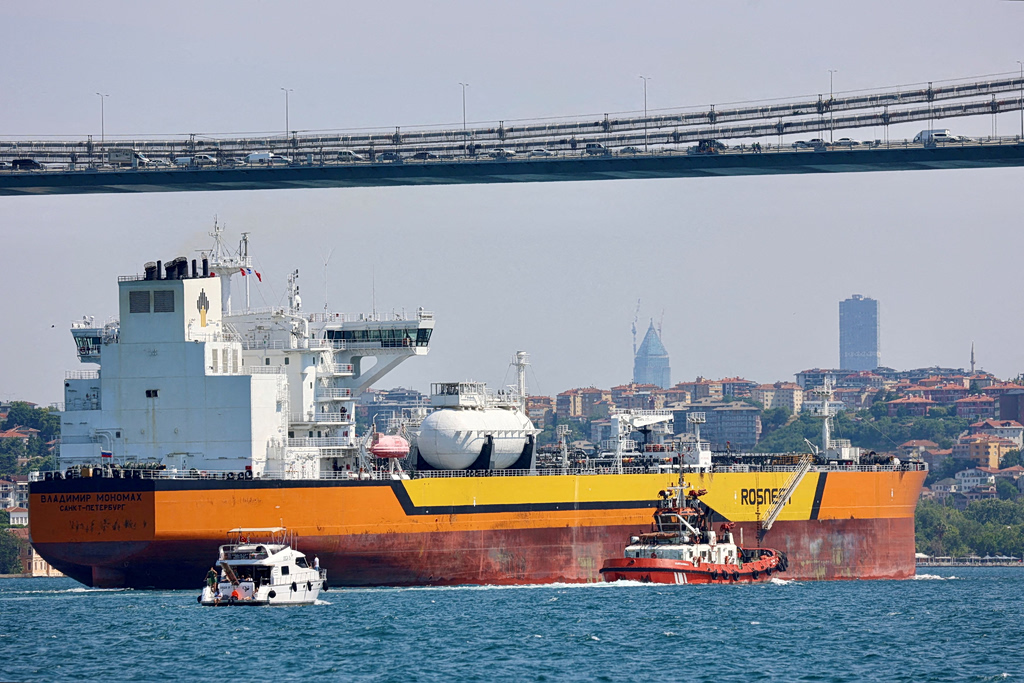
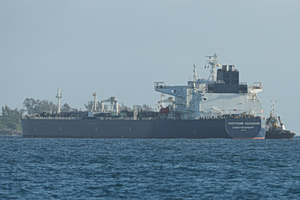
Rosneft’s Russian-flagged crude oil tanker Vladimir Monomakh transits the Bosphorus in Istanbul, Turkey, July 6, 2023. REUTERS/Yoruk Isik/File Photo
Turkey has become a central hub for absorbing and redirecting Russian crude and refined products. Imports increase, are blended or relabelled, and re-enter global markets, including European systems that formally reject direct Russian supply.
The origin is masked. The effect remains.
This is not evasion. It is adaptation.
This is not neutrality. It is a service.
A parallel economic channel that allows the war economy to function under new conditions.
Akkuyu takes this further.
With an additional 9 billion dollars transferred by Russia in December 2025, and the first reactor entering operation in 2026, Turkey has moved into structural reliance. A significant share of its electricity is tied to a Russian owned and Russian financed facility.
This is not cooperation. It is exposure.
A state that anchors part of its economic stability in Russian controlled infrastructure will not confront Russia at a decisive moment.
It cannot.
The Black Sea reinforces the same pattern.
Montreux has not been used to stabilise the theatre. It has been used to monopolise it. By restricting passage, Ankara has not only limited Russian manoeuvre. It has locked out broader allied flexibility, ensuring that any maritime support to Ukraine remains dependent on Turkish approval.
Even when additional support was possible, passage was denied.
The straits are not closed. They are controlled.
Control without closure is leverage.
What emerges is not a balancing power.
It is a system manager.
Turkey does not seek resolution. It seeks permanence at the choke point of Europe’s energy, security and migration flows. It places itself at the intersection of opposing needs and ensures that neither side can bypass it. Ukraine needs support. Russia needs channels. Europe needs access.
Turkey ensures that all three remain dependent on it.
This is not mediation.
It is architecture.
This is why the traditional description of Turkey as a balancer is no longer sufficient.
Turkey behaves less like a modern NATO ally and more like a 21st century Ottoman gatekeeper, a power that does not need to win wars to profit from them, only to ensure that wars remain unresolved long enough to convert geography into leverage.
This is the shift most analyses still fail to capture.
And it leads directly to Zelensky’s mistake.
In searching for alternatives to an uncertain American role, he has not diversified Ukraine’s strategic options. He has concentrated them in the hands of a state built on indispensability.
That is not a pillar.
It is a bottleneck.
By elevating Turkey to the level of a strategic anchor, Ukraine is not strengthening a future European security framework. It is accelerating the internal erosion of the alliance structure that still underpins its survival.
An alliance cannot function when one of its central actors derives advantage from the endurance of the adversary it is meant to contain.
This is not a contradiction.
It is a model.
Turkey is not merely an unreliable partner for Ukraine.
It is a functional partner of Russia’s war endurance.
Not because it shares Moscow’s objectives, but because it enables Moscow’s sustainability.
Russia wants to win.
Turkey wants to ensure that no one wins without passing through Ankara.
Zelensky went looking for an anchor.
He has attached Ukraine to the very system that keeps the war going.
Europe now faces a choice it has tried to avoid.
Either it begins to treat Turkey not as a complex ally, but as a structural strategic risk that must be reduced, or it accepts that its security architecture is being rewritten from within.
There is no stable middle ground.
Because a state that profits from both sides of a war does not stabilise it.
It monetises it.
Shay Gal works with governments and international institutions on strategy, risk, and security decision-making in high-stakes environments.