As much as we would like to believe that the dark ages of authoritarianism have gone for good, cases still come along to remind us that the apparatus of state, when left to its own devices, continues to function with mindsets from decades past. One such case, which shines a light on this phenomenon, is that of Nikos Romanos. After the events of 2008, Nikos Romanos found himself targeted by the Justice system. He was convicted of armed robbery (in cases tried in 2013 and later) and handed heavy sentences, while he was found guilty in separate trials of possessing and planting explosives; these sentences were subsequently reviewed by the highest judicial authorities. During his imprisonment, he completed his secondary education, obtained his high school diploma, and gained admission to university. In view of his rehabilitation and good behavior in jail, the Supreme Court reduced his original sentence; in accordance with the rules enshrined in the penal code, Romanos was subsequently released from prison. But let’s take things from the start. Who is Nikos Romanos?
Forced into adulthood at fifteen
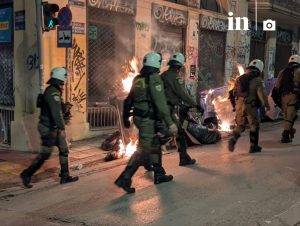
Romanos didn’t appear on the police radar out of nowhere. He is the 15-year-old who held his dead friend Alexandros Grigoropoulos in his arms when he was shot and killed by a police officer—a member of an auxiliary corps of the Greek Police—in Exarchia. On that fateful night of December 6, 2008, Epaminondas Korkoneas killed a minor with intent and in a calm state of mind, and in doing so robbed Nikos Romanos and an entire generation of the innocence of childhood; it will forever remain a dark day for Greece. Instead of showing understanding for the traumatized boy who saw his friend killed by one of its own, shot dead with a service weapon, the police treated him with suspicion; this is how the persecution of a young man by the apparatus of state began.
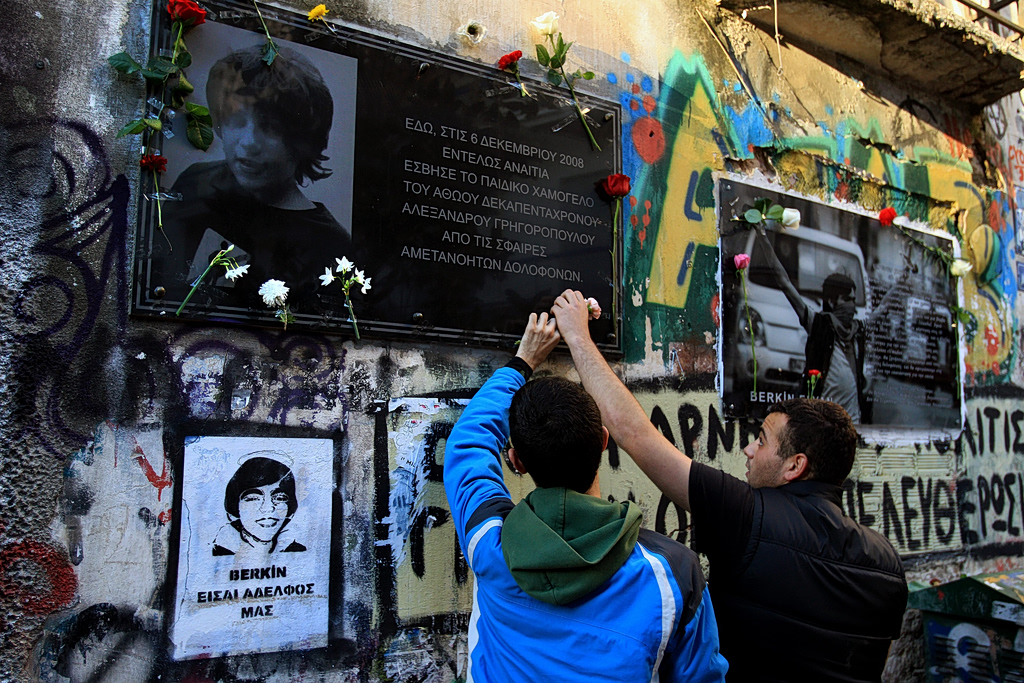
Two students place flowers at the spot were teenager Alexis Grigoropoulos was fatally shot by a Greek police officer on 06 December 2008 in Exarchia neighborhood, central Athens, Greece, 06 December 2014. Grigoropoulos, a 15-year-old student, was killed 06 December 2008 in an apparent police shooting according to reports, sparking rioting in the Greek capital. EPA/SIMELA PANTZARTZI

Alexis Grigoropoulos.
Conviction, imprisonment and rebuilding a life from scratch
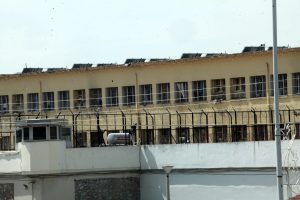
Despite the narratives that have attempted at intervals to portray him as a “terrorist”, the justice system has never found him Romanos guilty of involvement in a terrorist organization. He was convicted for the armed robbery in Velvento, Northern Greece, in 2013 and in separate cases for the possession and use of explosive devices—charges that led to long custodial sentences.
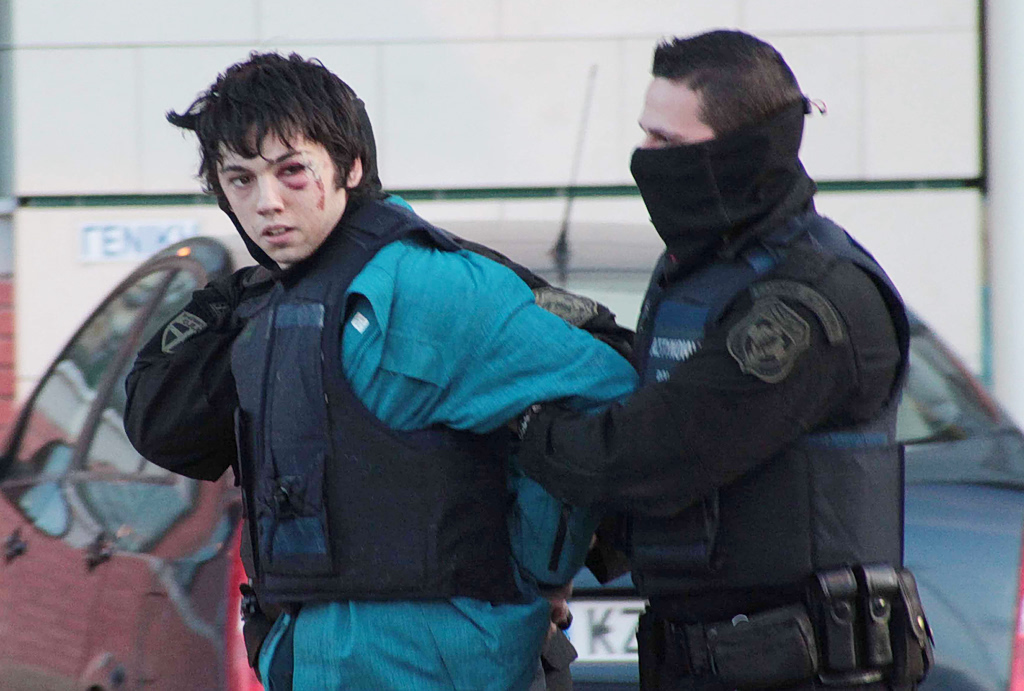
(EUROKINISSI)
While in prison, he completed his high school education, won a place at university and claimed his right to study, which was granted at his appeal hearings. The Supreme Court found that his subsequent behavior and efforts to acquire an education were a genuine indication of rehabilitation, reducing part of his sentence. This does not change the fact that he served his sentence; but it does show that the prison system worked where the state (or its protectors) failed to. Still, neither the social lens through which Romanos is viewed, nor the mechanisms through which the police keep tabs on him, have changed.
Back in the cross-hairs of Justice: the new “charge”
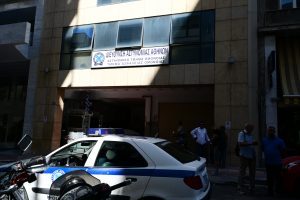
Years after his release, Romanos finds himself back at the epicenter of a new police investigation, with a charge that raises serious questions. It is built on foundations many legal experts consider to be weak: a fingerprint on a plastic bag linked to an apartment where an explosion occurred is the primary reason given for his detention. When the key piece of evidence is a movable object that by its very nature changes hands, the risk of arbitrary connections and miscarriages of justice being made becomes perilously high. Yet, the public management of the case and the speed of the prosecutions call to mind an exercise in communicating a “job done” than they do a calm and objective investigation. Clearly, the issue here isn’t seeing justice done, it is Romanos himself.
Practices such as these recall the infamous “flower planter case”, when the police tried to explain away the bruises their batons left on a protester’s body as the result of a fall into a flower planter, cultivating an institutional culture that sets out to construct a legitimizing mask for abuses of power that absolves them of blame. Now, behavior of that sort would seem to be making a comeback: despite his release from prison and his efforts to reintegrate into society, Nikos Romanos is being treated with scorn and disrespect by the authorities, who are holding him in custody on a charge based on questionable evidence. From the flower planter to the current case, the police’s perceived adherence to the law of the land seems to be serving as a cover for arbitrary and prejudicial practices that hark back to the darkest reflexes of the state.
You don’t have to like Romanos to be scared by what’s happening
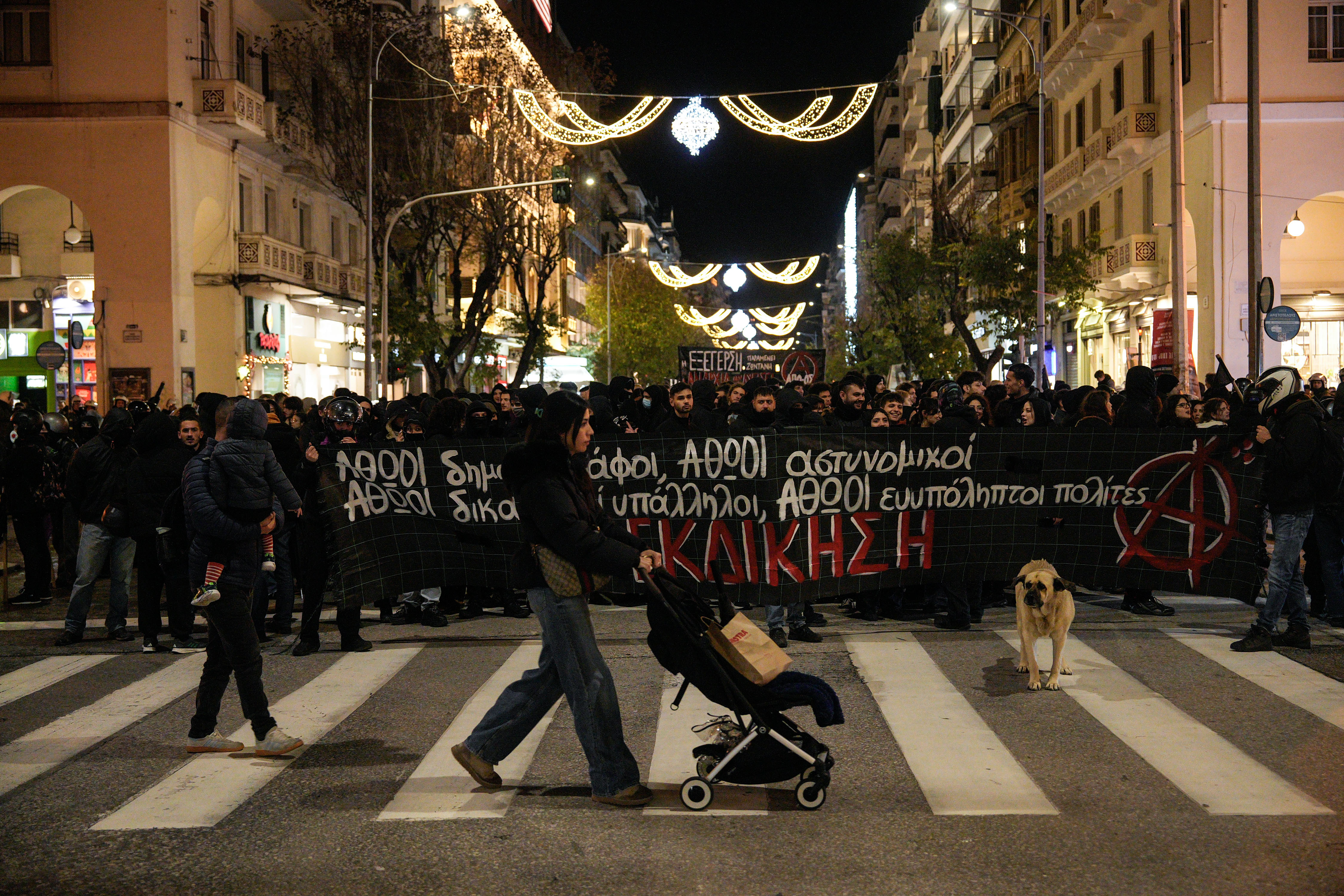
You just need to care about the presumption of innocence and equality before the law. When someone’s past trumps the evidence in the case file as proof of guilt, then justice is not blind—she has already begun to peep under the cloth covering her eyes. If a plastic bag can lead to pre-trial detention and serious charges, then there is nothing to stop the same logic of preventive punishment being applied to any of us. The case has a clear political dimension. When the state apparatus needs to demonstrate effectiveness, choosing an easy target makes it easy to produce a result. And the easiest target of all will always be someone who has already been in the cross-hairs. If the state chooses to deal with those who have attracted the attention of the justice system at one time or another by violently repressing them or by doing away with their presumption of innocence, then our democratic acquis is under attack.
The case of Nikos Romanos holds a mirror up to our society— a society which, in the critical years of his adolescence, deprived him of what he treasured the most. So if, in that mirror, we see reflected a police force whose actions are targeted and selective, it’s not just Romanos who will suffer the consequences; it’s all of us. The phrase “We haven’t seen the police acting so righteously since we took to bashing ourselves on concrete planters” isn’t a baseless jibe. It’s a warning. And as such, we have to heed it.