I don’t think it would be an exaggeration to say that for the past few years, very possibly since the COVID-19 pandemic, and perhaps even further back, to the years of the economic crisis, the conditions surrounding tourism have become increasingly difficult. And this phenomenon is most likely not unique to Greece, but a global one.
Speaking from the perspective of the particular destination I have been choosing for years, I can say that these days you have to expect anything, and you have to keep your cool at all times so you don’t lose control, because that now seems remarkably easy to do. It is the rule rather than the exception.
What I have come to realize is that a large part of the public, both tourists and those serving them, experience everyday vacation life as if they are going through a period of release rather than relaxation, as the season would supposedly demand. During vacation, you can hear or see things happening that under other circumstances would not seem normal.
I have been vacationing in Tolo for years. The seaside resort, in the Argolis region of the Peloponnese, is considered one of the area’s most popular destinations, if not the most popular. What I noticed this year is that the sections of Tolo’s huge beach allocated for rental sunbeds have increased significantly compared with previous years. I won’t comment on the cost of renting a sunbed, which, from what I have learned, ranges from €20 to €35. Unfortunately, in a free market, you can now be subjected to just about anything, although whether you accept it is up to you.
I will say, however, that the “free” areas on Tolo’s huge beach have now become significantly limited. In these areas, where there are no rental sunbeds—the so-called “free” sections of the beach—a considerable number of people have adopted the practice of staking out their spot.
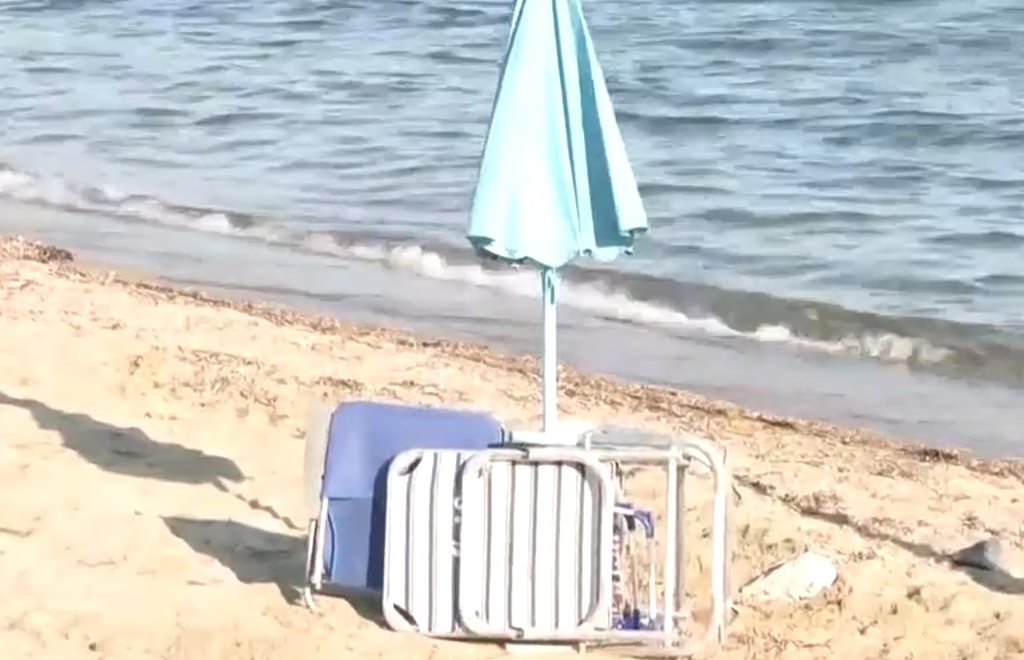
What does that mean? You go to the beach very early and don’t simply put up your umbrella where you want to sit. Instead, you mark out your own territory on the sand. And when I say “mark out,” I mean it literally. You draw your own “plot” in the sand, creating an image that can feel “threatening” to others because once the rest of the beachgoer’s belongings are placed inside the marked-off area, it is as if they are saying they are the “owner” of that spot and that no one is allowed to “trespass” on it—even though, of course, the space is PUBLIC.
It isn’t difficult to imagine what could happen if someone makes the mistake of “invading” that space, or simply sits in front of it. Let me repeat: we are talking about a space that does not “belong” to the person who has fenced it off. The photograph accompanying this article says it all. The space had been marked out by a family of four foreign tourists—all adults. Notice, too, how much room there is within the boundaries of the square they had drawn.
Imagine what would happen if every beachgoer did the same thing. Meanwhile, as I learned after asking, calling the Coast Guard is not a solution. The beachgoer will be warned, and the same scene will play out again the next day, either with the same person or with others.
I learned from a much more experienced tourist than I am that this phenomenon is not exactly new. It began in the 1990s, when groups of beachgoers with a particular political outlook—let’s call them anarcho-leftists—did the same thing on various Aegean islands. She mentioned Koufonisia. They would prevent other beachgoers from accessing their own, clearly marked-off space.
But if this phenomenon once took place in secluded areas, today it happens right before your eyes, even on highly popular beaches such as Psili Ammos in Tolo.
This phenomenon is one of many paradoxes you will encounter at tourist destinations these days. My point, of course, is not the practice of staking out a spot itself, but the fact that phenomena like this ultimately force you to go to the beach prepared for a confrontation.
You find yourself on the defensive, and in order to stand up for your rights, you have to go on the offensive.
But that isn’t a vacation.
It’s a nightmare.