 Μake us preferred on Google
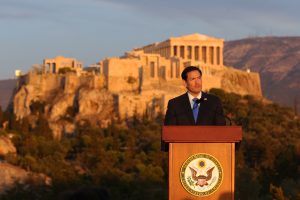
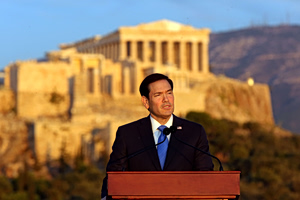
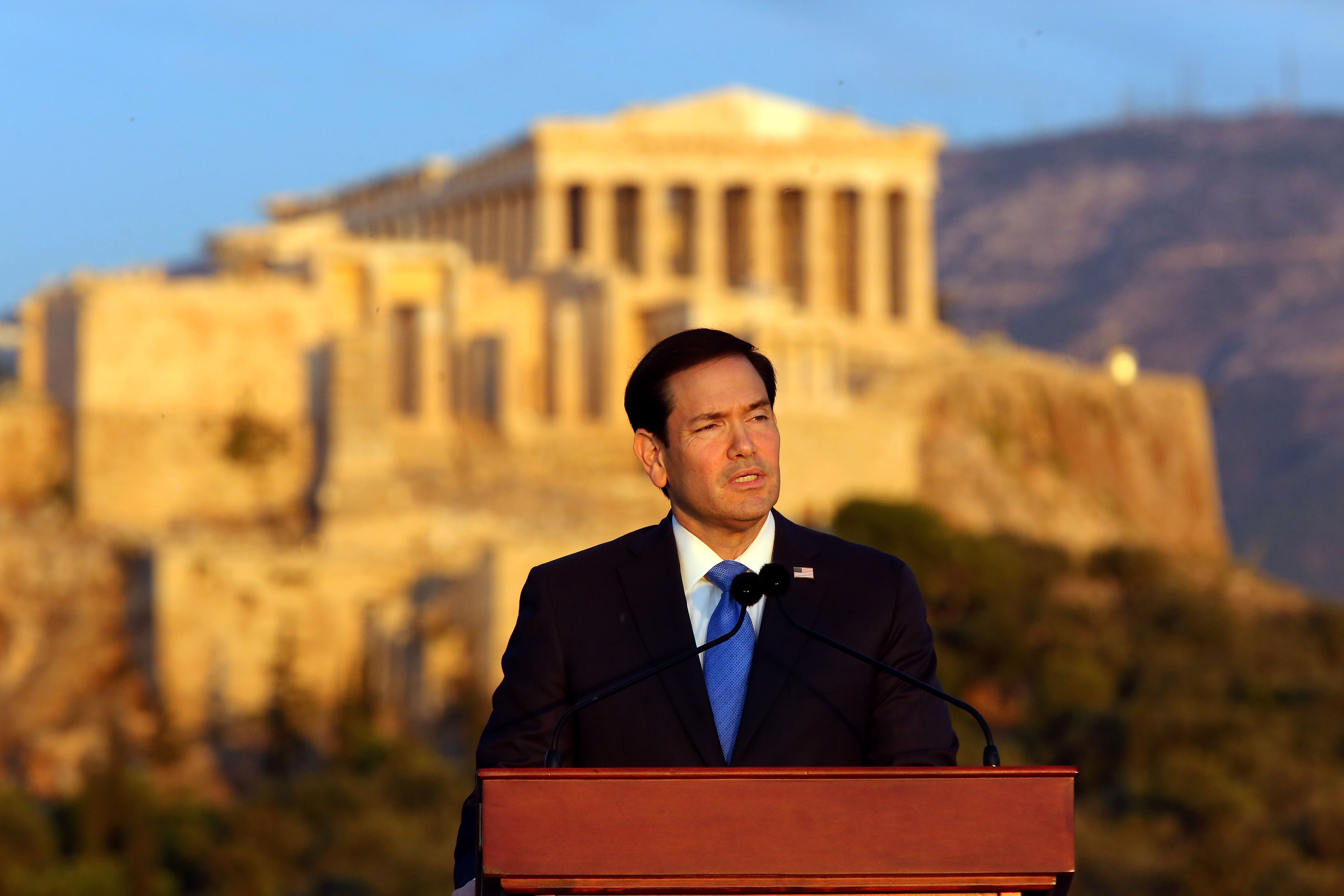
 The visit of U.S. Secretary of State Marco Rubio to Greece (we discussed it yesterday as well) had a dose of political Hollywood. The Acropolis in the background, lit by the rays of the setting sun, is the ideal Instagram backdrop.
Marco Rubio got that dose for free, and had half an hour at his disposal to speak to the world from that spot. That is, to his voters in America and to his country’s media. “The image is what traps you”, Roland Barthes used to say, and Rubio left Athens with an image in his archive of himself standing in front of the global and easily recognizable symbol of Democracy. He will use it as he prepares to seek the Republican nomination, posing as a conservative counterweight to the amoral Trump model.
Clearly, the U.S. secretary’s photo bombing was mainly for Americans. It was obviously also addressed to Greeks, who in their vast majority were indifferent to what he had to tell them, influenced by the forces of political nihilism that dominate the media.
What this indifference means can be seen in the approaches of the opposition parties. Rubio’s visit was an occasion for generalizations and slogans.
PASOK threw everything onto the plate: the Middle East, the Palestinians, Trump, Greek-Turkish relations, and the electricity interconnection cable with Cyprus and Israel. Its criticism, however, contains an absurdity. It invokes international law, which it considers to be 100% on Greece’s side, and says that Greek-Turkish issues are not simply “sensitive issues,” as Rubio put it. In other words, PASOK blames the government because Marco Rubio did not turn out to be the rich uncle from America, but a politician who promotes policies, meaning strategies, ideas, international relations, and interests.
There is no need to say anything serious about Tsipras. In an interview yesterday, he was talking about a telecommunications cable. His laziness does not allow him to learn accurately, even for appearances’ sake, the issues on the agenda he is talking about.
As for the opposition’s obsessive insistence that Greece loudly proclaim that it stands with international law, at times it becomes ridiculous. Obviously Greece must stand with international law. But at a time when the world’s main driving force is power, Greece, after recovering from bankruptcy, would be an easy victim if it did not also seek to gain power. And power is achieved through sound finances, political stability, defense spending, international prestige, and alliances.
In the field of alliances, Greece, a European country, let us not forget, has made great leaps. The alliance with Israel, without this signaling a crack in the effort to maintain good neighborly relations with Turkey, and Rubio’s reaffirmation of the strategic relationship with our country, which is developing as an energy hub for Europe, find Greece at an ideal moment. If we manage to make it through the elections without falling into the frame of political instability that has a destructive effect on Europe, the trend of escaping political misery will be confirmed.
If this scenario prevails, the followers of left-wing, and also far-right, grumbling will lose much of their livelihood. It is the country’s chance to begin freeing itself from the dead weight of the Metapolitefsi era.
Anne Carson’s knowledge of antiquity
Anne Carson’s Nobel Prize in Literature is the most significant in recent years. For many reasons, but mainly for one: because the approach of the poet, translator, and scholar to classical antiquity, deep and reflective, is based on study and not on trends and fashions. She does not rehash ready-made things; she is devoted to the adventure of ideas, not to tidying them up.
By a happy coincidence, I have recently been reading a long essay on Anne Carson by Elizabeth Sarah Coles (“Anne Carson: The Glass Essayist,” Oxford University Press, 2023). Her knowledge of antiquity, the author says, becomes a way of examining desire, loss, and the very act of reading.
She borrows the methods of scholarly research but escapes their limitations, allowing emotion to transform the argument. The forms change: essay, poem, translation, performance. She always pays attention to her sources and is transparent, but not out of ease. On the contrary, through study she tests, intervenes, doubts, and brings forward the timeless ideas of solid thought, with the satisfaction of being its unseen mediator in our time.
No. Classical antiquity is not the fashionable clever remarks created by political correctness, the clichés and the exclusions. It is the foundation of the most robust civilization, our own. And Anne Carson is its modern herald.