
 Μake us preferred on Google
 With the geographic arc entailed in the eastern Mediterranean again thrust onto the international limelight over the past 15 years – commencing with the “Arab Spring” in 2011 right down to the recent war in Gaza and reverberations from Russia’s invasion of Ukraine – the second annual Athens Policy Dialogues this year convened on the theme of “The East Mediterranean in Flux”.
The two-day panel discussions were kicked off on Thursday with an address by Greek President of the Republic Konstantinos Tassoulas, who detailed Greece’s historical, cultural impact and geostrategic presence in the wider region even before the advent of the modern Greek state in 1830. Just in the 20th century, he said, Greece has sided and fought with the Entente in WWI, with the Allies in WWII and, woefully, was the first real battlefield of the Cold War (1946-49). The still unresolved Cyprus problem also dominates it foreign policy interest, he added.
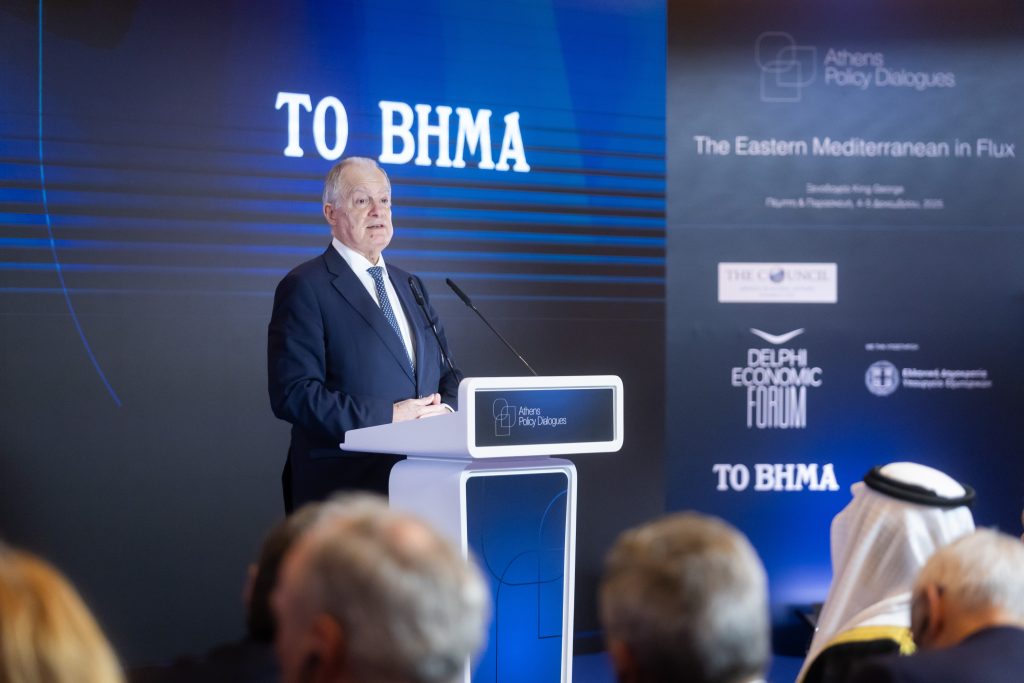
President of the Republic Konstantinos Tassoulas.
The event was organized and hosted by the Delphi Economic Forum, The Council – Greece in Global Affairs and the historic Athens weekly “To VIMA” (Το Βήμα), with representatives of each of the latter – DEF president and founder Symeon Tsomokos, Council President Prof. Athanasios Platias and To VIMA publisher Yiannis Pretenteris – welcoming panelists, dignitaries and media at a downtown Athens hotel.
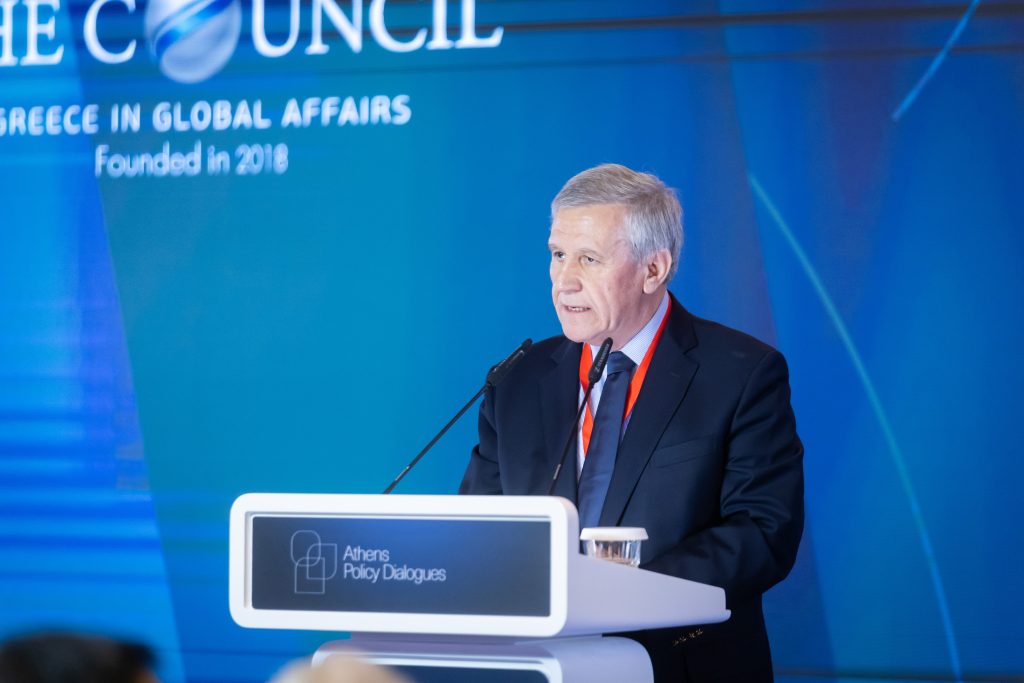
Delphi Economic Forum president and founder Symeon Tsomokos.
On his part, Platias said the eastern Mediterranean has emerged as a “powder keg”, along with SE Asia and Ukraine, a geographic region where the Middle East, Africa and Europe converge, thereby upgrading the need for Athens to emerge as a center for geopolitical dialogue.
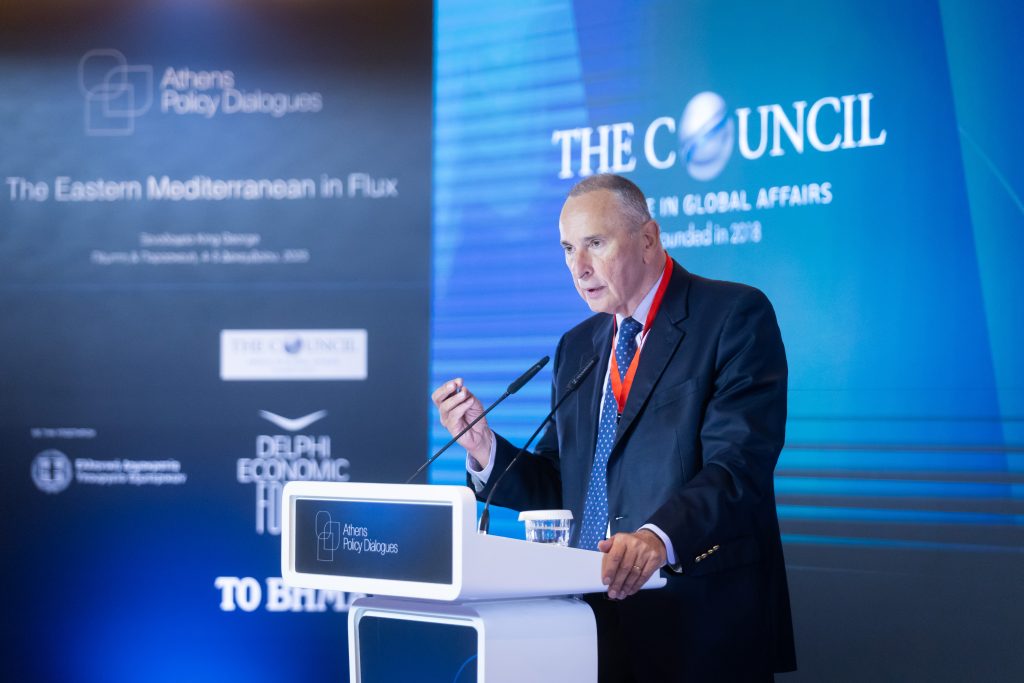
The Council – Greece in Global Affairs president Prof. Athanasios Platias
Pretenteris, on his part, reminded that the east Mediterranean “equation” now features competing claims over energy, energy exploration, maritime delineations, the presence of super and regional powers, and of late, even a Chinese presence-cum interests. He said the two-day event aims to detail and broach the entire spectrum of issues in the region.
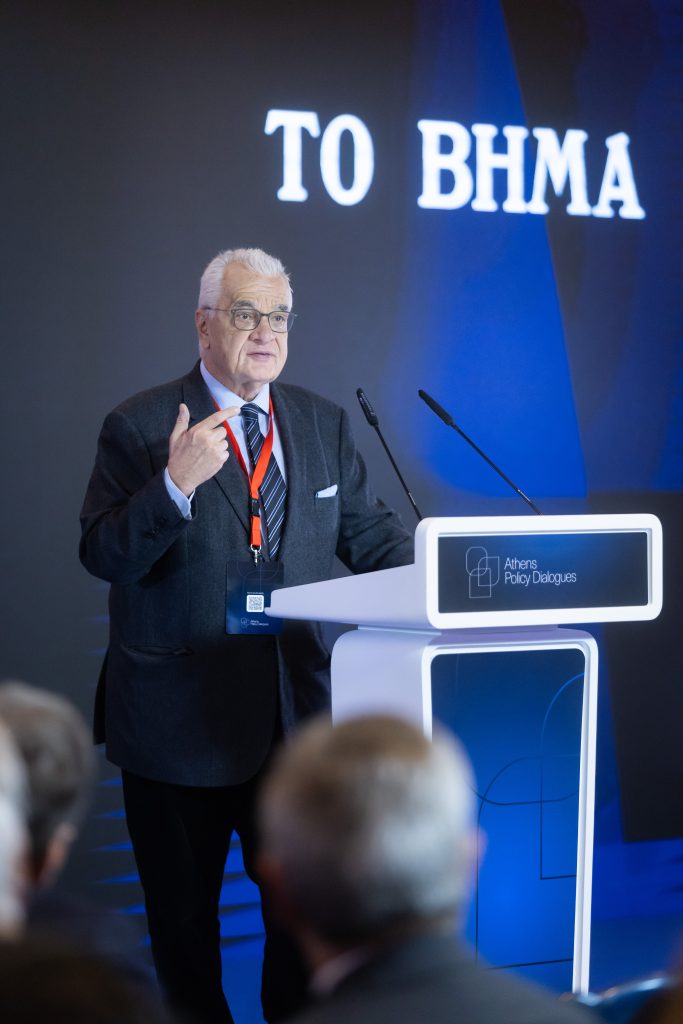
To VIMA publisher Yiannis Pretenteris.
Developments around the east Mediterranean rim for the past 15 years have been volatile and unpredictable: what began with the Arab Spring in 2011 led to the overthrow of Muamar Qadafi in Libya and years of factional warfare, the emergence of a Muslim Brotherhood government in Egypt that was in turn toppled and replaced – via election – by current President Abdel El-Sisi, nearly 14 years of punishing civil war in Syria that culminated with the abrupt collapse of the Assad regime and its replacement with a provisional government dominated by one-time Islamist rebels, and shockingly, the Gaza-Israel war that erupted with Hamas’ surprise attacks in southern Israel on Oct. 7, 2023.
For Greece, the east Mediterranean region has emerged as a geostrategic field of immense importance, given its potential for hydrocarbon exploitation, as a corridor for undersea power and data cables, pipelines and maritime traffic. Athens’ interests, however, face an almost diametrical opposition by official Turkey, foremostly in relation to the divided island of Cyprus, where a stalemate since 1974 has meant an internationally recognized two-thirds of the south that is represented in the UN and EU, and a Turkish-occupied one-third of the isle’s north.
Greece also faces Turkish intransigence in delimitating maritime zones, with the latter insisting on a unilateral to the point of revisionist interpretation of international law and Athens maintaining a steadfast position that whatever delimitation and interpretation be based on the UN Convention on the Law of the Sea (UNCLOS).
Another component of the current geopolitical “calculus” is a now strategic relationship between Greece and Israel, with Cyprus – the two-thirds not under occupation, of course – happily joining in where invited.