 Μake us preferred on Google
 At the Thiseio Theater in Athens, audiences are watching a stage adaptation of Fyodor Dostoyevsky’s novella A Gentle Creature. At its center is a 40-year-old pawnbroker who marries a woman decades younger than himself and tries to mold her in the woman he craves.
He believes affection can be deferred. First, he will build a fortune of 30,000 rubles. Then, once they retreat to the countryside, he will reveal his devotion — expecting gratitude in return, as though love were something that accrues value over time.
What he receives instead is silence, despair and, ultimately, his wife’s suicide. The future he thought he controlled collapses in an instant. Time, which he treated as an ally, proves to be a trap.
The same illusion governs politics: the assumption that there will always be more time.
A Window That Closed
That illusion has shaped Greece’s recent foreign policy choices and most notably in its relations with Turkey.
For a brief stretch, tensions in the Aegean appeared to ease. The government signaled that this calmer climate might allow for bold diplomatic moves, as public opinion seemed more receptive than in the past. Quietly, officials spoke of a rare opportunity to reset a chronically volatile relationship.
However, the “window of opportunity” abruptly closed when opposition emerged from within the ruling New Democracy (ND) party, amplified by nationalist voices outside Parliament, accusing the government of capitulation.
That lost time has since resurfaced as a source of strategic anxiety. With international instability on the rise, Athens is increasingly concerned about what happens if Donald Trump turns his attention to the Aegean and the Eastern Mediterranean. Would Washington tilt toward Greece or Turkey? And how far could Athens realistically go, given that its relationship with Ankara is now intertwined with Greece’s strategic partnership with Israel?
Expectations and Unease
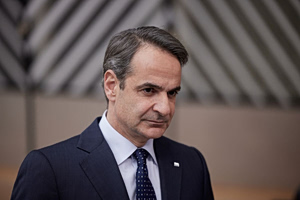
As Prime Minister Kyriakos Mitsotakis moves deeper into his second term, the question is whether he still has the political space to take decisive action or whether time is now working against him.
Recent polling suggests growing impatience amongst the electorate. According to a recent poll by Metron Analysis, 51% of respondents favor early elections, 61% say the country needs political change and 62% rate the economy negatively.
Privately, senior officials acknowledge the problem. “On economic policy, the government needs to move faster,” one top minister said. “Instead, it’s acting cautiously, even defensively. That hesitation is delaying foreign investments that could make a real difference.”
And yet, the governing party remains competitive. A Pulse poll shows that 48% of voters say they will base their decision on which party offers long-term prospects, while 23% prioritize stability. For now, ND continues to benefit from both instincts.
At the same time, qualitative data reveal deep frustration. Anti-establishment sentiment is rising, driven by figures such as Zoe Konstantopoulou, the contentious former parliamentary speaker, and Maria Karystianou, who lost her daughter at the Tempi train disaster and has since gained prominence and has just announced the creation of a political party. They appeal to similar audiences, though it remains unclear which will ultimately consolidate that space.
Their ascent, combined with turmoil inside the main opposition party, the center-left PASOK, paradoxically helps sustain the government. Fragmentation among its critics has kept dissatisfaction from coalescing into a single, credible alternative.
A Party Looking Inward
While the prime minister’s office promotes long-term reform plans stretching to 2031, PASOK remains consumed by its own internal crisis.
Party leader Nikos Androulakis is seeking to contain the damage before March when the party congress will take place, and is planning a decisive intervention at an upcoming meeting of PASOK’s Political Secretariat. But the party’s broader dilemma remains unresolved.
Talk of “progressive alliances” inevitably brings prominent figures from the left back into focus, including former Prime Minister Alexis Tsipras and other Syriza-era leaders – a roster with limited appeal for the moderate centrist voters PASOK needs to regain.
Polling reflects the problem. In a Metron Analysis survey of centrist voters, Mitsotakis, Androulakis, Syriza leader Socratis Famellos and Communist Party leader Dimitris Koutsoumbas each register roughly equal popularity. But while Mitsotakis dominates the center-right and right, Androulakis underperforms even within the center-left, trailing both Famellos and Koutsoumbas and showing minimal penetration on the broader left.
In practical terms, PASOK is ceding political ground and voters to its rivals.
Pressure on All Sides
New Democracy, too, is not immune to internal strain. If the first round of elections produces weaker-than-expected results, a long-simmering succession debate could erupt openly.
A period of instability affecting both major parties between the first and second rounds of voting could complicate government formation, with unpredictable consequences. That prospect worries institutional figures, including the President of the Republic Constantine. Tassoulas, who privately warn that the arithmetic is fragile and political polarization could spike.
Within the governing party’s parliamentary group, speculation is growing about an imminent cabinet reshuffle. More quietly, some lawmakers are floating scenarios involving early elections combined with changes to the electoral law, a move the prime minister has publicly ruled out.
Still, mixed signals are emerging from within his circle about raising the threshold for parliamentary entry from 3% to 5%, a change that would limit smaller parties and simplify coalition math.
The pressure from MPs is relentless. Many see early elections in the fall – potentially announced at the Thessaloniki International Fair, a traditional political milestone – as a release valve. “We can’t survive another winter like this,” several warn. “Time is no longer on our side.”