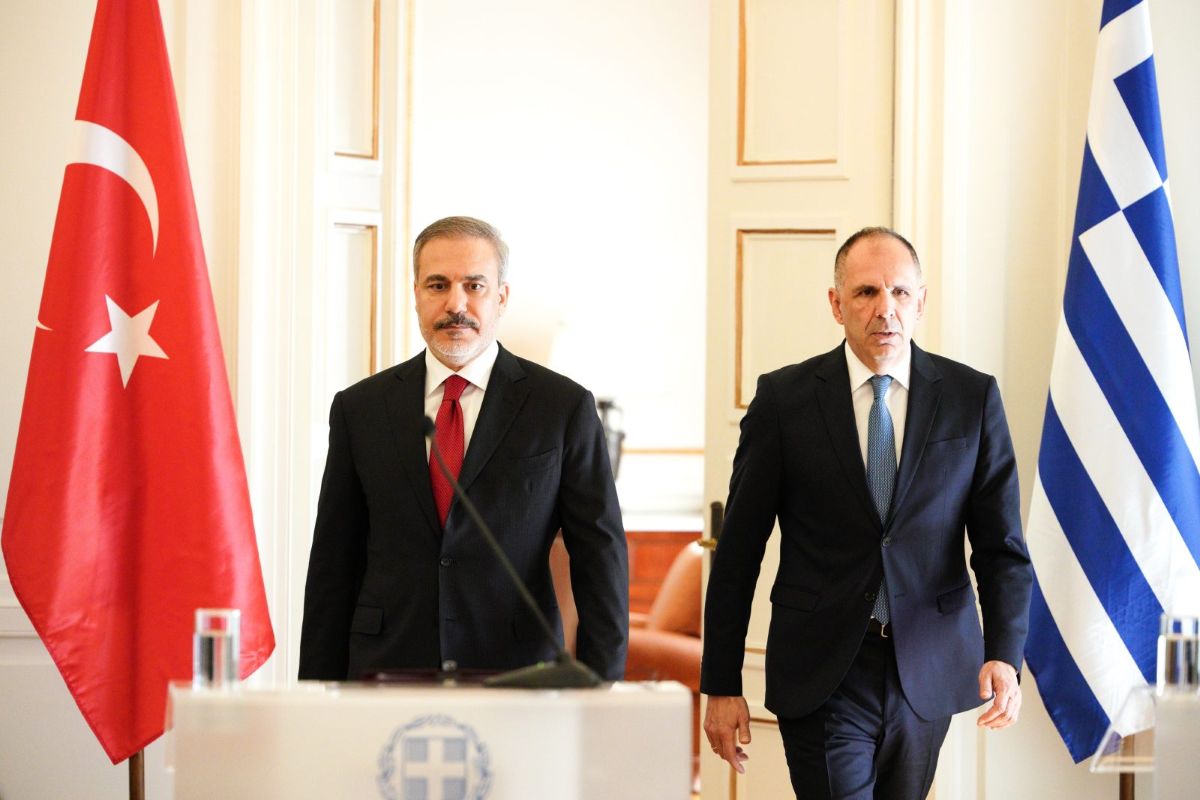
Greek Foreign Minister Giorgos Gerapetritis reacted immediately and firmly to his Turkish counterpart Hakan Fidan, after the latter spoke of anti-Turkish sentiment in Greece that, in his view, opens the way to crises with potential geopolitical costs. Fidan’s remarks, aired in Turkish media, amounted to a fresh attack on Greek foreign policy.
Both Gerapetritis and government spokesman Pavlos Marinakis described the statements of the Turkish foreign minister as provocative.
Responding in sharp terms, Gerapetritis rejected Fidan’s claims, stressing that Greece neither suffers from complexes nor defines itself in reference to Turkey, and will not accept instructions from anyone.
He noted that Athens understands the unease caused by its active and confident foreign policy, but insisted that this is the reality others must learn to accept. Turning frustration into hostility, he said, does nothing to promote the good-neighborly relations Greece has consistently sought, and certainly not through excessive or ill-timed declarations.
Government spokesman Marinakis, speaking on Open TV, struck a similar tone. He underlined that Greece is a sovereign state that respects international law, seeks dialogue with all sides, but will never place issues of sovereignty on the negotiating table. The government, he argued, has strengthened Greece by pursuing dialogue without concessions and intends to continue on that path.
This stern Greek response follows Fidan’s accusations on TGRT Haber, claiming that Greek politicians constantly invoke a ‘Turkish threat’ whenever crises arise. He described this approach as cheap politics that not only stirs unnecessary tensions but also risks creating crises with significant geopolitical costs—costs borne by the Greek state and its people.
According to Fidan, Turkey has become a recurring theme in Greek domestic politics, acting like a “political aspirin.” He likened this to Pavlov’s conditioned reflex, where merely mentioning Turkey provokes a predictable reaction in Athens, an issue he says must be addressed internally.
Fidan also argued that Greek foreign policy lacks the maturity and self-confidence of Ankara’s approach, noting that Turkey is prepared to confront challenges and has already taken measures against past Greek actions.
He concluded by provocatively ‘urging’ Greek politicians to drop anti-Turkish sentiment, warning that fear-driven tactics may yield short-term gains but could create serious political and strategic consequences for Greece.