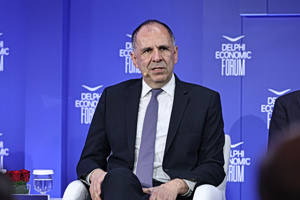
Bank of Greece (BoG) Governor Yannis Stournaras, fresh from the announcement this month that the Mitsotakis government will propose a renewal of his tenure at the country’s central bank, on Wednesday stressed that the global economy is facing heightened geopolitical uncertainty and energy pressures, although he added that international markets remain resilient and broadly optimistic.
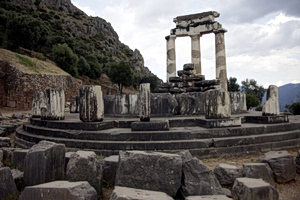
Stournaras spoke at the 11th Delphi Economic Forum, being held in the iconic and same-name site in south-central Greece this week.
He said the baseline scenario points to a relatively swift de-escalation of the Middle East conflict, adding that he expects the war to end soon and describing it as “a war of choice rather than necessity.”
Despite this outlook, Stournaras warned that uncertainty remains elevated and said monetary policy will be adjusted as needed in response to developments. He stressed that central banks stand ready to act decisively if required, highlighting that they now have greater experience in managing crises compared with the past.
Stournaras noted that international markets appear “resilient and optimistic,” estimating that the baseline scenario remains a relatively quick de-escalation of the conflict in the Middle East. “I am among the optimists that the war will end soon,” he said, adding that it “was not a war of necessity, but of choice.”
Referring to developments in the energy market and the possibility of escalation in the Strait of Hormuz, he emphasized that an agreement could quickly improve the situation. He also reminded that Europe has gained significant experience in managing energy crises in recent years.
ECB independence and monetary policy challenges
Stournaras, who is set to serve a three consecutive term as the country’s central banker, placed special emphasis on the independence of the European Central Bank, calling it “the greatest achievement” of Europe’s economic architecture. “No one in Europe could or would dare reduce the ECB’s independence,” he said, stressing that central banks aim to ensure stability for society—not maximize profits.
He explained that the key challenge for monetary policy is bringing inflation back to target “without risking a recession,” noting that decisions require delicate balancing, especially amid external shocks.
Europe, Greece’s outlook
At the European level, he stressed the need for deeper integration. “We need more Europe, not less,” referring to capital markets union and closer cooperation among member states. He noted growing convergence, with southern Europe now growing faster than the north.
Regarding Greece, he said the country’s economy has come a long way since the crisis.
“Let’s not forget where Greece was 15 years ago,” he said, highlighting improvements in investments and the country’s overall outlook.