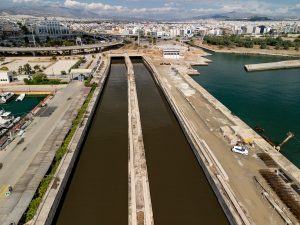
“Make use of us, Greece.” That was the specific proposal put forward by Greek Defense Minister Nikos Dendias in Brussels, calling for the corridor from Alexandroupoli northward to serve as an example of how Europe can move military forces while also protecting the infrastructure along their route.
In the same intervention, Dendias raised two further issues: joint ballistic missile defense, citing Cyprus as a key example, and strengthening the operational capabilities of the European Union’s Military Committee, for which he reserved his sharpest criticism.
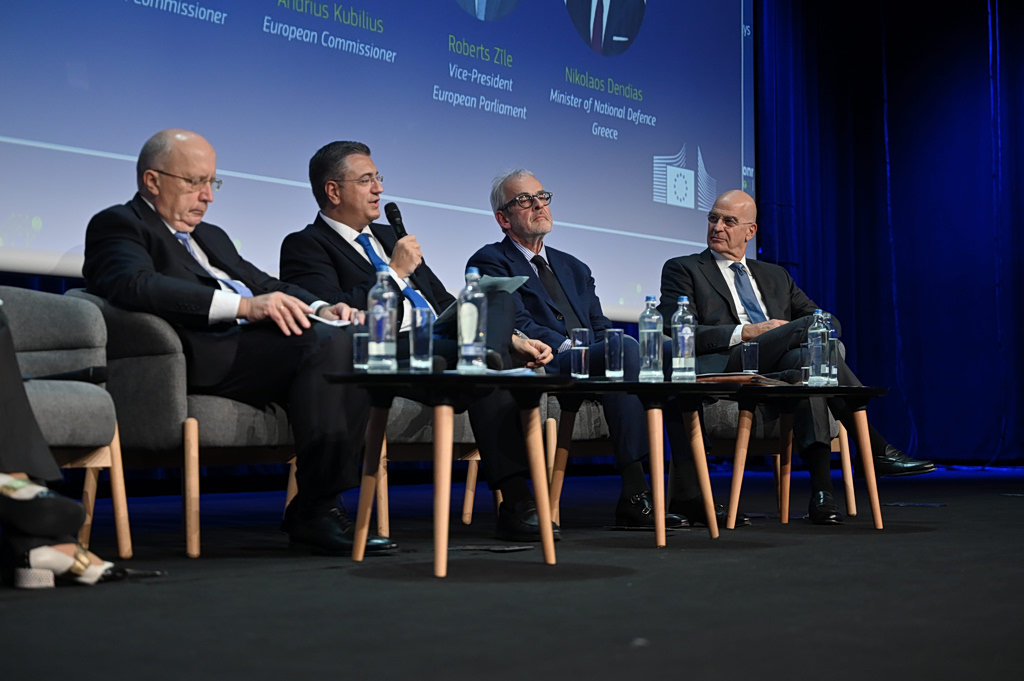
Greek Defense Minister Nikos Dendias took part Tuesday, Sept. 29, in a discussion on military mobility in Brussels as part of the Connecting Europe Days, the EU’s flagship mobility and transport event.
Speaking at the “Connecting Europe Days” event, Dendias described a route linking Greece with Bulgaria, Romania and Moldova. Alexandroupoli, which he described as the port closest to the Ukrainian front, was at the center of his argument. He called for the development of capabilities and the strengthening of resilience in Greece and along this specific corridor to serve as a European model.
In Brussels, in the context of the ‘Connecting Europe Days’ event – which opened with a speech delivered by President of the European Commission Ursula von der Leyen @vonderleyen – I participated in a discussion regarding military mobility, along with Commissioners @tzitzikostas…
— Nikos Dendias (@NikosDendias) September 29, 2026
The proposal focuses on linking two needs that are often considered separately: the ability to move military resources and the defense of the routes along which those resources would travel. Dendias did not announce an implementation agreement, secured funding or a timetable. He did, however, identify a specific geographic priority and propose Greek participation in putting it into practice.
From there, he turned to the more difficult question: Who will defend European infrastructure?
His reference to Air Marshal Clancy, head of the Military Committee, was accompanied by a direct challenge to the adequacy of the current structure. “Have you ever heard in the history of humanity of a military structure headed by a committee?” he asked.
His request was for existing structures to be given greater capacity to act.
The discussion moderator, Magda Kopczynska, intervened, noting that the three participants in the previous panel had categorically rejected the need to create new structures. The minister clarified that he was calling for the existing structures to be improved: “Let’s turn the Military Committee into something more substantive, more capable and with greater forces.”
He did not specify what additional powers or forces should be added. He made clear, however, that he sees strengthening European defense as complementary to NATO, rejecting the prospect of the alliance withdrawing from Europe. The remark accompanied his call for fear of competition with NATO not to act as a deterrent to stronger European defense capabilities.
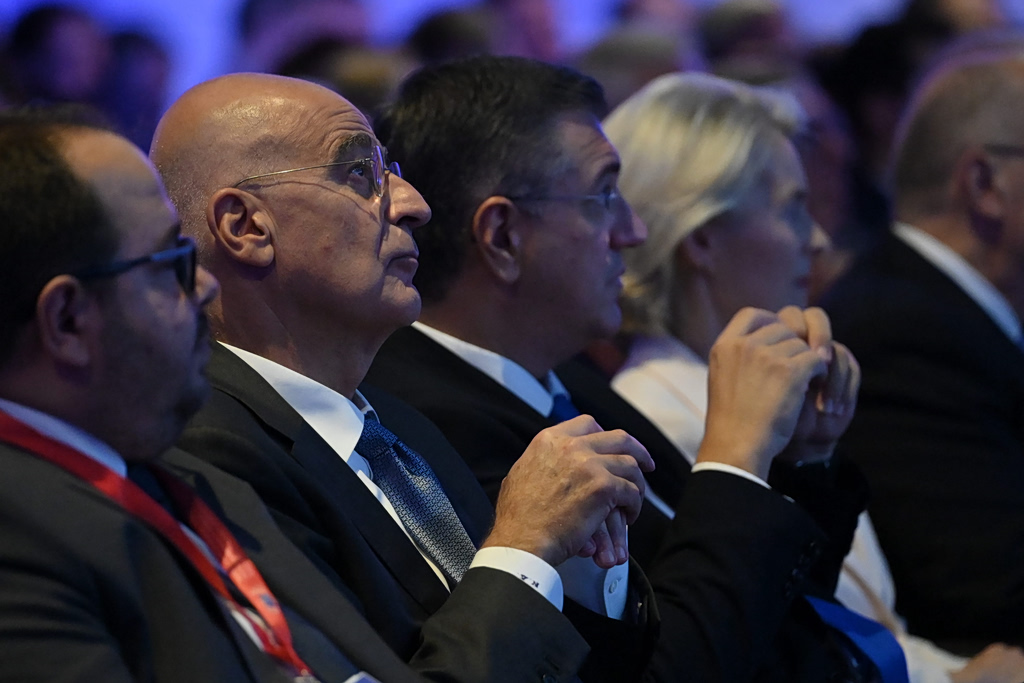
Greek Defense Minister Nikos Dendias took part Tuesday, Sept. 29, in a discussion on military mobility in Brussels as part of the Connecting Europe Days, the EU’s flagship mobility and transport event. Roberts Zile
The second area in which Dendias gave concrete meaning to European cooperation was ballistic missile defense. He used a hypothetical scenario involving a Houthi attack on a European country to ask whether Cyprus or another small state could independently develop the necessary defensive capabilities.
His answer pointed to joint European protection: “It should be done at a pan-European level.”
In this context, he proposed expanding the logic of the “Achilles Shield,” describing protection across land, sea, air, cyberspace and space. His proposal therefore went beyond the security of transport routes to Ukraine. It also encompassed threats from Europe’s southern neighborhood and the need to protect states that do not independently possess all the capabilities required.
He warned that artificial intelligence could give terrorist groups and non-state actors capabilities that are currently available to powerful militaries, reinforcing his argument for European countries to address such threats collectively.
Asked how prepared Europe is today to protect its infrastructure, he replied that “we are still a long way away.” He linked this shortfall to economic planning. Referring to the €100 billion cited by Apostolos Tzitzikostas, he argued that the EU can undertake such spending when its security is at stake.
He added, however, another factor that should be included in the calculation: the cost of protecting whatever is built.
That was also the link to the Greek proposal. The northbound corridor was presented as an opportunity to plan infrastructure, its military utility and its protection together.