Ms. Metsola, the President of Ukraine has received an ultimatum from the U.S. President. What is the EU’s position on this development, and how sustainable do you consider Europe’s long-term support for Ukraine to be? What role can—and should—the European Parliament play in ensuring that this commitment remains stable?
We are united in our call for peace because we all want the violence, the suffering and killings to end. Therefore, we welcome the efforts in coordination with the United States to bring this about. These are difficult negotiations. But we have always repeated that peace must be just, and it must be lasting, and it must have Ukraine and Europe at the table. The future of Ukraine must be decided by Ukraine and Ukraine alone. The talks in Geneva were good progress. There is still a way to go but we are hopeful. The European Union has peace at its core, so we will do everything we can to support this process.
On the support for Ukraine, the EU has always firmly stood by Ukraine’s side since day one and we will continue to do so. Member States have already expressed their readiness to provide security guarantees, and we believe that Ukraine’s EU membership, which must be criteria- and merit-based, will be the core puzzle piece. We will be ready for the day after and support Ukraine’s reconstruction in any way possible.

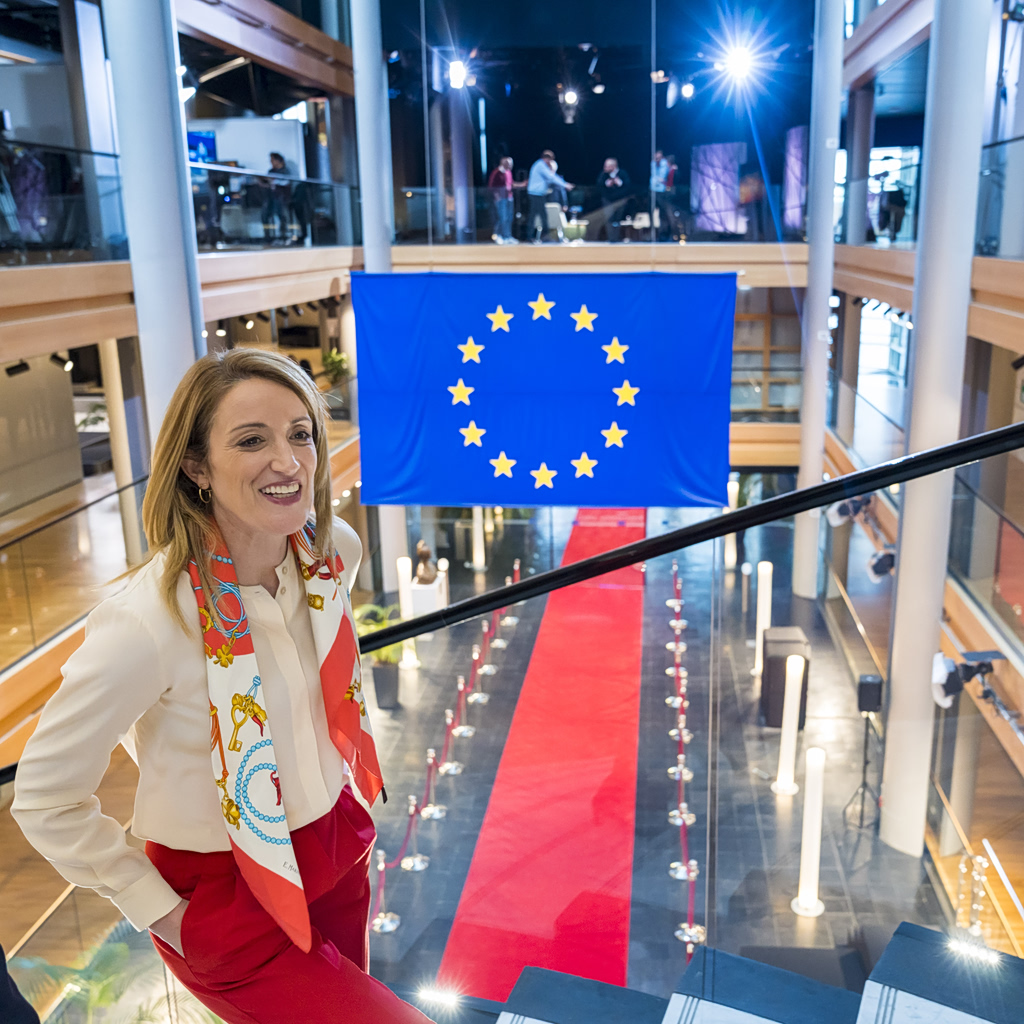
Photo shooting of Roberta METSOLA, EP President for the Views wall in Parlementarium
In 2025 the debate on a European Defence Union has returned forcefully. However, the SAFE programme has created significant friction between the Commission and the European Parliament, leading the Parliament to file a case before the European Court of Justice. What do you expect from this institutional confrontation?
This is not about institutional confrontation or the content of the regulation, which enjoys wide support in the European Parliament. It is rather about the legal process being used. It is good for the Court to express itself on this issue that will guide the process for other instruments too. We have ensured legal certainty and predictability in our actions.
Parliament has been vocal about the need for the EU to step up its defence capabilities. We have already adopted legislation at record speed that has increased our ammunition production, boosted joint public procurement and strengthened our defence industrial base. Right now, we are working to cut red tape for the defence sector. We will continue to deliver on this.
LEX Signing ceremony by Roberta METSOLA, EP President and by Mikuláš BEK, Minister for European Affairs, on behalf of the Czech Presidency of the Council
What do you believe the European Union’s strategic position should be within the growing U.S.–China rivalry? Should the EU remain aligned with the United States, or move towards a more autonomous strategic path?
I think recent years have shown us that the EU has been far too dependent on third countries, especially when it comes to security or energy. The war against Ukraine was a wake-up call. We are working to cut our energy dependence by investing in our renewables, diversifying our supply chains and completely phasing-out Russian gas and oil. The same goes for critical raw materials. We are also investing in our defence industry. All with the aim to become more autonomous and self-reliant.
In an uncertain world, we are also looking towards strong partnerships, all of which must be based on our shared democratic values. Here the transatlantic alliance will remain our most important partner. And while we might not always see eye to eye, we are committed to strengthening this relationship to the benefit of people and companies on both sides.
In the negotiations on the EU’s multiannual budget, the European Parliament is calling for more resources for defence, technology, and social cohesion. What are your red lines in these negotiations? And do you believe that MEPs—as directly elected representatives—should have a greater role in the allocation of EU funds?
We have made our concerns clear. We want regional actors to have more of a role as to where money should go, and we want a budget that has the necessary flexibility and transparency. As directly elected representatives it is our duty to ensure every euro goes where it truly matters and that it is allocated for. We take this role very seriously. At the same time, the budget must also consider future generations. We are at the beginning of the negotiations, but I am confident that we can find a landing zone to ensure that this budget truly delivers for every European citizen. However, these will as always be tough negotiations.
Other political forces accuse the EPP of giving ground to the far right and of legitimising it through cooperation. How do you respond to this? And what do you intend to do to bridge the divide between the EPP and the Socialists on key issues for Europe?
I am a bridge-builder and will always take this role seriously. The political landscape in our Parliament is different than it was in the last term. We are now comprised of eight political groups that span the complete political spectrum and have vastly different interests. That is politics and that is democracy. But they must keep finding compromises and move things forward. Standstill is not an option. I stand unashamedly for the centre. Of course, as President, I represent all MEPs, but I know that the strongest majorities are always built from the centre out. That is how we stay true to the promises and deliver on what truly matters to people. That is what we are doing now, and what we will continue to do. My role is to represent all my colleagues and to help us find common ground. I work every day to help find compromises that can move Europe forward.

Official visit by Roberta METSOLA, EP President to Athens (Greece) – Bilateral Meeting with Kyriakos MITSOTAKIS, Greek Prime Minister
In recent years, geopolitical, energy, and health crises have required very rapid decision-making. How can the European Parliament speed up its procedures without undermining its democratic functioning and public accountability?
The key is efficiency and quality. Speed must not mean rushed regulation. When I was first elected President of the European Parliament, I promised that we would work to make this House more modern, more efficient and more effective. For this, we have reformed massively. We sped up our processes to ensure that we can deliver faster without compromising our democratic legitimacy. When you look at the legislative aspect, we are delivering in record time. Files that have previously taken months, now take weeks or even days. One of the main features of our reform was to drastically reduce the time to allocate files to committee so we can get to work faster. Committees now also have greater flexibility to adopt reports using simplified or accelerated procedures allowing us to vote faster. All of this does not take away from our democratic responsibility. We are the voice of the people, and we take this responsibility very seriously.

Official visit by Roberta METSOLA, EP President to Athens (Greece) – Speech at the Plenary Hall of the Hellenic Parliament

Official visit by Roberta METSOLA, EP President to Athens (Greece) – Bilateral Meeting with Kyriakos MITSOTAKIS, Greek Prime Minister