Farmer protests across Greece, now entering their fourth consecutive week, are emerging as a serious political problem for the government, with repercussions extending far beyond the primary sector. While roadblocks eased slightly over the Christmas period, offering some relief to holiday travelers, the government remains politically cornered, paying the price for the increasingly precarious position of Greek agriculture and the wider regional economy.
The growing crisis of confidence between the government and the farming community, long considered a reliable electoral base for New Democracy, has sparked concern within the ruling camp that the continued mobilizations could trigger broader political developments. In government circles, rumors are circulating about a possible replacement at the helm of the Ministry of Rural Development, as Agriculture Minister Kostas Tsiaras has so far failed to establish a communication channel even with farmers in Karditsa, his own electoral district.
Such a move could reportedly be combined with a limited corrective cabinet reshuffle that Prime Minister Kyriakos Mitsotakis is said to have been considering for some time.
Dialogue Deadlock and Mounting Pressure
The reluctance of even government-friendly farmer unionists to engage in dialogue, combined with widespread skepticism toward official assurances that most farmer demands have already been met, has further complicated the situation. Delays in subsidy payments—alongside revelations linked to the OPEKEPE subsidy scandal—have tightened what officials describe as a “Gordian knot.”
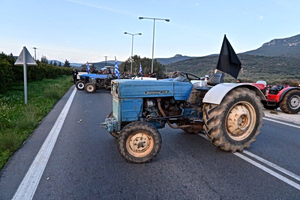
Tractors and farm machinery remain stationed at dozens of locations nationwide, with intermittent blockades of major highways. What initially appeared to be another short-lived social protest has gradually evolved into a political issue with economy-wide implications. Public tolerance of the disruptions, particularly among drivers affected during recent holiday travel, has been widely interpreted as a sign that the protests enjoy broad public sympathy.
A Strategy That Backfired
Within the government, the prevailing assessment is that the strategy pursued so far has failed. Attempts to stir public resentment over travel disruption or to portray the protests as politically orchestrated by opposition-aligned farm unionists have not gained traction. The fact that roadblock decisions are taken unanimously, and with the backing of farmers sympathetic to the government, has undermined claims of political manipulation.
Officials had initially expected the blockades to dissolve before Christmas, citing what the government says were the largest subsidy payments in recent years, along with concessions such as lower energy prices and fuel tax refunds. Instead, as government ultimatums were repeatedly rejected, protests intensified, with farmers threatening to escalate road closures.
Economic Risks and Political Dilemma
Government figures now acknowledge that the economic impact of the blockades is already visible and could worsen if the stalemate continues. Transport delays and supply-chain disruptions are weighing on exports and the domestic market, adding pressure to an economy already strained by high prices.
The dilemma facing the government is stark: substantive concessions would carry fiscal costs and risk encouraging similar demands from other social groups, while inaction reinforces the image of a government disconnected from regional Greece and focused on managing impressions rather than addressing structural problems.
Political Wear and Tear
Observers both inside and outside government argue that the farmer protests expose deeper dead ends in agricultural policy and test a governing approach perceived as communication-heavy but light on structural solutions. Farmers are pressing broader issues such as production costs, energy prices, subsidies, and the long-term viability of rural Greece, that cannot be resolved through quick fixes.
Against the backdrop of recent opinion polls showing rising public dissatisfaction, several analysts warn that the pressure symbolized by tractors on highways could shift from a recurring winter ritual into a clear indicator of wider political wear. Regional lawmakers from the ruling party openly speak of a risk of “irreversible electoral damage” if the standoff continues.